
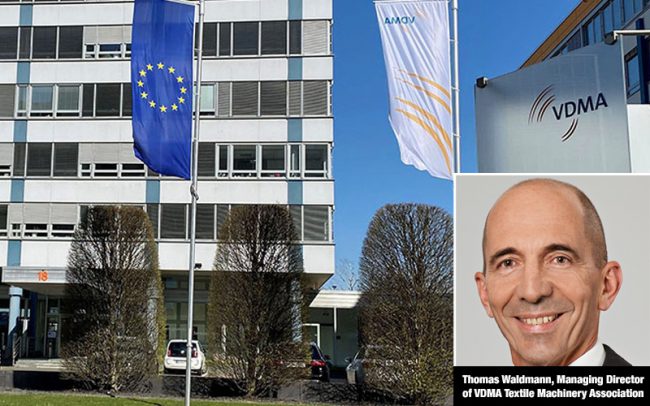
“Turkey is Performing Very Well”
Managing Director of VDMA Textile Machinery Association Thomas Waldmann said that, “Turkish textile factories are able to fill orders from Europe very quickly. They are also efficient in their ability to meet the demands of both smaller shipments and sudden purchase changes in Europe.”
We interviewed with Thomas Waldmann, Managing Director of VDMA Textile Machinery Association for our ‘German Special Edition’. Waldmann explained the effects of the pandemic process on the German textile machinery industry and his expectations for 2021.
How was your member’s reaction to Pandemic? How did German companies create a roadmap to get through the process with less damage?
Of course, the general conditions for the mechanical engineering industry have been dominated by the coronavirus pandemic since spring 2020. Sales are particularly hard hit by the Covid-19. Due to postponed trade fairs and travel restrictions, companies as well as VDMA as an association have increasingly been using web conferences / webinars to keep in touch with customers around the world. With the web series “Textile Machinery Webtalks”, the VDMA has developed a marketing platform that is attractive to potential customers and members alike. The aim of the webtalks, in which three VDMA member companies each present their technologies along the textile chain, is to educate and motivate potential customers to look beyond their own textile horizons, especially when it comes to introducing efficient and sustainable technologies.
Very up-to-date and future-oriented topics as well as solution approaches were and are dealt with, such as mask production, circular economy, digitalisation and artificial intelligence in the textile chain and much more. We know from the feedback from our members that concrete projects and business deals have been initiated through the webtalks. Since June 2020, 13 Webtalks have been held with more than 2,600 actual participants from 80 countries (in average 200 per webtalk). In March 2021, the Textile Machinery Webtalk will move to the recognised platform IndustryArena (industryarena.com). More technology and application-oriented webtalks from VDMA member companies will take place via this portal. In addition, VDMA members also have the chance to hold presentations together with their customers (textile or nonwoven manufacturers) and/or textile research institutes.

Do you have any member active in the field of mask and protective cloth line or related sectors?
For masks, the production of the textile starting material is the first step in a multi-stage production process. Members of the VDMA are at the beginning of this technological chain. The filter material of surgical masks as well as FFP2 and FFP3 respirator masks consists of fine-pored meltblown nonwovens and spunbond nonwovens. Production lines for these nonwoven products are manufactured by Oerlikon Nonwoven or Nanoval. Calenders for these types of nonwovens are offered by Andritz Küsters and Schott & Meissner. Spinnerets for spunbonded and meltblown webs are produced by Enka Tecnica and Sossna.
With a wide range of measurement and control technology, Mahlo can support manufacturers in monitoring and controlling important parameters such as basis weight and air permeability during the production process. For surgical masks, FFP2 respirators and social distancing masks (community masks) a wide variety of other materials and combinations of materials are used (nonwovens, woven fabrics, knitted or warp knitted fabrics and laminates thereof):
The Karl Mayer Group offers textile production technologies for knitted and warp knitted mouth and nose masks. The masks can be produced in a single step without the need for sewing and include an integrated pocket for a nonwoven filter. Mouth and nose masks can also be woven seamlessly in one piece on Dornier weaving machines and then lasered into the desired shape. Jakob Müller narrow fabric weaving machines can also produce fabrics for masks whose pattern and colour can be changed quickly.
Elastic bands are required to wear the masks and several technologies are available for their production: Braided products such as stranded and round braids are produced on Herzog braiding machines. Karl Mayer has developed a solution for producing elastic tapes on warp knitting machines. Lucas offers circular knitting machines for the production of rubber bands.
Küsters Textile manufactures a padder which is also used in the field of surgical masks. Antiviral and antimicrobial textile finishing chemicals can be applied to the fabric webs with Weko contactless application systems.
The complete mapping of all production steps is extremely important for the quality assurance of a medical product: Halo-electronic offers a software system with which each mask can be traced throughout the entire production process. Andritz Diatec manufactures a fully automatic, high speed line for the production of surgical and further disposable face masks.The company KMF offers a newly developed sewing automat for mouth and nose masks (not certified). Ontec Automation manufactures production lines for surgical masks and on request also for FFP2 masks without valve. Schott & Meissner has developed a new generation of a respirator mask assembly line for FFP2 masks.
Beck packautomaten offers different technologies for the packaging of masks in single or multiple piece packaging. Textile machinery manufacturers are also at the beginning of the technological chain for the production of e.g. protective gowns and disinfective wipes.
“The year 2021 will definitely be better than 2020”
What do you think about the textile machinery industry situation globally in this hard time and what is your prediction for post Corona Period? What steps should be taken for the textile industry to return to its old days?
The economic outlook for the textile machinery sector brightened considerably at the end of 2020 and beginning of 2021. Investment activity in China, the largest sales market, has picked up significantly, following the restraint which prevailed there even before the Covid-19 pandemic. Sales in the important volume market of Turkey have been going extremely well since summer 2020 and market players continue to expect good business there. After a weak year in 2020, the Indian market is expected to recover in 2021. After a long time, positive signals are also coming again from Latin America, e.g. from Brazil. The markets in the EU are also picking up again. Due to the pandemic, a longer-term forecast is still difficult, but in general the year 2021 will definitely be better than 2020.

Turkey, especially in pandemic process has become an important supply point for Europe again. What do you think about the Turkish textile market and its potentials?
As already mentioned, Turkey is performing very well. One reason is that brands and retailers shifted their orders from the Far East to the İstanbul due to the pandemic and its consequences for trade flows. Turkish textile factories are able to fill orders from Europe very quickly. They are also efficient in their ability to meet the demands of both smaller shipments and sudden purchase changes in Europe.
The effects of the pandemic seem to continue in the first months of 2021. As VDMA, what are your expectations from 2021? Which kind of innovations and progress is expected in upcoming years in the German textile machinery sector?
Of course, the pandemic is still dominating our lives and businesses. But the supply of several Covid-19 vaccines makes the pandemic appear more manageable with a view to the time ahead. The business outlook is quite positive. The main trend for the years to come is Industry 4.0 and digitisation. The future of the textile industry is more and more determined by Industry 4.0. It has many dimensions and possible fields of application – in three of them (Smart Services, Operations and Factory), key solutions are provided by the machinery industry.
Interview: Dilek HAYIRLI


