Turkish Ready-to-Wear Industry Prepares for Smart Manufacturing
The Aegean Ready-to-Wear and Apparel Exporters’ Association (EHKİB) is preparing to launch the “Digital Transformation and Smart Manufacturing Technologies in the Ready-to-Wear Industry “P&D Project” to accelerate the digital transformation of the Turkish ready-to-wear industry, improve production efficiency and enable companies to make more effective use of artificial intelligence technologies.
Developed as a result of the work carried out by EHKİB’s Artificial Intelligence, Digital Transformation and Sustainability Committee, the project aims to analyse ready-to-wear companies’ digital infrastructures, production processes, data utilisation capabilities and readiness for artificial intelligence applications. Based on companies’ levels of digital maturity, tailored consultancy programmes will then be developed.
Bağcı: “We See Digital Transformation as a Productivity and Competitiveness Programme for Our Industry”
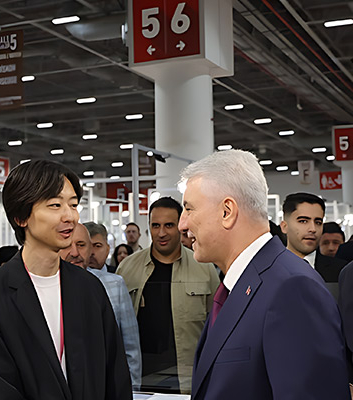
Çağlar Bağcı, Chairman of the Aegean Ready-to-Wear and Apparel Exporters’ Association, noted that competitive conditions in the global ready-to-wear industry are changing rapidly, with speed, flexibility, efficiency, traceability and data utilisation capabilities becoming just as decisive as price.
“Alongside its labour-intensive structure, the ready-to-wear industry is one of the sectors being transformed most rapidly by technology. Due to rising production costs and global competition, productivity is no longer an option for our industry; it is a necessity. We do not view digital transformation simply as adopting new software or introducing new technologies into production. The real transformation lies in being able to accurately interpret production data, measure losses, monitor costs in real time and integrate this data into decision-making processes. Our Artificial Intelligence, Digital Transformation and Sustainability Committee, established within our Association, closely monitors the transformation needs of our industry. We have designed our P&D project around this approach” he said.
A Tailored Digital Transformation Roadmap for Each Company Instead of a One-Size-Fits-All Approach
Chairman Bağcı explained that following the needs analysis, a company-specific SIRI Digital Maturity Assessment will be conducted. “Within the scope of SIRI, which provides an assessment and roadmap tool showing companies where to start their digital transformation journey, a digital maturity assessment report will be prepared for each company. We are aware that our companies are not all at the same stage when it comes to digitalisation. Following the needs analysis, we plan to develop a SIRI Digital Transformation and Artificial Intelligence Roadmap for each company, tailored to its production structure, infrastructure and priorities,” he said.
As part of the project, companies are expected to be assessed at three different levels of digital maturity: “beginner”, “intermediate” and “advanced”. Differentiated consultancy programmes will be offered to companies based on this classification.
AI Applications to Be Identified from Design to Quality Control
Pointing out that artificial intelligence offers significant opportunities at many stages of ready-to-wear production—not only in design and marketing—Çağlar Bağcı said that one of the key objectives of the project is to identify the right areas for AI adoption within companies. “We have significant potential to use artificial intelligence across a very broad range of areas, including production planning, demand forecasting, quality control, inventory optimisation, cost and profitability analysis, delivery scheduling, sales and marketing,” he commented.
“P&D Support Significantly Reduces the Cost of Transformation for Our Companies”
Chairman Bağcı also noted that companies take investment and consultancy costs into consideration during their digital transformation processes, emphasising that the support mechanism provided through P&D projects represents an important opportunity, particularly for exporting SMEs. “Within the scope of the project, expenses related to eligible activities such as needs analysis, consultancy, training and overseas marketing are supported by the Ministry of Trade at a rate of 75%. Therefore, companies can access, under the P&D framework, activities that would otherwise require significantly higher budgets if carried out individually, providing them with a substantial cost advantage,” Bağcı said.
“Before Investing in Technology, Companies Need to Determine What the Right Investment Is”

Ertan Aslan, Chairman of EHKİB’s Artificial Intelligence, Digitalisation and Sustainability Committee, explained that the project will focus not on directly providing machinery or software investments, but on preparing companies for the right technology investments. He warned that technology investments that are unsuitable or do not correspond to actual needs could create additional costs for companies. “Rather than telling our companies ‘buy this machine’ or ‘use this software’, we first want to identify which problems they need to solve. Can existing systems be used more efficiently? Which processes should be digitalised? What data should be collected? How should systems be integrated? How quickly will the investment pay for itself? Once we have answers to these questions, moving towards technology investment becomes much more effective. Our aim is to guide companies in directing their digital transformation budgets towards the right areas,” he said.
Digital Transformation to Be Integrated with Export Activities
Ertan Aslan noted that one of the key pillars of the project will be AI-supported target market and potential buyer analyses, emphasising that digital transformation will not be limited to increasing internal operational efficiency. Aslan stated that the participating companies’ product groups, price levels, production capacities, minimum order quantities, delivery capabilities, certifications, sustainability performance and production technologies are among the criteria planned to be analysed. “We do not consider digitalisation separately from exports. As a result of these consultancy activities, we aim to create a ‘Digital Supplier Profile’ for each company. This will help our manufacturers communicate more effectively to international buyers not only what they produce, but also their production capabilities, speed and flexibility, sustainability performance and technological infrastructure,” he continued.
International Technology Centres and Best Practices to Be Examined
Ertan Aslan stated that activities enabling companies to closely follow technological developments around the world are also planned within the scope of the P&D Project. He explained that international exhibitions, technology centres and successful best-practice examples in the fields of smart manufacturing, digitalisation, artificial intelligence and production technologies will be examined as part of overseas marketing activities.