“At Qmatex, We Adapt Our Machınes to the Final Product”
Developing specialized weaving solutions for a wide range of applications, from technical textiles and 3D composites to biomedical fabrics and filtration, Qmatex goes beyond conventional machinery with its customer-centric approach. Through in-house engineering and manufacturing, the company provides tailored solutions to address the technical challenges posed by different fabric structures.
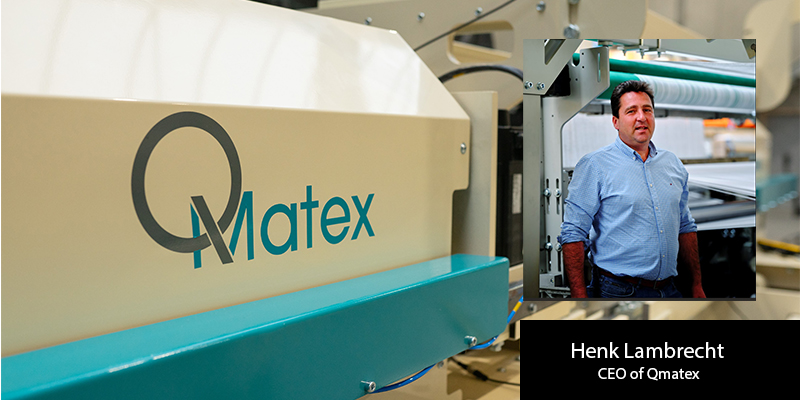
Every fabric has its own specific production requirements when it comes to weaving technologies. The production of high-performance, multi-layered and structurally complex technical fabrics, in particular, requires engineering solutions that go beyond standard weaving machinery. Bringing together its expertise in mechanical engineering, electronics and textile technology, Qmatex develops custom-made machines to meet these requirements. We spoke with CEO of Qmatex Henk Lambrecht about the company’s customer-focused development approach, the capabilities offered by different weaving technologies and its outlook on the future of the technical textiles market.
Qmatex is known for developing custom-made weaving machines for niche markets. What key factors differentiate your approach to customized weaving machinery from standard loom solutions?
 To create customized installations, we like to spend a lot of time understanding the needs of our customers. Before we start designing the machine, we concentrate on the final fabric specifications and optimize the machinery from there. The result is that every machine is tailored to the fabric at every step of the process, resulting in the highest quality for our customers.
Qmatex is not just the machine supplier, but also a development partner. In many cases, our customers ask for products that do not exist yet. We assist them in producing first samples to a running industrial production line. After a machine is delivered, we stay involved to guide the production process development.
We engineer and build everything in house, which allows us to respond quickly and to offer support long after the machine has been installed, whether service or spare parts are required. In short, a standard loom asks the customer to change his product to fit the machine. We adapt our machine to the final product.
Your expertise covers technical textiles, 3D composites, biomedical fabrics, filtration, tubular fabrics and distance fabrics. What are the most demanding requirements of these applications, and how do your weaving technologies address them?
Every application behaves differently because of differences in material, weaving structures, thickness and so on. In 3D weaving, there are multiple challenges such as controlling yarn tensions, exceeding certain densities or increasing the amount of layers stacked above eachother. Our machines are specifically designed to produce these kind of fabrics as we implement our in-house developed technology. For example, our shuttle looms feature integrated motors that actively control the weft tension while inserting picks. Another example is our rapier system, which is desinged to move up and down on every pick, allowing our machines to weave significantly more layers.
Qmatex combines expertise in mechanics, electronics and textile technology. How does this multidisciplinary approach contribute to developing innovative weaving machines and solving complex customer requirements?
When customers come to us with a project, it often can’t be produced on a standard loom. They might want 10cm thick multi-layered preforms, bifurcated structures for implants or samples of materials that have not been woven before.
In these cases, we rely on the multiple disciplines under our roof. A textile expert can assist our customer in defining the fabric specifications, yarn tension, shed geometry and beat-up behaviour. Our mechanical engineers desing the machine according to the needs set forward by the fabric and the electrical engineers allow for customisability and flexibility through software.
“We Offer The Flexibility To Weave Different Types Of Fabrics On The Same Machine”
Your technical loom portfolio includes solutions such as shuttle, rapier, double-rapier and closed-edge weaving machines. What are the main advantages of these technologies for manufacturers working with high-performance and heavy-duty fabrics?
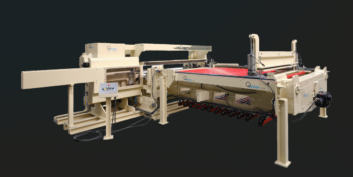 Each type of loom serves different use case. Shuttle looms allow for seamless edges in the final fabric and allow to weave tubular or bifurcate fabrics. These aspects make it a great fit for customers in medical fields. Our rapier looms also have the option to be converted to shuttle weft insertion, this gives our customers the flexibility to weave different types of fabrics with the same machine.
As mentioned before, the rapier or shuttle is able to move vertically to insert picks in the center of every shed, making these looms ideal for multi-layered high performance fabrics. Our fabric-first approach and focus on customisability means we can adjust parameters such as the beat-up force according to the fabric requirements and customer needs.
Your QS-R-4-500 machine incorporates contactless rapier technology, parallel reed beat-up and multi-rapier capability, with applications including biomedical fabrics, spacer fabrics and filtration. What production challenges were you targeting with the development of this technology?
When dealing with high-end applications and delicate yarns, friction is a very important aspect to control. Abrasion of the warp or weft yarns shows up in the final fabric and leads to a loss of performance.
A conventional reed beat-up takes place in an arc, which results in a slight difference in beat-up between the different fabric layers. To achieve a uniform beat-up, we let the reed move straight forward towards the fabric.
The QS-R-4-500 allows to weave with one to four rapiers, depending on the fabric that is being produced. This creates the option to weave multi-layered and spacer structures, as well as increase production speed.
Qmatex also develops solutions for velvets and carpets, including machines for cut and loop pile fabrics and wide-width carpet applications. How are customer expectations and production requirements changing in these markets, and how is Qmatex responding?
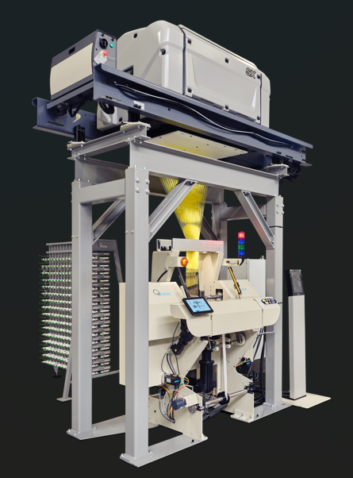 Customers expect more desing variety and shorter changeovers and of course expect production speeds to keep increasing. They also expect the machines to be ‘connected’, easy to operate and reliable. Because of our focus on custom machines, we are able to tailor our machines to these changing needs. A large part of the market runs on older machines, which is why we also offer retrofits and automation so manufactureres can modernise without replacing their machine park.
“We Expect Strong Growth in Technical Applications”
Looking ahead, which technologies, applications and market segments do you expect to drive the next generation of specialized weaving machinery, and what are Qmatex’s priorities for the coming years?
We expect strong growth in technical applications such as 3D composite preforms for aerospace, automotive, ceramic composites, biomedical textiles and implants, filtration, defence and so on. These applications often require custom machinery, and it is precisely there where Qmatex excels.
On the technology side, we foresee an increase in demand for further automation, data connectivity, process monitoring and quality control, as well as increase need for handling delicate and difficult fibres such as carbon, ceramic or bio-based materials.