“Our Cooperation with Türkiye will Deepen in Technical Textile Production Technologies”
Interview: Dilek Hayırlı
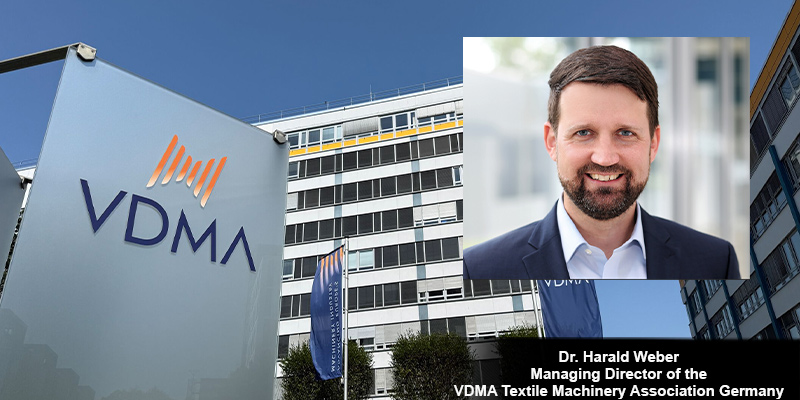
While order intake in the European textile machinery sector is seeking stability, Türkiye continues to maintain its strategic position for German manufacturers with its strong industrial infrastructure, logistical advantages, and vision for high value-added production. Dr. Harald Weber, Managing Director of the VDMA Textile Machinery Association Germany, emphasizes that cooperation with Türkiye will further deepen in the fields of automation, digitalization, and technical textiles.
Global uncertainties, fluctuations in trade policies, and economic conditions that complicate investment decisions have led the European textile machinery industry into a cautious period in recent years. However, according to the Germany-based VDMA Textile Machinery Association, the downward trend is gradually giving way to stabilization. In this landscape, Türkiye stands out not only for its strong textile production capacity, but also for its proximity to Europe, logistical reliability, and industrial vision focused on higher value-added production.
Dr. Harald Weber, Managing Director of the VDMA Textile Machinery Association Germany, states that the long-standing cooperation between German machinery manufacturers and the Turkish textile industry is expected to gain new momentum, particularly in the areas of automation, digitalization, and technical textile technologies.
How would you define VDMA’s role in the global mechanical and plant engineering sector? What critical responsibilities does the association take on behalf of its members with policymakers, industry, and international stakeholders?
 VDMA Textile Machinery represents around 140 manufacturers of machinery, equipment, components, accessories and software for the production of textile materials – from spinning to the production of textile fabrics and finishing. They represent about 90 percent of the total industry volume in Germany. About 13 percent of our members come from Austria, France, the Netherlands, Italy, Portugal, Switzerland, Sweden and Great Britain. All this embedded in the structure of complete VDMA with its around 3,500 members in total.
VDMA acts as a strong voice of the industry, communicating the sector’s needs and positions on global platforms. In addition the association is a facilitator of exchange, connecting member companies with each other, with policymakers, industry stakeholders, and international partners. Due to the significant export share in textile machinery, which exceeds that of many other sectors, supporting export activities is a key focus. The activities include e.g. business delegation trips to key markets around the world and facilitating participation in major trade fairs (e.g., ITMA, ITMA Asia, Techtextil), often through joint pavilions and government‑supported initiatives.
“VDMA Economists Predict the Downward Trend in Revenue will Stop in 2026”
How would you evaluate the German and European mechanical engineering sector in 2025? What were the key developments in terms of orders, exports, and investment appetite?
The economic situation for the European textile machionery comapnies remained poor. Following significant declines in order intake since 2022, 2025 once again brought a drop in order volume for the industry, although this was more moderate than in previous years. Order intake in the German textile machinery manufacturing sector appears to be stabilising. For the year 2026 VDMA economists are forecasting zero growth in turnover for 2026. At least the downward trend has been halted.
Looking ahead to 2026 and beyond, what do you see as the main opportunities and risks for the sector? How do global uncertainties, geopolitical developments, and trade policies affect VDMA members’ strategies?
Looking ahead to 2026 and the years that follow, the German textile machinery industry faces a mixed landscape. The sector is emerging from several years of declining order intake, and although stabilization is visible, global uncertainties continue to shape the strategic environment. The erratic US customs policy contribute to a global situation of uncertainty, which makes investment decisions difficult. But it is not only the US that uses questionable methods in international trade. China has been flooding the markets by exporting inexpensive polyester fibres and fabrics to other textile-producing countries, such as India and Turkey, thereby inhibiting investment in those countries. In view of global uncertainties, companies are in the process of making their supply chains more resilient.
What role do digitalization, automation, and Industry 4.0 play in VDMA’s strategic agenda? What concrete steps are being taken to accelerate the digital transformation of member companies?
Digitalisation and automation have been the major innovation themes of recent years, offering solutions to many structural challenges facing the industry—including rising cost pressure, quality demands, sustainability obligations, and labour shortages. A concrete example for the next steps is the Digital Product Passport (DPP). The sector is preparing for the EU Digital Product Passport requirements expected to apply from mid‑2027. VDMA supports this transition through: Expert panel discussions, regulatory guidance, cooperation with partners such as Global Textile Scheme (GTS). Although the DPP directly affects only the textile manufactuers, smart and efficient machine help to fulfil the requirements.
What are VDMA’s priorities regarding sustainability and energy efficiency? How does the association guide the sector in alignment with the European Green Deal and climate targets?
VDMA Textile Machinery positions sustainability as both an ecological duty and a strategic economic opportunity. The member companies of VDMA play an enbaling role by providing technologies e.g. for recycling of textile production waste and textiles. Apart of the recycling issue the machinery of the VDMA members enable high energy and resource efficiency across the entire textile value chain—from fibre processing to finished goods. In doing so, not only sustainability goals are met but also the competitiveness of textile producing enterprises is strengthened.
The shortage of skilled labor and talent is becoming an increasing challenge in the sector. How is VDMA addressing this through education, programs for attracting young talent, and competency development initiatives?
The Walter Reiners Foundation of VDMA Textile Machinery awards every year prizes for junior engineers across categories such as Bachelor, Master, Diploma, and project theses. These prizes serve as strong incentives for students to specialize in textile machinery engineering or textile technology. One of the foundation’s most impactful activities is its financial support for university excursions e.g. to the leading fair ITMA or to member companies. These excursions give students hands‑on exposure, direct contact with engineers, and insight into cutting‑edge machines—bridging the gap between academic learning and industrial reality.
“VDMA Members Look Forward to Establishing New Business Connections at ITM 2026”
How does VDMA assess the current potential of the Turkish market, and in which areas do you expect collaboration between German machinery producers and Turkish industry to deepen in the coming years?
The textile machinery companies within VDMA can look back on decades of close and trusted cooperation with the Turkish textile industry. Turkey’s strong industrial base and its immediate proximity to Europe offer significant advantages—particularly when it comes to delivery times, logistics reliability, and overall cost efficiency. These factors make the country an attractive partner for German machinery manufacturers. In the coming years, collaboration between German textile machinery manufacturers and the Turkish textile industry is poised to deepen particularly in automation and digitalisation and e.g. in technologies for the production of high value textiles and technical textiles. Numerous VDMA members will be exhibiting at ITM in Istanbul in June and look forward to strengthening existing business contacts and establishing new ones.