Re-engineering Fluid Dynamics for Waterless Textile Processing
Interview: Tuğba KARADEMİR
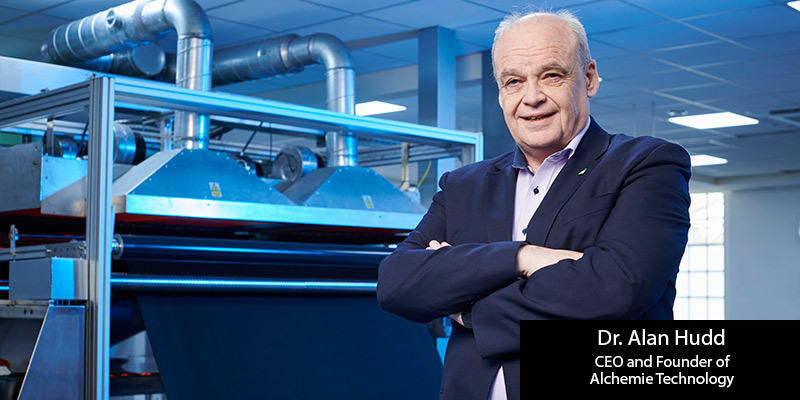
Alchemie Technology is reducing water, energy and chemical consumption in textile dyeing and finishing processes with its Endeavour™ and Novara™ technologies, while offering manufacturers more precise, flexible and demand-driven production capabilities. Dr Alan Hudd, CEO and Founder of Alchemie Technology, discusses the transformation of textile manufacturing through digital technologies and Türkiye’s potential in this field.
Sustainability, rising energy costs and increasing pressure on water resources are driving the need for new technologies, particularly in textile dyeing and finishing processes. Developed as alternatives to conventional wet processing, digital solutions not only reduce resource consumption but also offer greater precision, flexibility and speed in production. Standing out with the technologies it has developed in this field, Alchemie Technology aims to transform textile dyeing and finishing processes with its Endeavour™ Waterless Smart Dyeing and Novara™ Digital Precision Finishing systems. We spoke with Dr Alan Hudd, CEO and Founder of Alchemie Technology, about the digital technologies developed by the company, its approach to sustainable production, the Dye-to-Service model, and the transformation that lies ahead for the textile industry.
How does Alchemie Technology assess the global textile industry in 2026, particularly the transformation taking place in dyeing and finishing technologies?
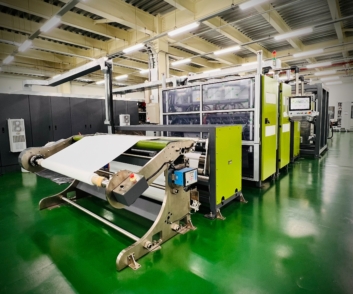 If you look back at how textiles were processed for a century, the industry operated on a simple, brutal logic. For example, to get vibrant colour or high-performance finishes, you had to burn tons of fossil fuels, submerge fabrics in massive vats of water, and send polluted wastewater downstream. For decades, wet processing quietly generated over 20% of global industrial water pollution, creating a footprint heavier than international aviation.
By 2026, that old model hit a brick wall. Manufacturers are no longer just fighting for market share, they are fighting against volatile energy tariffs, strict local water rationing, and upcoming EU carbon border mandates. We are witnessing a fundamental shift in investment priorities. Mills are stepping away from “end-of-pipe” band-aids like bigger wastewater treatment plants and are instead investing in process elimination. They want technologies that permanently shrink operational costs per meter while giving them the agility to run smaller, faster, demand-driven batches rather than drowning in unsold inventory.
“We Are Bridging This Gap by Re-engineering Fluid Dynamics”
Alchemie’s core technology is based on a precision digital fluid application technology developed from inkjet principles. What are the key differences between this technology and conventional application methods such as spraying and pad-batch processes? How does nanodroplet technology enable greater precision in applying dyes and chemicals to textiles?
 Conventional wet processing relies on heavy liquid saturation. For example in spraying systems, even though it also offers non-contact application, they lack volumetric control. Whilst in pad-batch dyeing, fabric is drawn through large chemical troughs and crushed between heavy rollers, saturating the entire material mass and requiring massive thermal energy to dry.
The standard industrial inkjet delivers fine surface placement, but their droplets lack the momentum required to penetrate deep into woven or knit textile structures. Alchemie bridges this gap by re-engineering fluid dynamics for textile dyeing applications.
Our proprietary architecture fires controlled nanodroplets of dyes at ultra-high velocities, assisted by targeted airflow. This kinetic delivery propels the liquid directly into the core of the textile matrix, achieving complete, uniform fibre saturation without submerging the fabric in water baths. Because the system controls liquid delivery at a nanolitre level, chemistry is deposited strictly where needed with zero runoff. Furthermore, the platform is chemistry-agnostic, enabling manufacturers to run standard, cost-effective dyes and formulations rather than expensive, specialised digital inks.
“Endeavour™ Reduces Total Production Costs by Up to 50%”
Could you explain how Endeavour works and its key differences from conventional dyeing processes? What advantages does it offer manufacturers in terms of quality, colour fastness, production speed and cost?
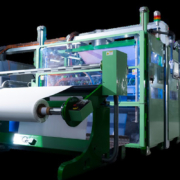
When you watch Endeavour™ in action, the first thing you notice is what’s missing, that are the dye bath, the endless pools of coloured water, and the thermal energy. Whilst in a traditional setup, batch dyeing can drag on for six to eight hours per lot as fabric boils in a chemical bath, followed by wash-off cycles to scrub away unabsorbed dye.
With Endeavour™, we turn that chaotic process into a seamless and continuous line running at speed up to 40 metres per minute. Then the dyes will be jetted only where it’s needed in high-velocity precision, meaning that there will be no chemical waste in the process. Then the upon the dyeing process, the fabric will go through the fixation and drying process, before it gets into the softening process. The result from our Endeavour™ is not a compromise, it delivers rich colour depth and fastness that meets the global brand standards while slashing utility expenses and the overall production costs by up to 50%.
“We Reduce Active Chemical Use by Up to 30%”
Your Novara™ Digital Precision Finishing technology enables finishing chemicals to be applied digitally only where they are needed, including single- or double-sided functional finishing. How do you assess the new production possibilities offered by Novara™, particularly for technical textiles and high-value-added fabric applications?
 Conventional finishing methods are inherently unselective. In traditional application, fabric is fully submerged in a bath, forcing chemistry into every internal void and across both faces of the textile. This approach consumes excessive raw materials, stiffens the fabric hand-feel, reduces breathability, and requires immense thermal energy to dry out the soaked material.
Novara™ fundamentally changes this process by treating functional finishing as a high-precision digital process. Novara™ applies micro-droplets of chemicals strictly to target zones on the fabric surface. This micro-precision enables manufacturers to produce dual-action functional textiles on a single production line. For example, applying a moisture-wicking finish to the inner face of an activewear fabric while jetting a durable water repellent (DWR) onto the outer face without cross-contamination.
Because active agents are deposited only on the necessary fibres without filling internal structural voids, textiles retain their natural soft hand-feel, breathability, and elasticity. Furthermore, applying highly concentrated chemistries directly to the surface reduces active chemical usage by up to 30% and slashes drying energy requirements by up to 85%. For high-value-added technical textiles, such as flame retardants, anti-microbials, thermoregulating coatings, and stain repellents, Novara™ is the centre between high functional performance, production cost, and environmental footprint.
The “Dye-to-Service” model introduced by Alchemie in 2026 represents a different approach to the traditional dyehouse business model. How does this model work?
Historically, adopting groundbreaking industrial machinery meant taking a terrifying leap of faith, spending millions in upfront capital expenditure before seeing a single cent in return. We introduced the Dye-to-Service model to break down that wall entirely. It gives manufacturers access to Endeavour™ and Novara™ systems through flexible, production-on-demand frameworks, aligning our success directly with their output.
This model reshapes how fashion supply chains work. In the old world, brands had to dye oceans of fabric and cross their fingers that it sold. With digital precision, mills can hold un-dyed greige fabric and dye exact quantities in a matter of days based on real-time market sales. There are no massive minimum order quantities, no changeover waste between colours, and no mountain of discounted deadstock at the end of the season.
Finally, how do you see the future of digital dyeing and finishing technologies in 2027 and beyond? How do you assess the potential for digital and water-saving dyeing technologies to become more widely adopted in markets such as Türkiye, which has a strong textile and finishing manufacturing base?
Looking ahead to 2027, digital dyeing won’t be seen as an alternative technology, instead it will be the standard threshold for doing business. At Alchemie, our team is pushing hard into expanding our digital application capabilities across complex fibre blends, integrating bio-based dyes, and pairing our systems with AI-driven data matching to make the factory of the future a reality.
When we look at Türkiye, we see one of the most vital textile powerhouses on earth. Turkish manufacturers are world-renowned for their craftsmanship and strategic position as the primary supplier to European fashion. But Turkish mills are also sitting at the epicentre of rising energy costs, regional water pressures, and strict upcoming European regulations like CBAM. For Türkiye, adopting waterless digital dyeing isn’t about making a sacrifice for the environment, it is about securing a massive competitive edge, neutralising utility costs, and locking in its position as the ultimate low-carbon, high-speed partner for the global textile future.