

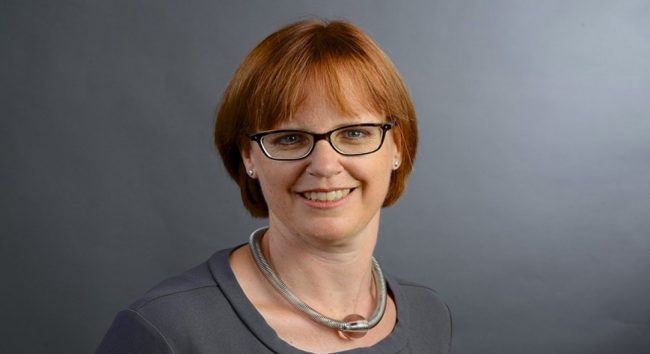
“Turkey Shows A Good Business Development, Which is Leading to Good Order Intake for Our Members”
Cornelia Buchwalder, Swissmem Secretary General
We interviewed with the Swissmem Secretary General Cornelia Buchwalder for ‘Swiss Special Edition’. We talked with Buchwalder about the effects of the pandemic on the textile machinery industry, the roadmap of Swiss manufacturers and their 2021 expectations. Buchwalder said; “Although global development remains difficult, Swiss textile machinery manufacturers report a good order intake. Turkey also shows a good business development, which is leading to good order intake for our members.”
How was your member’s reaction to Pandemic? How did Swiss companies create a roadmap to get through the process with less damage?
It is well known that the textile machinery industry is an early cyclical industry. Textiles are nowadays not only a day-to-day product but also a luxury good. Therefore, our member companies were hit early by the crisis. But this also makes the textile machinery industry one of the industries where the upswing starts earliest. Accordingly, our members are currently talking about a good order intake.
What do you think about the textile machinery industry situation globally in this hard time and what is your prediction for post Corona Period? What steps should be taken for the textile industry to return to its old days?
The big issues for the textile industry in the coming years remain sustainability and the careful use of resources. The industry must find even better and more effective solutions to these challenges. In addition, textile solutions are being used in more and more applications, such as agriculture and construction. This continuous development of the fields of application is another building block for success.
Turkey, especially in pandemic process has become an important supply point for Europe again. What do you think about the Turkey textile market and its potentials?
We assess the outlook for Turkey as very good. Last year showed that very long supply chains, for example between Europe and Asia, can become a problem. This is a great opportunity for Turkey, as it lends itself to building shorter and more agile supply chains with its textile expertise.
Please update our readers with the latest statistics of Swiss textile machinery export.
After quite a few years with “best-ever” order volume and results, Switzerland, as many other industrial countries, encountered a heavy slowdown of our industry. It has become apparent that 2020 and 2021 will be a very difficult years for all market players due to the global corona pandemic.
In Switzerland we never had an imposed lockdown for the industry. So most of companies continued production – on a lower level, due to postponement of orders and projects, supply chain difficulties and the unsecure situation in general. The 2020 export statistics of the Swiss Textile Machines showed a minus of around 25% compared to 2019, the top five export countries being China, Germany, Turkey, the US and India.
The effects of the pandemic seem to continue in the first months of 2021. As Swissmem, what are your expectations from 2021? Which kind of innovations and progress is expected in upcoming years in the Swiss textile machinery sector?
Although global development remains difficult, Swiss textile machinery manufacturers report a good order intake. Turkey also shows a good business development, which is leading to good order intake for our members. With regard to innovation and progress, the important trends continue to be sustainability, digitisation and the circular economy. Therefore many of the innovations will integrate these aspect. Industry 4.0 offers various possibilities, be it in product or process optimization or in the development of completely new business models. Our member companies use these possibilities to generate maximum customer benefit. With regard to sustainability, the optimized utilisation of resources is again one of the major topics. Raw materials are scarce and energy is expensive, therefore making our machines more efficient in both aspects is key.
Interview: Dilek HAYIRLI


