“We Have Developed A New Sono-Finishing Process That Gives Textiles an Anti-Viral Finishing”
Verena Ruckh, Head of Advertising and Marketing Department of Brückner
We interviewed Verena Ruckh, Head of Advertising and Marketing Department of Brückner, for the “Dyeing and Finishing Technologies Special Issue” in our Tekstil Teknoloji magazine. Ruckh explained the effects of the pandemic process on the industry, Brückner’s roadmap and 2022 expectations.
“During the pandemic, we learned how important it is to be flexible”
How was your company’s reaction to Pandemic? As Brückner, what kind of preparations do you make for the post-pandemic period?
The year 2020 was quite different than others – in many respects. Many of our customers did not know how their customers would behave due to the Pandemic, so many orders have been postponed or even cancelled. This made further plannings almost impossible for us. Another challenge was, that we had to digitalize our work even more than before in a very short period of time. All our staff was working at home from one day to another and meetings could take place only virtual. It was a completely new experience for all of us, but it worked really well.
During the pandemic, we learned how important it is to be flexible. We have restructured our organization internally so that we can respond even faster and more flexibly to customer requirements in the future. What we will definitely keep after the pandemic, is video conferencing and webtalking with our customers. This has found good acceptance and in the end saves time and money. Nevertheless, we are looking forward to the big trade fairs and to meeting our customers face to face!

“We have to deal with delivery interruptions and shortness of transport possibilities”
In the post-pandemic period, there will be some changes in the products, production models, and supply points required in the textile industry. What kind of changes do you think will happen for the sector?
There is one change, that has already happened and this is a quite big challenge for all of us. We have to deal with delivery interruptions from suppliers and sub-suppliers and also the shortness of transport possibilities. This of course has effects on our delivery times. In addition, we have to contend with sometimes substantial price increases for raw materials like e.g. steel or copper. You can imagine that customers are not happy about this situation. This makes it all the more important to discuss these issues openly and honestly with our customer. But anyhow, it is not that easy.
Which kind of innovations and progress is expected in upcoming years in finishing machines?
One big issue is – and will be in the future – sustainability. In the finishing sector, which is the most energy-intensive process in the whole textile production chain, this means to introduce even more energy-saving products. This can be reached by heat-recovery and air purification systems, biofilter, active carbon filter or new airflow and heating technologies inside the dryer. At the same time, we are already working on an even better remote service for our customers, because the effects of the pandemic have shown, that many things can be done online, even the commissioning of machines. Predictive maintenance of our lines will also be a big topic in the future. Regardless of the price of the machine, it only costs extra when it is down and customers are unable to produce. Therefore, continuous and expert maintenance, supported by remote services, is an important standard for the future of textile finishing lines.

“We Automated A Major Part of Our Production Steps”
Can you talk about the major functional improvements you recently made, and how this will benefit the textile industry?
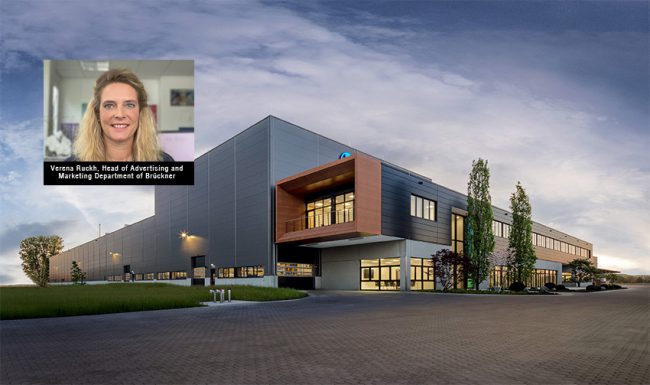
We recently built a completely new production plant in Bavaria, in the South of Germany to keep up with our trend “made in Germany”. In this new production plant, we are able to act clearly faster and more flexible. Large and heavy machine components can be moved and assembled much easier and we can even build up complete lines for testing and develop things further. In addition, a major part of our production steps have been automised.
In times of pandemic, antiviral and antibacterial finishing of textiles became more important than ever. In principle, this type of finishing is not a novelty, but the traditional finishing has some disadvantages. Together with two partner companies we have developed a completely new sono-finishing process which is suitable for all kind of textile fabrics and gives the textiles an anti-viral and anti-bacterial finishing. With this new technology, zinc-oxide nanoparticles are mechanically embedded in the textile structure, so the anti-viral and anti-microbial properties remain in place for a very long time.
Besides, not polluting chemical binders are required in the process and the use of chemicals can be reduced by up to 50%. To prove the lasting and reliable anti-viral effect, many trials have been made together with international renowned textile research institutes. The development is still ongoing, but this new technology make it an optimum solution for finishing clothing for medical workers, laundry in hospitals and care homes, hotels, as well as many other areas where hygiene and infection control are critical. Interested parties may ask for trials in our technology centre in Leonberg near Stuttgart. We are always happy to support customers with their own product development.
What percent of your machines do you export annually? Which are the top markets geographically?
The export rate of our machinery is approx. 95%. Our top markets are the Far East, especially India, Bangladesh, Pakistan, China, Indonesia but also Turkey, Usbekistan, Brazil and of course the European markets like Germany, Portugal, Belgium, France and England.
As Brückner, what are your expectations from 2021 and 2022? Are there any plans for launching new products targeted at textile industry?
The main trend for the upcoming years will be digitalization, Industry 4.0, artificial intelligence and sustainable production. We already offer a lot of energy- and resource-efficient solutions. Our R&D department is always focussed on innovative technologies, virtual machines, traceability, remote control data exchange and intelligent user interfaces. With regard to the topic sustainability it is worth to mention our improvements in energy efficiency: German textile machinery of today need approx. 30% less energy compared to 10 or 15 years ago! So stay tuned for our ITMA 2023 presentation!
Interview: Dilek Hayırlı