Trusted Partner for Yarn Cutters and Sensors: Fil Control
With a reactive, available, and competent team, Fil Control has become one of the most famous brand on this market. The company produces yarn sensors, yarn cutters and quality control devices and sells its products all over the world through its sales department and agent network.
Fil Control is part Aventech, an industrial holding working on the energy, petrol, gaz and textile machinery industry fields. With 350 employees and a turnover over 55 million euros, Aventech owns 7 factories over 3 continents (Europe, Africa, Asia).
Fil Control works on 2 majors fields:
– Development, production and sales of equipment devices for the textile machinery industry.
– Electronic Subcontracting for PCBA and finished products.
Thanks to the skills and experience of its engineering department, in electronic, mechanic and design, the company can answer to generic needs, but also to any kind of bespoken demands, by adapting or developing its products to answer to each specific application of customers.
Fil Control developed a marketing and commercial policy of globalization, targeting the whole market of the yarn textile industry.
Most of the main world famous textile machinery manufacturer already trust in Fil Control for many years: Oerlikon, Saurer, Rieter, Fadis, Ratti, N. Schlumberger, Aiki, Galan, Hongyuan, Jingwei Group.
Yarn Cutters
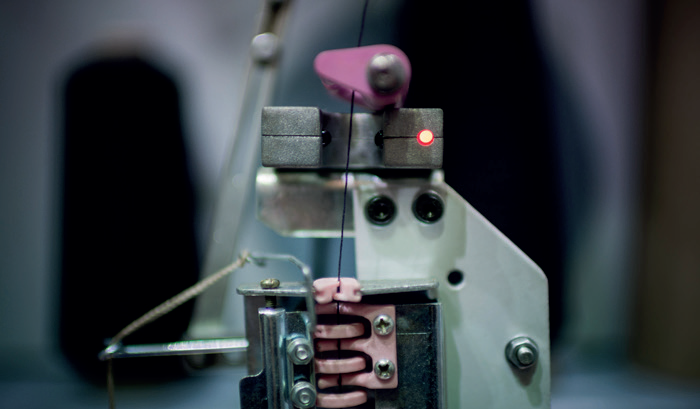
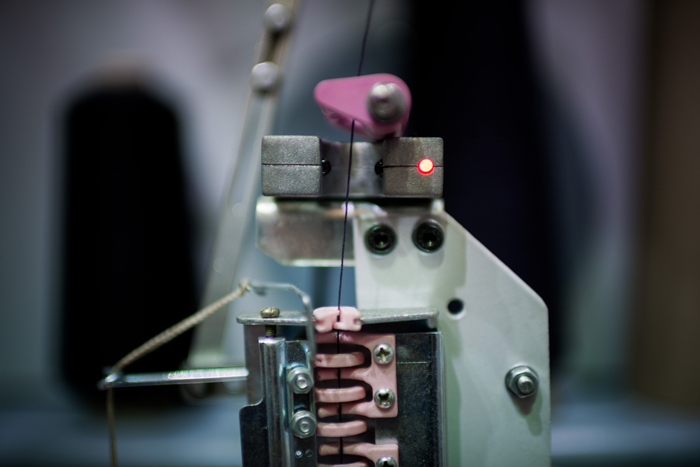
One of Fil Control’s prominent product groups is thread cutters. Electro-mechanical systems are used to cut off textiles yarn, Fil Control’ yarn cutters are devoted to protect textile machinery.
Designed by Tele-mechanic® 40 years ago, CA9-T keeps being a major actor on the market and regularly updated, according to new user requirements.
When yarn processing, the yarn may break and then after must be cut off and the cut end must be grip as early as possible in the process.
Fil Control Yarns Cutters prevents loss of time, material waste, neighboring yarn entanglement, and corrective maintenance when the wire is wound on the rotating parts, which can cause the breakup of important and expensive parts on the machine.
During winding operations, the wire must be cut when the expected length is reached.
Fil Control offers 2 main types of yarn cutters:
Yarn cutter with manual reset: Most commonly installed on the conventional texturing machinery.
Yarn cutter with automatic reset: Pneumatically or electro-mechanically controlled, they are designed for continuous process machinery.
Yarn cutter with manual reset
CA9-C
The CA9-C series are yarn cutters devoted to textile machines. They can cut up to 1 100 dtex yarns.
Functions: When operating on yarn machines, the breaking of one (or more) yarn has to be detected immediately and automatically. Yarn sensors play this part. To avoid a “wild” rewinding which could be cause of perturbations on neighbouring sites, even of breaking of the machine, it is recommended to mount CA9-C onto the machines. First they cut off the broken yarns, second they grip them. On winding machines, the yarn has to be cut when the bobbin is full. CA9-C series have to be manually reloaded.
Principle: The yarn passes through the groove of the yarn cutter and is led by two guides. When occurring, a hammer (knife) striking against an anvil cuts the yarn. The electromagnet, activated by the yarn sensor, attracts the framework and releases the blade. Striking strength is supplied by a compressed spring triggered by the electromagnet. A pincer holds the yarn.
Electrical Protection: The CA9-C series are protected against reversed polarities and is dust resistant.
Yarn cutter with automatic reset: Pneumatically or electro-mechanically controlled, they are designed for continuous process machinery.
CFD (Pneumatic)
The CFD 423865 is a pneumatic yarn cutter specially developed for RIETER texturing machines. It can cut yarns up to 3 000 dtex.
Functions: The CFD is useful on automatic machines, during the winding process, to automatically cut the yarn when the bobbin is full.
Principle: The yarn runs inside the tube of the yarn cutter, in an air flow. When the bobbin is full, a signal coming from the machine will give information to cut the yarn. One ceramic blade is moved by the compressed air through a spring and acts like scissors versus another fixed ceramic blade (guillotine). Blade motion must be completed fully to assume the cutting function. Cutting time cycle must be less than 50 ms (+/- 20 %).