The Brotherhood of Maraş and Antep Lives On Through “Maraş Aba” Motifs
The exhibition “A Story of Brotherhood”, which reinterprets the traditional “Maraş Aba” through a contemporary artistic approach, held its second showing in Kahramanmaraş.
Dr. Mutlu Aslantürk, a faculty member at the Faculty of Fine Arts at Kahramanmaraş Sütçü İmam University, reinterpreted the motifs of the “Maraş Aba”, one of Kahramanmaraş’s deeply rooted weaving traditions, with a contemporary perspective. The special collection consisting of 15 artworks was first presented to art lovers at the Gaziantep Panorama Museum on the occasion of Gaziantep’s liberation day and attracted significant attention. The same collection was later exhibited again within the scope of Kahramanmaraş’s February 12 Liberation Day events, meeting art enthusiasts in the city once more.
Historical Memory Transformed into Art with an Academic Vision
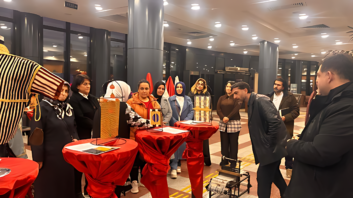 Through her extensive research on traditional clothing culture, Dr. Aslantürk brings cultural heritage together with art lovers through a collection prepared around the abas, one of the symbols of the War of Independence in Kahramanmaraş and its surrounding regions. The exhibition titled “A Story of Brotherhood” stands as a tribute to the Maraş heroes and veteran militias who rushed to support Antep after the liberation of Maraş, fighting shoulder to shoulder with their neighbors during the Turkish War of Independence. It highlights the strong bonds, solidarity, and sense of brotherhood that united the two cities during the struggle.
Each artwork in the exhibition represents the reflection of values such as solidarity, loyalty, prayer, and resistance, while also presenting the contemporary artistic interpretation of cultural heritage.
“Motifs Are Not Just Patterns, But the Language of Memory and Identity”
In her remarks about the exhibition, Dr. Mutlu Aslantürk emphasized the historical importance of the solidarity demonstrated by Maraş and Antep during the War of Independence. She recalled that after Kahramanmaraş was liberated from enemy occupation on February 12, 1920, the Maraş militias rushed to defend neighboring Gaziantep, which was still under occupation, declaring: “Antep cannot fall to the enemy unless it becomes our grave.”
Aslantürk stated that the Maraş Abası, which was carried on the backs of all the martyrs and veterans of the Maraş gangs, is a very precious symbol for them. “I consider the Maraş Aba worn by all martyr and veteran Maraş militias as sacred. Through this exhibition, I honor the spirit of solidarity, brotherhood, and patriotism they demonstrated at the cost of their lives. I respectfully commemorate all our ancestors who took part in the defense of our homeland,” she said.
Mutlu Aslantürk concluded her remarks as follows: “I would like to express my gratitude to Gaziantep Metropolitan Municipality Mayor Fatma Şahin, who hosted the first exhibition of the collection with deep appreciation; to Cahit Altıgöz from Maraş Antik, who added valuable pieces from his collection to my exhibition, and to Researcher, Historian and Author Orhan Saydam; to Kahramanmaraş Metropolitan Municipality, represented by our Mayor Fırat Görgel, for hosting our exhibition in their hall; to Kahramanmaraş Governorship and Provincial Culture Directorate, represented by our Provincial Culture Director Eshabil Yıldız, for facilitating the second exhibition of our exhibition in Kahramanmaraş; and to our Rector Prof. Dr. Mahmut Ak, our Dean Prof. Dr. Ersin İrfan Akıncı, and our Department Head Prof. Dr. Mehmet Zahit Bilir, under whose patronage we continue our work.”