Shima Seiki Unveils New Flat Knitting Technologies at Febratex 2026
Based in Wakayama, Japan, Shima Seiki, one of Leading flat knitting solutions provider, participated in the Brazilian Textile Industry Fair Febratex 2026 alongside its Brazilian representative, Brastema Tecnologia Textil.
At the exhibition, the company displayed a comprehensive lineup of its technologies, including WholeGarment® knitting machines, computerized flat knitting machines—featuring a new model that offers high productivity and superior cost performance—a glove knitting machine, and its latest digital solutions.
In addition, a broad collection of knit samples demonstrating the potential use of advanced knitting technologies beyond fashion and apparel was presented to visitors. Solutions for technical textiles and industrial applications were also among the prominent highlights at the display.
The company’s flagship SWG-XR® WholeGarment® knitting machine was exhibited with a structure operating on four needle beds and incorporating Shima Seiki’s proprietary SlideNeedle™ technology. The machine enables the knitting of high-quality WholeGarment® products across all needles. The N.SVR®183 featured at the exhibition as a conventional V-bed machine capable of performing WholeGarment® knitting on every other needle.
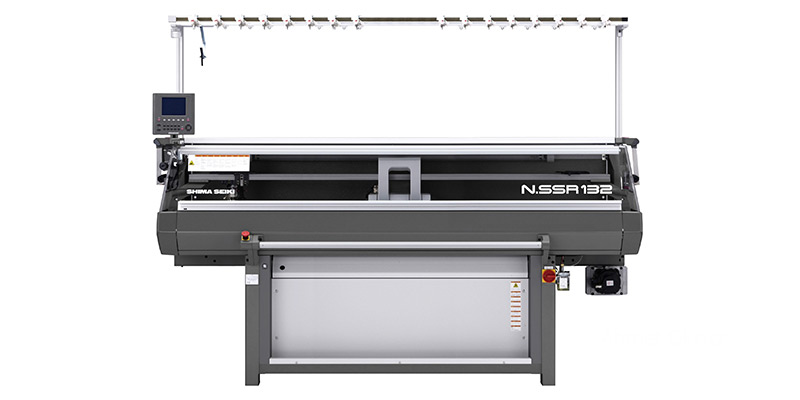
The SWG®091N2 “Mini” machine also demonstrated WholeGarment® knitting opportunities across different product groups through its compact and economical structure. Meanwhile, N.SSR®132, the new model of the N.SSR® series—one of Shima Seiki’s global standards in shaped knitting—was showcased in Brazil for the first time at Febratex. Featuring a 52-inch knitting width, the model allows for the production of larger sizes while offering the flexibility to respond to diverse customer and market needs within an economical price range. The machine also maintains the Made-in-Japan Shima Seiki quality and reliability.
The N.SSR®072 was on display as the new global standard machine specializing in jacquard collar knitting. Made-in-Japan quality and reliability combine with high productivity, ease of use, and cost performance to meet the expectations of the fashion industry. On the other hand, the N.SIR®123SP demonstrated its capabilities in producing technical textiles as well as unique knit-weave hybrid fabrics through its special loop presser bed with intarsia functionality.
The SVR®202 drew attention at the exhibition as another solution with its tandem knitting feature. The machine, which can perform double-system knitting when the twin carriages are used together, allows for two identical pieces to be knitted simultaneously as a single-system when the carriages are used separately. The SFG®-I glove knitting machine completed Shima Seiki’s comprehensive knitting machine exhibit at the exhibition.
Digital Solutions Were Also Exhibited
In addition to machine technologies, Shima Seiki also brought its digital solutions to visitors at Febratex 2026. Presentations were held on the SDS® KnitPaint-Online knitting software, which is used by knitting businesses worldwide to generate knitting data for Shima Seiki computerized flat knitting machines.
The APEXFiz® subscription-based design software, which supports the creative processes of knitting, was also introduced at the exhibition. Supporting various stages from planning and design to realistic textile simulation and the creation of 3D virtual product samples, APEXFiz® contributes to reducing the need for physical sample production.
Virtual samples allow for the creation of digital models accurate enough to replace physical sample production, thereby saving time, cost, and materials during sample preparation processes. Once a design is approved for production, the automatically generated knitting data can be transferred to SDS® KnitPaint-Online and converted into machine data. In this way, the process between design and production is digitally connected.
Shima Seiki’s APEXFiz® and SDS® KnitPaint-Online solutions support the digital transformation of the supply chain while contributing to sustainable production goals by reducing the need for physical samples and the associated resource consumption.