
EDANA: Nonwoven Production in Europe Returns to Pre-Pandemic Levels
Despite the current economic and energy crisis, and the war in Ukraine, Nonwovens production in Greater Europe showed steady growth in 2022 as volumes returned to pre-pandemic levels.
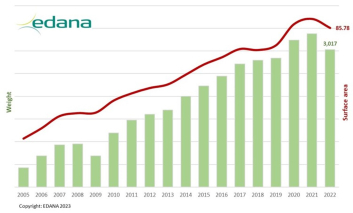
The latest figures, released from EDANA’s Statistics Report on Nonwovens Production and Deliveries for 2022, show that after a spike caused by the exceptional increase in demand for nonwovens materials in 2020 and 2021 due to the Covid-19 pandemic, (+9.3% in 2020-2021), production in Greater Europe (including Western and Eastern European countries, Turkey, Belarus, Russia, and Ukraine) is back on track.
In 2022, compared to data from 2019, nonwovens production in Greater Europe increased in volume by 3.3% to reach 3,017,085 tonnes, and by 9.1% in surface area resulting in 85.8 billion square metres of nonwovens being manufactured.
Welcoming the latest figures, Jacques Prigneaux, EDANA’s Market Analysis and Economic Affairs Director, further expanded on the data: “This conclusion can be refined according to the different production processes. Some processes, such as drylaid-hydroentangled and air-through bonding, recorded an even higher output in 2022 than in 2021. While, the production of other fibre-based materials, including drylaid, wetlaid, and airlaid technologies, were below the levels observed three years earlier. The production of spunmelt nonwovens was down again after peaking in 2021, but the 2022 output was still 8.1% over its 2019 level.”
In 2022, the most notable increase was in table linen applications
Similar conclusions can be drawn from the end-use perspective. Nonwovens market segments such as hygiene, medical, building construction, filtration, electronic materials, and wipes, which were almost flat or had significantly decreased compared with their 2021 levels, were still well over figures observed in 2019. There were some exceptions in other durables applications, where nonwovens sales were still below 2019 levels: automotive interiors (-27.8%), agriculture (-13.1%), and civil engineering (-4.6%). In 2022, the most notable increase was in table linen applications, which exceeded both 2019 and 2021 levels.
The source data was supplied by EDANA’s member companies and complied by Prigneaux. “When a company becomes an EDANA member, they are asked to reply to a questionnaire about their business which gathers data on their sales by market segment, and on their consumption of raw materials and production by technology. We collect data in both tonnage and square metres,” explained Prigneaux. “This is extremely valuable as it helps EDANA and its members to follow the evolution of the grammage of different products both by technology and by market segment. ”
The questionnaire that EDANA’s nonwovens producing members receive is very wide and assesses many elements including CO2 emissions, and new for 2022, energy consumption. The exhaustive excel document and report comprising all the data is available free of charge for those members that took part in the exercise.