The Legendary Color “Edirne Red” Finds New Uses
The world-famous “Edirne Red,” a color of great importance in the global textile industry, was first produced as a root dye in the city of Edirne in the 15th century. The hue—described as a brighter shade of brick red—was discovered by two master dyers whose secret formula eventually spread from Edirne to Europe.
Assoc. Prof. Nilgün Becenen, Director of Trakya University’s Edirne Rose and Red Research and Application Center, stated that Edirne Red (known in Europe as Rouge d’Adrinople), once the subject of espionage in the Ottoman era and thus dubbed the “legendary color,” is now being used in a growing number of fields.
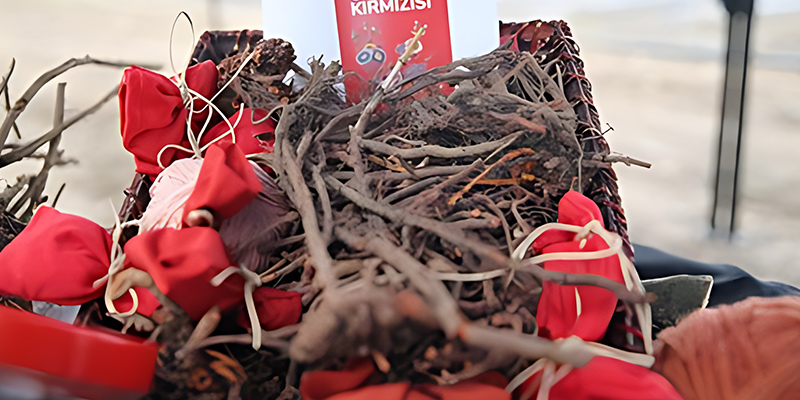
Speaking to Anadolu Agenc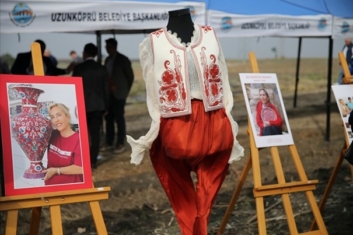 y, Becenen explained that Trakya University has been leading pioneering efforts to reintegrate Edirne Red into the city’s cultural identity. The first step, she said, was to raise awareness and promote the color, followed by trial cultivation of the root dye plant from which the pigment is derived.
Through research projects, her team succeeded in reconstructing the original dye recipe. “We learned how to cultivate and harvest the root dye plant. Then we prepared dyeing formulas. After more than 500 trials, we found the authentic color. During a meeting attended by representatives of the Edirne Governorship, Municipality, and our university, we officially reintroduced the color.” she said.
Cultivation Areas for the Dye Plant Are Expanding
Becenen noted that the development of Edirne Red is being carried out in collaboration with local institutions. The rubia tinctorum plant—used to produce the dye—has been successfully cultivated in experimental plots and is now being grown by local farmers.
“Our work is progressing well. Production of the root dye plant has begun. It’s a significant value for Edirne.” she said. “We don’t see it as an alternative to major crops like sunflower or wheat, but rather as a complementary product that can be grown in rural areas where such crops don’t thrive. It can provide added value for farmers, increasing agricultural diversity and income. The root dye plant can be harvested for three years and contains 30 different natural pigments in its roots. It’s non-allergenic and non-carcinogenic, producing a bright and vibrant red.”
Adaptable to Many Uses
Becenen emphasized that the applications of Edirne Red are expanding every day. “Edirne Red can be used as a solid dye and adds value to every object it colors,” she said. “It’s already used in textiles and will soon be applied in printing. It can be incorporated into home textiles, clothing, ceramic art, and wooden crafts. It’s a natural dye that adapts to virtually any need.”
Having played an important role in global textile history, Edirne Red was originally created in the 15th century as a root dye. The secret formula, discovered by two local dyers and named after the city, was smuggled to Europe through acts of industrial espionage.
Later, the formula began to be produced in France, where it spread throughout the European textile industry. By the 1740s, it became known as Rouge d’Adrinople and gained prominence particularly in textile applications. The color was also widely used in the decoration of historical buildings and traditional handicrafts in Edirne, but over time, it gradually faded from memory.
Today, efforts are underway to revive the legendary color in its birthplace and restore its prominence in both art and industry.