“Turkish Manufacturers Retain Their Entrepreneurial Spirit and Export-Oriented Structure”
Interview: Tuğba KARADEMİR
While consolidating its strong position in carpet weaving technologies in 2026, Vandewiele also accelerated its development of digital tufting solutions. Continuing to innovate in response to the growing demand for automation, digitalisation and production efficiency, the company aims to strengthen its leadership in woven carpet technology and further advance its position in the tufting segment in 2027.
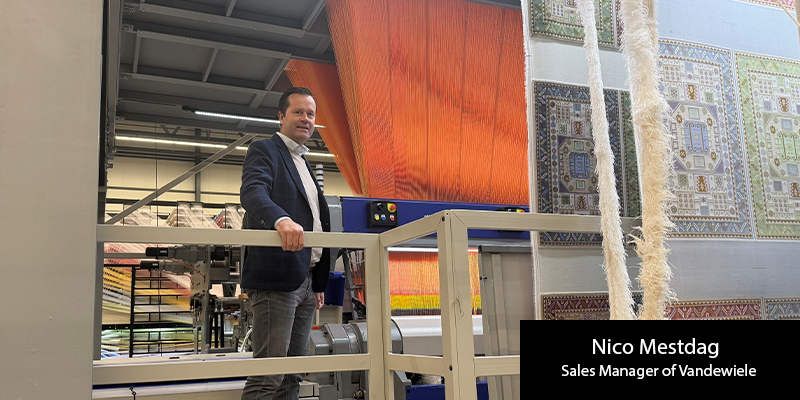
Changing production requirements in the global textile machinery industry are making investments in digitalisation and automation increasingly important. Specialising in carpet weaving and tufting technologies, Vandewiele is responding to this transformation with innovative machinery solutions, integrated electronic systems and data-driven production technologies. In our interview with Nico Mestdag, Sales Manager at Vandewiele Group, we discussed the company’s performance in 2026, its key technological developments, global growth strategy and the changing investment expectations of Turkish textile manufacturers. We also explored the technological trends expected to shape the industry in 2027 and Vandewiele’s priorities for the coming year.
How would you evaluate 2026 for Vandewiele Group? What were the most significant developments, achievements and challenges for the company and the global textile machinery industry throughout the year?
 I would describe 2026 as a year of resilience and focused innovation for Vandewiele Carpet. The market has remained challenging, with inflation, financing costs and geopolitical uncertainty causing some customers to postpone investment decisions. However, we also see that companies are ready to invest when the business case is clear—particularly in solutions that increase output, reduce labour dependency, improve flexibility and minimise waste.
During the year, we further strengthened our position in carpet weaving and accelerated our development in tufting. For us, the key achievement has been to combine innovation with the reliability our customers expect, helping them remain competitive today while preparing for a more automated and data-driven future.
“Every Innovation Must Deliver A Practical Benefit”
What were the most notable new products and technologies introduced by Vandewiele in 2026? Could you tell us more about the key solutions you presented this year and the production needs they are designed to address?
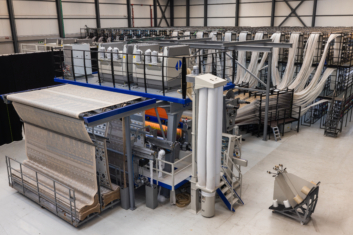
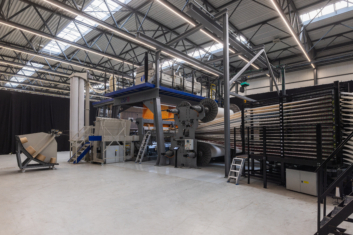 Our innovations in 2026 were centred on three customer priorities: productivity, flexibility and control. In carpet weaving, the RCF platform with Fast Creel supports continuous production, digitally controlled yarn tension, faster style changes and significantly less yarn waste and manual handling.
We also continued to advance our fully digital tufting portfolio. Depending on the application, these solutions can reach speeds of up to 2,500 rpm, with precise electronic control and real-time broken-end detection through the Vandewiele Tufting Sensor.
In addition, our cabling and twisting technology for finer DTY, ATY and FDY yarns opens new possibilities for softer and more differentiated premium carpets. Ultimately, every innovation must deliver a practical benefit: more output, consistent quality, easier operation and a lower total production cost.
What are the latest developments in Vandewiele’s investments and global growth strategy? Which areas are currently receiving the greatest focus in terms of production capacity, R&D and technological development?
Our strategy is to combine global proximity with strong, coordinated R&D. We continue to build our capabilities in Belgium, while expanding production, sales and service close to the world’s main textile regions.
Within the carpet business, our focus is on digital weaving, highspeed tufting, automated yarn handling, integrated electronics and software, and solutions that cover the complete process from yarn preparation to finished carpet.
A major strength of Vandewiele is our vertical integration: machines, drives, electronics, sensors and manufacturing software are developed to work together as one system. Looking ahead, our investments will support faster local service, shorter response times and scalable production, without compromising the quality and long-term support associated with the Vandewiele name.
How are digitalisation, automation and data-driven technologies transforming textile production, and what role does Vandewiele play in this transformation?
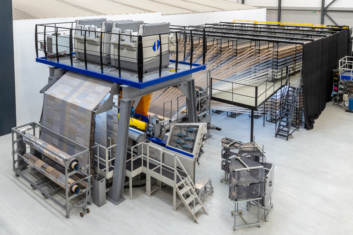 We are moving from controlling individual machines to managing the complete production process. Connected equipment gives manufacturers real-time insight into output, stoppages, quality, energy use and planning, which supports faster decisions and continuous improvement. Vandewiele plays an important role in this transformation by combining digitally controlled weaving and tufting machines with BMSvision manufacturing execution solutions, connecting the shop floor to planning and business systems.
Individual yarn control, intelligent HMIs, automated creels, integrated sensors and data analytics all reduce manual intervention and make quality more consistent. In the coming years, I believe the biggest gains will come from connected production lines, intelligent scheduling, predictive support and practical AI tools that help operators maximise uptime and prevent quality losses.
“Manufacturers Need To Be Able To Produce Complex Structures Economically”
Technical textiles and high-performance textile applications are creating new opportunities for machinery manufacturers. Which emerging applications and market needs are you currently focusing on, and how is Vandewiele adapting its technologies to meet these requirements?
We see considerable potential in areas such as automotive textiles, artificial grass, aviation and contract flooring, cleaning textiles, geotextiles, protective fabrics, spacer and multilayer structures, and high-performance velvet. These applications require much more than speed. Manufacturers need precise yarn control, repeatable quality, the ability to process specialist materials and enough flexibility to produce complex structures economically. We are therefore adapting proven Vandewiele technologies—including three-rapier weaving, individual yarn control, digital tufting and advanced tension management—to meet these requirements. Our approach is very application-driven: we work closely with customers to translate a functional textile concept into a stable, scalable industrial production process.
“Our Strong Local Presence Allows Us To Maintain Close Relationships With Our Customers.”
Istanbul was an important event destination for Vandewiele throughout 2026. How would you evaluate your interactions with customers and industry professionals in Türkiye at ITM 2026 and ICFE 2026?
Both ITM and ICFE once again demonstrated Istanbul’s importance as an international meeting point for the carpet and textile industries. We had valuable discussions with manufacturers from Türkiye, Central Asia, the Middle East and many other markets. The conversations were very concrete: customers are looking for faster weaving and tufting, greater digitalisation, more product flexibility, and solutions that reduce labour requirements and waste.
Turkish manufacturers remain highly entrepreneurial and export-oriented, but investment decisions are increasingly assessed on total cost of ownership, energy efficiency, service availability and speed to market.
We are also seeing growing interest in polyester yarns, hand look and high-density carpets, wider formats, differentiated surface effects and more flexible tufting technologies. Our strong local presence is particularly important because it allows us to remain close to customers before, during and long after an investment.
Looking ahead to 2027, what are your expectations for the textile machinery industry and Vandewiele Group?
Looking towards 2027, we expect a competitive market in which customers remain very disciplined about investment. Technologies will need to demonstrate measurable improvements in output, efficiency, quality and flexibility. Automation, machine connectivity, digital yarn control, energy management and AI-supported process optimisation will continue to gain momentum.
For Vandewiele Carpet, the priorities are clear: we want to reinforce our leadership in woven carpet technology while accelerating our position in tufting. We will focus on higher effective output—particularly for demanding, high-density products—simpler operation, a better digital user experience, more autonomous production and closer integration between machinery, electronics and software. At the same time, we will continue to explore new applications and support customers worldwide through strong local sales, service and long-term partnerships.