“We will Launch Our New Production Facility in 2026”
Interview: Dilek Hayırlı
Serkon Makina is preparing to significantly strengthen its capacity and technological infrastructure with its new production facility, which will be commissioned in 2026. The company, which is taking smart production to an advanced level with AI-supported fabric control systems and integrated spreading-cutting lines, is positioning the ITM 2026 Exhibition as a strategic showcase to present its new generation automation solutions, digital projects, and future vision to the sector.
Serkon Makina, one of Turkey’s leading companies in automated fabric spreading, CNC cutting, and fabric inspection technologies, is making a difference in the textile sector, where digital transformation is accelerating, with its smart production solutions. Re-designing its production processes end-to-end with AI-supported systems, data-driven software infrastructure, and a sustainability approach, the company aims to accelerate its R&D investments in 2025 and further increase its growth momentum with a new production facility planned for 2026. We spoke with Serkon Makina Sales Engineer Sefa Sağyalavaç about the 2025 assessment, technology and R&D projects, ITM 2026 preparations, and global growth strategies.
How was 2025 for your company? How would you assess the demand trends, investment appetite, and general market dynamics for textile machinery, both in Turkey and in international markets, specifically for 2025?
 2025 was a transformative and strategic year for Serkon Makina, both in the domestic market and in terms of exports. Rising global cost pressures, difficulties in accessing labor, and sustainability goals led textile manufacturers to focus on investments in automation, efficiency, and digitalization. In the Turkish market, many textile companies tended to shift their production to alternative markets, particularly due to rising labor and energy costs. However, we observed relatively more vibrant investments in the boutique garment manufacturing, medical textiles, defense industry, and technical textiles segments.
In international markets, particularly in Egypt, Europe, and Central Asia, we can say that demand for AI-powered fabric inspection systems, fully automated fabric laying, and CNC cutting solutions has increased significantly. 2025 marks a period where customers demand not just a “machine,” but end-to-end integrated solutions and sustainable long-term investment models. This approach perfectly aligns with the strategic vision that Serkon Makina has adopted since its inception.
R&D Focus: Artificial Intelligence, Data, and Integrated Manufacturing
In 2025, which projects were the most prominent among those you conducted at your R&D center? How do you evaluate the impact of these projects on your product range and competitiveness?
 In 2025, Serkon Makina’s R&D center primarily focused on intelligent automation, sensor integration, advanced software infrastructures, energy efficiency, and production traceability. Projects enabling more integrated, synchronized, and data-driven operation of fabric inspection, spreading, and cutting lines were at the heart of our R&D activities during this period. The SERKON.AI-based defect detection and color and tone detection systems, which form the backbone of these efforts, constitute the foundation of our new generation control and software infrastructure. Thanks to this infrastructure, our machines have evolved from mere command-following systems into intelligent production solutions that collect data from the production process, analyze this data, and provide decision support mechanisms to the operator. SERKON.AI and Colortron solutions can be integrated with existing fabric inspection machines as well as stenter and sanforizing machines, allowing for the monitoring of quality, color, and tone consistency at different stages of production under a single digital structure.
As a tangible outcome of this approach, the new generation MN3 fabric inspection machine, thanks to its efficiency and reporting infrastructure, allows for the real-time monitoring of critical parameters such as active operating times, downtimes, and fabric usage of spreading lines. It also enables the evaluation of the relationship between detected fabric defects and the pattern to be cut; this structure, with its IoT-based architecture, allows communication between fabric inspection systems and spreading systems.
Our digital twin project, developed as part of our R&D efforts, aims to model cutting parameters, vacuum values, and different production scenarios in a virtual environment, especially in CNC cutting machines. This allows the cutting process to be optimized before it is deployed in the field; the risk of errors is reduced, and data-driven decision-making processes are strengthened.
Furthermore, the FMC30 platform, developed for low-rise cutting, offers a high-performance and economical solution for boutique production businesses and those requiring flexible production, with up to 40% efficiency increase.
Can you give examples of tangible results in your current product portfolio, such as increased efficiency, speed, energy savings, labor savings, or reduced waste rates?
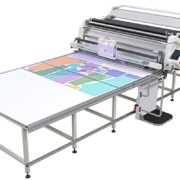
 Throughout the transformation process from manual fabric laying to automated laying systems and then to CNC cutting technologies, Serkon has continuously improved its product portfolio with a focus on efficiency, speed, and sustainability. The automated laying and CNC cutting solutions we offer today provide clear and measurable performance gains in the field. According to feedback from our customers, in highly automated laying and cutting lines, laying and cutting speeds increase by 30-50%, while labor requirements decrease by up to 40%.
This transformation produces even more significant results, especially in businesses transitioning from manual to automated processes. Furthermore, thanks to optimized laying and cutting processes, fabric waste rates decrease by 3-7%, and energy consumption is reduced by 15-20% with new generation systems. All these gains significantly shorten the return on investment period, especially for businesses with high-volume production.
As a company that produced Turkiye’s first fully automatic CNC cutter in 2009, what innovations in CNC cutting technologies have you implemented by 2025? How do you measure the performance differences that these new generation systems provide to businesses?
As of 2025, we have advanced our systems to a higher level focusing on efficiency, quality, and sustainability. Within this scope, we have implemented innovations in our CNC cutting systems such as dynamic vacuum control, automatic brush cleaning, and automatic blade management. These systems significantly contribute to increasing both stability and continuity in cutting processes. Dynamic vacuum control, especially in three-thread brushed and airy fabrics, prevents shape changes, resulting in energy savings and more precise and stable cutting. Automatic brush cleaning and blade management significantly reduce maintenance needs, preventing unplanned downtime.
Serkon’s automated fabric spreading and CNC cutter machines offer significant advantages in terms of speed and accuracy in production. How do the automation and software technologies used in these machines provide tangible benefits to customers in terms of cutting precision, fabric utilization efficiency, and labor optimization?
The software infrastructure used in Serkon machines consists entirely of solutions developed by the Serkon R&D team and specifically optimized for production processes. These software solutions ensure maximum fabric utilization efficiency by planning cutting paths in the most efficient way; minimizing human error throughout the entire process, from fabric inspection to laying and cutting. Thanks to the flexible software structure developed according to user needs, labor optimization and process repeatability are significantly increased. In terms of maintenance, the modular machine structure, free remote diagnostic capabilities, and durable component selection shorten planned maintenance times and significantly reduce unexpected downtime. In terms of energy performance, high performance is achieved through intelligent motor control and optimized vacuum systems, while aiming for low energy consumption.
“ITM 2026 is a Strategic Meeting Point for Us to Reflect Our Technology Vision”
ITM 2026 Exhibition will be one of the most important meeting points of the sector. As Serkon, how is your preparation process for the fair progressing? Are there any new products, technologies or innovative R&D projects that you plan to launch?
ITM 2026 is more than just a trade exhibition participation for Serkon; it will be a strategic meeting point where we reflect our technology vision and future strategy to the industry. Our preparation process is progressing systematically and intensively, with coordination between our R&D, production, and marketing teams. At the exhibition, we aim to showcase our smarter, more integrated, and more sustainable next-generation automation solutions to industry professionals. We plan to present solutions that represent a new level in Serkon’s understanding of automation, particularly focusing on AI-powered fabric inspection systems and automated labelling and control systems. We will share more details closer to the fair; however, we can already say that ITM 2026 will be a platform where Serkon will showcase not only its products but also its future vision.
What are some key points you can share regarding your capacity increase, production line modernization, or new investment plans? What strategic steps are included in your roadmap for the 2026-2027 period?
At Serkon Makina, we operate in our current 8,750 m² production facility with a high-tech and flexible production infrastructure. To take this infrastructure to the next level, we are implementing a new facility investment that will expand our production area to 20,000 m². We plan for our new facility to be fully operational by 2026. Along with this growth process, our priority investment areas in the coming period include further digitalization of production lines, capacity increase, and expansion of R&D and testing areas.
Could you provide information about your target new markets, global growth strategies, or international collaborations for the upcoming period?
At Serkon Makina, we are structuring our global growth strategy around a selective market approach, strong local collaborations, and long-term sustainability. Our goal is not only to enter new markets but also to position ourselves as a permanent, reliable, and solution partner in the markets where we operate. In the coming period, we anticipate a significant increase in our overseas sales, particularly in the Middle East, North Africa, Eastern Europe, and Central Asia regions. We observe a rapidly increasing demand for highly automated solutions focused on efficiency and energy savings in these markets. Our end-to-end integrated solutions, especially those for slaughterhouses, are strongly aligned with the current and future needs of manufacturers in these regions.
A significant pillar of our global growth strategy is our local distributorship structures, strong technical service infrastructures, and strategic collaborations. At Serkon, we consider after-sales service, technical support, and training processes an integral part of growth. This approach significantly contributes to the sustainable and healthy growth of our brand in international markets.