Archroma Reaches the Top with Both the EcoVadis Gold Rating and the ITMF Innovation Award
Archroma has achieved two significant successes on the global stage with its sustainability-focused efforts and innovative technologies. While the company received the EcoVadis Gold Rating for the second consecutive year thanks to its sustainability approach integrated into its operations, it also became the winner of the ITMF 2025 Sustainability & Innovation Award with the revolutionary Denim Halo process that reduces the environmental impact of denim production.
Archroma Awarded the EcoVadis Gold Rating for the Second Consecutive Year
 Archroma, a global leader in specialty chemicals toward sustainable solutions, has been awarded a Gold rating by EcoVadis for the second consecutive year. This achievement places Archroma in the top 5% of more than 150,000 companies assessed across 150 countries and 250 industries.
EcoVadis, a leading organization in business sustainability ratings, evaluates companies according to strict criteria covering environment, labor and human rights, ethics, and sustainable procurement. The Gold rating reflects Archroma’s progress in integrating sustainability into every stage of its operations and value chain.
Archroma CEO Rajiv Sharma said: “Our company is built on sustainable innovation, and this recognition reflects our ongoing efforts toward purpose-driven leadership. Our strategy—from innovations to operational excellence—focuses on providing measurable impact and long-term value for our customers, our communities, and the planet.”
Rajiv also added: “The double materiality assessment strengthens our commitment to stakeholder engagement, ESG integration, and responsible growth. We will continue to align purpose, innovation, and accountability at every level of the organization.”
Archroma Wins the ITMF Sustainability & Innovation Award
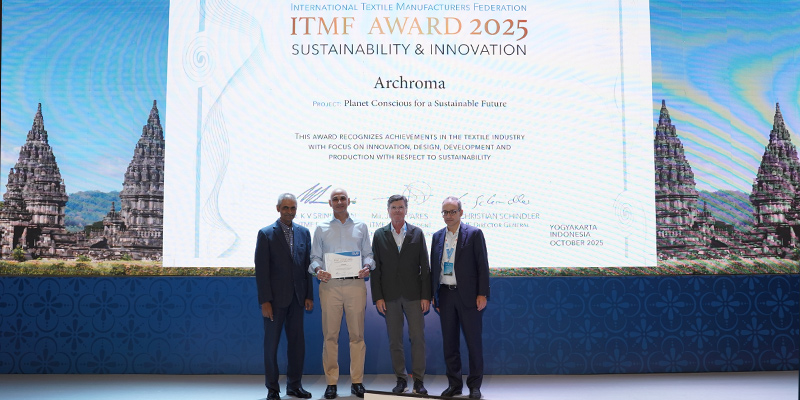
Archroma has won the International Textile Manufacturers Federation’s (ITMF) 2025 Sustainability & Innovation Award with Denim Halo, a revolutionary denim pretreatment and dyeing process.
This process offers brands and mills a simple way to produce the highly demanded distressed denim looks with significantly reduced environmental footprint and cleaner chemicals.
Archroma’s Vice President of Commercial, Dhirendra, said: “Archroma believes in challenging the status quo. Under our planet-focused roadmap, we seek solutions that not only advance sustainability but also fuel the creativity and profitability of textile manufacturers. Denim Halo is an example of this approach. We are honored to be recognized by ITMF. Working with manufacturers around the world, we are demonstrating that superior sustainability and superior product quality are not alternatives to each other—they are in fact the same goal.”
Distressed denim, a consumer favorite for decades, is more popular than ever. However, achieving the much-desired worn and faded look remains problematic, involving manual scraping, hazardous potassium permanganate sprays, or energy-intensive stone-washing processes. Traditional indigo and sulfur dyeing processes also increase the burden due to water and energy consumption and significant wastewater discharge.
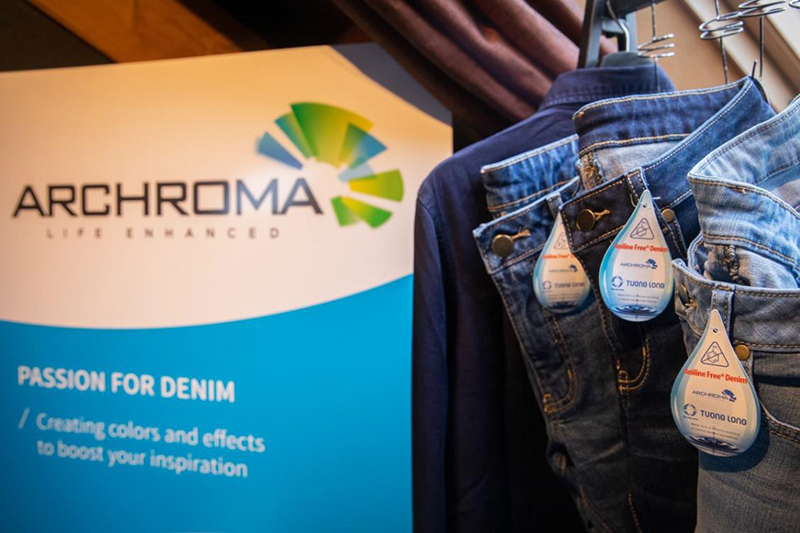
Denim Halo is a groundbreaking alternative. It uses DIRSOL® RD, a unique new chemistry, and a wide portfolio of textile dyes based on decades of advanced research to create laser-friendly denim that provides superior contrast in deep black and indigo shades. DIRSOL® RD acts as a new viscosity regulator and patented pretreatment that enables surface dyeing while reducing water, energy, and greenhouse gas emissions in processing and washing. In Denim Halo, it is combined with an Archroma dye solution tailored to the specific production needs of the mill:
• DENISOL® pre-reduced indigo dyes, including the innovative aniline-free formulation;
• DIRESUL® pre-reduced sulfur dyes, including the energy-saving black formulation; and
• EarthColors® dyes made from agricultural waste in biosynthetic earth tones.
Impact assessments conducted using Archroma’s ONE WAY Impact Calculator show significant environmental benefits for Denim Halo compared with standard processes, with ZDHC Level 3 MRSL compliance. Results include 40–56% water savings, 30–36% energy reduction, and 33–34% CO₂ emission reduction depending on the dye formulation used.
The benefits extend beyond sustainability to safety and economics. Mills can produce distressed effects without changing standard dye recipes or equipment settings. The process enhances worker safety by enabling high-contrast laser finishing and eliminating potassium permanganate and manual scraping. Denim Halo also reduces caustic soda consumption in sulfur mercerization and allows easier washing. Technical advantages include reduced yarn shrinkage and improved garment abrasion resistance, with less chemical use in dyeing and finishing, especially for black denim.