“We Suitor to Manage IHKIB with the Common Mind of 200 People”
Interview: Dilek Hayırlı
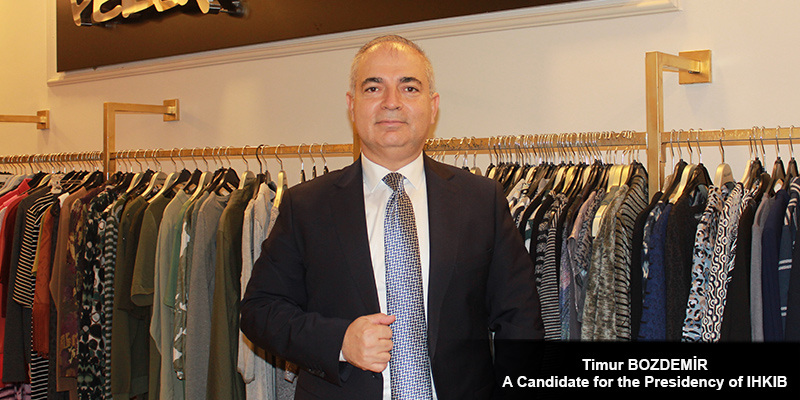
Timur Bozdemir, a candidate for the presidency of Istanbul Apparel Exporters’ Association (IHKIB) aims for a fundamental transformation in the sector with his 20 years of textile experience and economic perspective. Bozdemir states, “Instead of selling a $90 product for $20, we must establish a value-oriented strategy. We envision an IHKIB where every member has a voice, and which is managed transparently, participatively, and with common mind.”
Timur Bozdemir, who has been actively involved in the textile industry for approximately 20 years and is also notable for his background as an economist, is running for the presidency of the Istanbul Apparel Exporters’ Association (IHKIB) this term. Setting out with the goal of a transparent auditing system, participatory governance, and a fair election process, Bozdemir states, “We must manage a large organization like İHKİB not with just a few individuals, but with a broad team of 200 people who share a common vision.” We spoke with İHKİB Presidential Candidate Timur Bozdemir about his candidacy and projects.
We know you as an economist and for your visionary perspective. But what was your journey like to get to this point?
I was born in Malatya in 1974 and grew up in Istanbul. I am married and a father of three. I started my career as a bank inspector, then worked as a manager in the real sector. I have been in the textile industry for about 20 years and I also operate in the tourism sector. I love textiles because creating a product, seeing the result, and knowing that it works gives me great satisfaction. Textiles are the right field for me because it offers the opportunity to combine science and practice. Despite the challenges in the market, I do not intend to leave textiles.
You have a foreign trade company and export textiles. What kind of products are in your portfolio? Which countries do you export to?
Our product portfolio is centered on women’s outerwear, and we make a point of maintaining our expertise in this area. Today, we export to approximately 25 countries. While our export network is primarily focused on Europe, the Americas are our strategic target market. Having our own office in New York allows us to carry out targeted strategies for this market. The U.S. has a population of 350 million, and including Canada and South America, the total market potential reaches 500 million—a large and strong market that we are focusing on.
In Turkiye, mass production is being abandoned due to rising costs; therefore, to maintain profitability, we are shifting towards products made with more technical and specialized fabrics. In addition to our own facilities, we also undertake contract manufacturing. Cutting, embroidery, digital printing, sewing, packaging, and export procedures are all managed within our own control system. This allows us to maintain quality and offer our customers fast and flexible solutions.
How did you decide to run for the presidency of IHKIB?
In the previous term, I was a member of the board of directors. However, I realized in practice that neither the board of directors nor the audit committee was functioning effectively. Together with five of my colleagues, I resigned from the board. It was again at the insistence of these colleagues that I decided to run in this term.
“Making the Right Decisions Requires Common Mind”
During your candidacy, you have called for “thinking together.” If you are elected president, what will your management style be?
It is technically impossible for a large institution like İHKİB to be managed solely by the board of directors. In fact, the regulations allow for the inclusion of industry representatives and civil participation in the working committees. For this reason, I am calling for “electing not a president, but a management team.” Because in order to make the right decisions, collective intelligence, diversity of voices, and participatory governance are needed. It is clear in civil society that no single person’s judgment can be superior to everyone else’s. Therefore, we will strengthen our committees with colleagues from within the industry as well as from civil society. The board of directors will function as defined by law, but each board will have an actively working committee underneath it. In this way, instead of making decisions with just two people, we will manage decision-making processes with a broad team of around 200 people, creating a healthier and more inclusive management approach.
What steps will you take to ensure transparency in governance?
We will ensure complete transparency in our governance. We want independent auditors to participate in our meetings, and we want external experts, not just the official audit board, to prepare monthly reports. We are determined to establish a system where complete transparency is ensured.
“Anyone Who Exports Even One Cent Should Also Have the Right to Vote”
“You say, ‘Those who export even one cent should also have the right to vote.’ What was your reason for saying this?
There is a proverb from my hometown: It takes one bad apple to spoil the (whole) bunch. Yes, if we do something right, the friends around us who walk together with us will pick it up, either from our character or from our example. Our claim is simple: if a company exports and makes payments to IHKIB, it should have a say in the management. Currently, IHKIB has 24,000 members, but only 2,500 companies are eligible to vote. If a company is required to make mandatory payments to the union while exporting, it should also have the right to determine the management. Under the current system, companies exporting less than 35,000 dollars are ‘not considered exporters,’ yet membership fees are still collected from them. This is a serious contradiction. Moreover, the voting process is complicated and tied to unnecessary bureaucracy. The member’s registration already exists, so why is additional documentation required? In national elections, we vote with an identity card; why can’t we do the same in exporters’ unions? We will change this: on election day, anyone who comes with their ID will be able to cast their vote.”
I see you’re actively involved in the field. How are you preparing for the election?
We are constantly visiting companies with our team of 50 people. We listen to the problems of our companies and try to find solutions together. We also meet with our sector stakeholders every Saturday at the Sentez Business Center in Merter. Our door is open to everyone, and we welcome all sector representatives to our meetings.
In an interview, you said, “We sell a 90-dollar product for 20 dollars.” In your opinion, how can a value-oriented strategy—rather than a production-oriented one—be built to reverse this situation?
“I believe that to overcome the problem of selling a 90-dollar product for 20 dollars, we need to build a value-driven strategy instead of a production-driven one. The key to this lies in creating a strong Made in Turkiye brand. For years, ‘German-made’ or ‘imported’ products were synonymous with quality; now it is time to associate our own country’s name with quality. In ready-to-wear fashion, we have very significant advantages to achieve this. Our rich culture, tolerance, hospitality, multicultural structure, and unique assets—from Ephesus to Cappadocia—add an extraordinary story to our products. When we combine these elements with our designs, we are not just selling a product, but an emotion, a memory, and a value. This, in turn, increases the true value of the product. That is why we will invest particularly in the Made in Turkiye brand.”
“I Believe the Industry will Start to Breathe Again within the Next 2–3 Years”
The Turkish ready-to-wear industry is one of the areas where global competition is felt most intensely. As of today, what do you think is the main “structural” problem of the sector? (Price pressure, access to finance, production quality, branding, etc.)
In my opinion, one of the biggest problems of the sector is the inadequacy of the legal and regulatory framework. Without updating certain regulations—such as labor laws and Central Bank policies—it is not possible for Turkiye to strengthen its position in the ready-to-wear industry. Another major issue is the lack of clear target market strategies. Sales to the United States, Europe, Asia, or Africa should be addressed as a national policy. Since exporters bring net capital inflows into the country, they should be differentiated from other sectors, and their access to finance should be reorganized accordingly. Existing instruments, such as Eximbank, should be used effectively and should not create unnecessary burdens. While sufficient funds cannot be allocated to Eximbank, I do not believe that there is currently a need for a second bank—such as the Turkish Trade Bank—that is not functioning effectively and only generates operational costs. The burden of this bank falls on exporters’ associations, and in my view, these associations simply do not have the capacity to carry such a burden.
So, how do you evaluate the state of the textile industry over the last year or two? Is a turnaround possible? Will there be a recovery? What are your predictions regarding this?
Recovery is possible from any bad situation. We know this from the founding of the Republic; Atatürk and his colleagues managed to build a country from scratch against disbanded armies and the whole world. Recovering the textile industry is at least as possible. It requires progressing on two fronts simultaneously: solving small problems one by one and addressing macro issues from above. With IHKIB’s administrative units and its expanding management team, this is achievable. I believe the sector will start breathing again within 2-3 years.
Recent economic fluctuations have led to an increase in bankruptcy filings and rising unemployment rates in the textile sector. On the other hand, it’s noteworthy that many manufacturers are relocating their production facilities to Egypt. How would you interpret this situation in terms of overall economic balance and the future of the sector?
In recent years, the rise in bankruptcies and unemployment in the textile sector, along with some manufacturers turning to Egypt, has been noteworthy. As long as I and those who think like me continue to make our voices heard, we don’t need to fear this negative trend. The main problem here is that those who want to produce in their own country are being silenced. Those who close their factories and go to other countries are not guilty; the fault lies with the system that remains silent about this situation. Our duty is to solve the obstacles faced by manufacturers and to strengthen the intention to produce in Turkey. This can be achieved through regional regulations, such as minimum wage adjustments, and by providing local infrastructure and support. There are thousands of people who say they would rather live in their district or village and earn $500 than $1000 in Istanbul; this desire should not be stifled. The simplest thing to do is to stop the shift to Egypt and revive the intention to produce in Turkey. A country survives on factories, not cafes; we must reiterate this truth to manufacturers and the sector.
“We Did It… But We’re Very Tired”
If you take office, what three concrete steps do you plan to take in the first 100 days for the structural transformation of IHKIB?
We plan to take three concrete steps in the first 100 days of taking office: Firstly, we will present our proposals regarding legal regulations. Secondly, we will restructure trade delegations and, if possible, work with 30 committees. Thirdly, we will initiate efforts to establish free trade agreements and meeting points with target markets. We will also open the Digital Transformation Center and the Istanbul Fashion Academy to the sector.
If you win the election, what sentence would you like to say when you look back in 2028?
If we win, the sentence I would like to say in 2028 would be “We did it,” but I would add one more sentence: “We did it, but we were much more tired than we expected.” Because when those who aim to accomplish things emerge, some will try to slow down or obstruct the process. However, the truth will find its way sooner or later; like a dam built in front of water, every obstacle will be overcome in time. Also, we have a strong and well-prepared board of directors that we haven’t yet shared with the media. We will introduce our board of directors to everyone during election week.