Uster Offers A Comprehensive Solution Porfolio For The Turkish Market
Interview: Tuğba KARADEMİR
Uster Technologies stands out as a strategic partner in the Turkish textile market with its integrated solutions that connect quality data from fiber to yarn and beyond. Supporting the efficient processing of recycled fibers, Uster helps local manufacturers in Turkey enhance quality, reduce waste, and boost their international competitiveness. At ITM 2026, the company aims to showcase these integrated solutions.
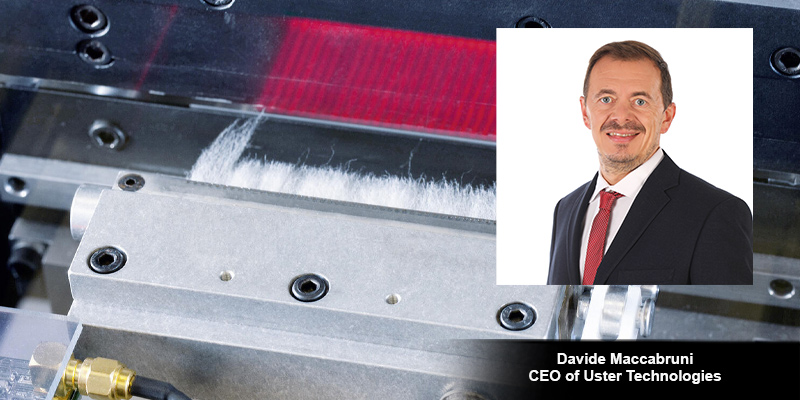
In an exclusive interview conducted for Tekstil Teknoloji Magazine, we spoke with Davide Maccabruni, CEO of Uster Technologies, about the company’s strategic direction and its growth objectives in both the global and Turkish markets. Maccabruni elaborates on Uster’s continuous development, detailing its innovative solutions—from advanced technologies that optimize spinning processes to the efficient processing of recycled fibers. He also highlights the company’s commitment to sustainable production practices and explains how they contribute tangibly to helping manufacturers in Turkey improve quality, reduce waste, and strengthen their international competitiveness.
How was the year 2025 for Uster? Could you evaluate your performance in terms of sales, market dynamics, key export markets, and overall development of your solution portfolio?
 2025 was a year of gradual stabilization following the slowdown in the previous period. We saw solid performance in Asia, where investments in modernization, automation, and sustainability continue to drive demand. In other regions, market dynamics remained more subdued, with cautious investment behavior and slower recovery. Türkiye remains a strategically important market with strong long-term potential, but current conditions are still challenging. Overall, the industry is clearly shifting from capacity expansion towards smarter investments focused on efficiency, quality, and traceability.
For Uster, this environment confirmed the relevance of our strategic direction. We continued to strengthen our solution portfolio, moving from standalone instruments towards integrated quality management systems. By connecting quality data across the textile value chain, we enable our customers to improve performance, reduce waste, and make better-informed decisions.
“We Deliver Measurable Improvements in Performance, Efficiency and Sustainability”
Uster was celebrating 150 years of leadership in textile quality solutions. As you move from traditional instruments to integrated end‑to‑end quality management systems, how has this transformation influenced your customer relationships and value proposition?
Uster’s 150th anniversary reflects continuous adaptation to customer needs and industry change – an evolution very much aligned with Darwin’s principle of staying fit in a changing environment. Over time, Uster has moved from supplying instruments to becoming a trusted partner. Today, we increasingly act like a “family doctor” for textile mills: not only measuring quality, but advising on how to improve it across the entire process. This transformation strengthens customer relationships and shifts our value proposition from products to solutions – delivering measurable improvements in performance, efficiency, and sustainability.
Uster introduced its new fiber process control system in 2025. What unique advantages make AFIS 6 the indispensible control instrument?
Spinners aim to preserve the quality of valuable incoming fiber throughout the entire process. Uster AFIS 6 supports this by providing detailed analysis at every stage – from bale to roving – ensuring full process control. A key advantage of the latest generation is its ability to measure not only cotton but also 100% synthetic fibers and blends within the same system. This reflects current market needs, where fiber mixes are becoming more complex. AFIS 6 delivers reliable, consistent data that enables better blending, reduced waste, and improved yarn quality.
Sustainability and circular economy are becoming central in textile production. How is Uster contributing to these important aspects in spinning?
Recycled fibers are no longer a niche – they are becoming a structural component of textile production. However, their variability makes quality control more challenging. Uster contributes by enabling precise measurement of key parameters such as fiber length, nep content, fineness, and maturity – even in recycled materials. This allows spinners to better control blending and optimize processes. More broadly, by connecting quality data along the value chain, we support more efficient use of resources, reduced waste, and more consistent output – the key elements of a circular textile economy.
“Türkiye is a strategically important market for Uster”
Türkiye is an important textile hub with dynamic spinning and fabric industries. What is Uster’s strategy for the Turkish market, and how are your systems helping local manufacturers enhance quality, reduce waste, and increase competitiveness?
Türkiye is a strategically important market for Uster, with a strong, vertically integrated textile industry and a clear focus on quality and export competitiveness. Our strategy is to support Turkish manufacturers in moving further up the value chain. We do this by providing solutions that connect quality data from fiber to yarn and beyond, enabling better process control and faster decision-making. This helps reduce waste, improve consistency, and meet increasingly strict requirements from international customers. At the same time, we maintain close local engagement – through service, application support, and training – to ensure that our technologies are fully leveraged in daily operations.
ITM 2026 will bring together leading textile machinery and technology providers from around the world. How is Uster preparing for ITM 2026, and what novelties, demonstrations, or innovations will you showcase at the exhibition?
Trade fairs like ITM are important moments to engage directly with customers and partners, and to exchange perspectives on industry developments. At ITM 2026, we will present further steps in our transition towards integrated solutions, including new features for our laboratory instruments. While I will not disclose details at this stage, the focus will be on enhancing usability, expanding data connectivity, and delivering additional value through quality intelligence. We look forward to welcoming visitors in Hall 7, Booth 714B, and to continuing the dialogue on how quality and data can drive the next phase of textile manufacturing.