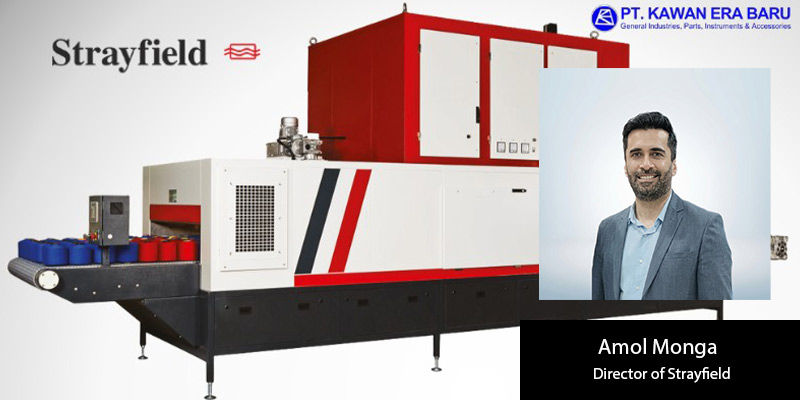
RF Drying: Driving Energy Optimisation and Decarbonisation in Textiles
Interview: Tuğba KARADEMİR
Strayfield Director Amol Monga notes that investment priorities in the textile machinery industry are shifting away from initial equipment costs towards long-term operational efficiency, energy optimisation, process control and decarbonisation. Highlighting the advantages of RF drying technology in terms of fast and uniform drying, precise moisture control and energy efficiency, Monga also points to the significant opportunities RF technology offers for the processing of next-generation fibres.
Energy costs, sustainability targets and production efficiency continue to be key factors in textile machinery investments. This transformation is increasing the need for more precise, energy-efficient and automation-ready technologies, particularly in drying and thermal processing. With more than 50 years of experience in RF heating and drying technologies, Strayfield is also focusing on energy optimisation, one of the key areas of this transformation, through the solutions it develops. The company’s RF technology stands out by offering fast and uniform drying, precise moisture control and consistent product quality across different fibre types. In our interview with Strayfield Director Amol Monga, we discussed investment trends in the textile machinery industry in 2026, the advantages offered by RF drying, the contribution of the new 40 kW dryer to energy efficiency, and the potential of RF technology for processing sustainable fibres.
How does Strayfield assess the textile machinery industry in 2026? What changes are you observing in manufacturers’ investment priorities, particularly in drying and thermal processing technologies?
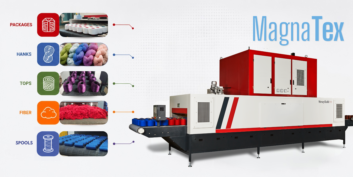
Strayfield sees the textile machinery industry rapidly moving towards greater energy efficiency, sustainability and automation. Manufacturers are increasingly focused on optimising production while reducing energy consumption. Automation between dyeing and drying is also becoming an important area of development.
Investment priorities are shifting from initial equipment cost towards total operational costs, decarbonisation, reliability, process control and consistent product quality. Manufacturers are increasingly evaluating equipment based on long-term efficiency, performance and its contribution to production optimisation.
Strayfield participated in ITM 2026 in Istanbul from 9–13 June. How would you evaluate your experience at ITM 2026?
Türkiye remains an important market for Strayfield and an important reference base globally. ITM 2026 provided an opportunity to connect with customers and industry stakeholders from Türkiye, Central and South Asia, North Africa and Europe. The event highlighted growing demand for advanced drying technologies that improve production efficiency and meet evolving manufacturing requirements.
“RF Drying Combines Speed with Uniform Moisture Removal”
Strayfield has more than 50 years of experience in Radio Frequency (RF) heating and drying technologies. What are the key advantages of RF drying compared with conventional textile drying technologies?
RF drying combines rapid drying, uniform moisture removal, gentle product treatment and efficient energy utilisation. Strayfield RF dryers provide consistent drying across yarns, fibres, hanks, tops and blended materials.
Key benefits include faster production, uniform moisture distribution, gentle drying, consistent product quality and efficient power transfer through Strayfield’s Balanced Output Design. RF technology can process materials including cotton, polyester, acrylic, wool, viscose and blends, with systems available from 25 kW to 125 kW. The 125 kW system has a published cotton capacity of 375 kg/hr. For more information: RF Dryer for Textile
In January 2026, Strayfield introduced its new 40 kW textile dryer, offering the same drying speed and 50 L/hr output with 15% higher energy efficiency and a 30% smaller footprint. How can the new dryer help textile manufacturers reduce energy costs while maintaining production performance?
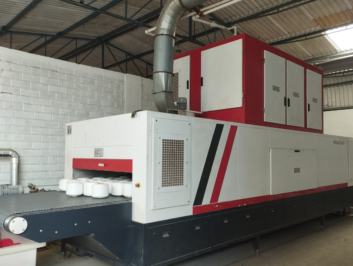 The new 40 kW dryer was developed to deliver the same drying performance in a more compact and energy-efficient configuration. It offers a 30% smaller footprint, enabling easier integration into existing production lines and retrofit layouts.
The system provides the same evaporation capacity while reducing reliance on auxiliary heating. For selected products, this can reduce energy costs by about 15%. Auxiliary steam or electric heating remains optional where specialised fibres require it.
For selected products, energy costs can be reduced by about 15% by avoiding or reducing auxiliary heating. Optimised RF heating provides the required drying performance while reducing reliance on auxiliary steam or additional electric heating.
Energy efficiency is becoming a decisive factor in machinery investments. How does Strayfield approach energy optimisation in its latest RF drying systems?
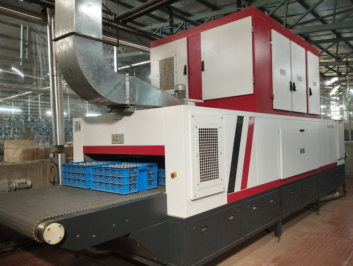 Strayfield optimises energy use through direct volumetric heating, transferring approximately 80–90% of RF energy directly into water molecules. Double Electrode Balanced Output and Flat Electrode Technology improve energy distribution, while welded structures reduce RF leakage.
Automatic electrode adjustment continuously regulates power according to changing moisture levels. Faster processing, instant start/stop, higher throughput and precise moisture control further improve productivity and reduce energy waste.
RF enables faster processing, instant start/stop and higher throughput while using targeted energy transfer. Precise moisture control helps prevent wet spots, defects and inconsistent results, improving overall productivity and product quality.
Strayfield has recently explored the use of RF technology for banana fibre drying, highlighting faster and more uniform moisture removal. What opportunities do you see for RF drying in processing new-generation fibres and sustainable materials?
RF drying offers strong potential for sustainable and new-generation fibres such as banana and hemp. Volumetric heating removes moisture throughout the fibre mass, preventing localised burning and outer crusting.
Controlled drying helps preserve natural strength and texture, while processing can be two to twenty times faster than conventional hot-air drying. The fully electric process also eliminates fossil-fuel use and reduces waste heat.
“Greater Electrification and Automation to Take Centre Stage from 2027 Onwards”
Finally, how do you see the future of textile drying and thermal processing technologies in 2027 and beyond? What new products, technologies or applications is Strayfield currently developing?
From 2027 onwards, textile drying is expected to move towards greater electrification, energy efficiency, automation and hybrid systems. RF can support decarbonisation by directly targeting moisture rather than heating surrounding air.
Key developments for Strayfield MagnaTex include hybrid RF/hot-air or RF/IR systems, advanced volumetric heating, real-time moisture control and solid-state RF generators. Strayfield is also developing applications including banana fibre drying, high-throughput RF defrosting, chemical-free disinfestation, spice and fresh-food pasteurisation, ceramics and fibreglass.
Strayfield continues to expand applications of volumetric RF heating and drying, focusing on energy efficiency, automated processing and sustainable solutions. Current areas include banana fibre drying, high-throughput RF defrosting, chemical-free disinfestation, spice and fresh-food pasteurisation, ceramics and fibreglass.