400 Million Dollars Fund Support for the Textile Sector Led by Inditex
A fund designed by the World Bank Group—led by Inditex, the owner of brands including Zara, Zara Home, Massimo Dutti, Pull&Bear, Bershka, Oysho, and Lefties—and managed by SIMA, will provide long-term financing to textile, apparel, and footwear manufacturers in emerging markets.
The fund, which also covers Türkiye, has been structured around two sub-funds: one will provide loans directly to textile and apparel manufacturers, while the other will finance energy service companies and distributed energy developers working with these suppliers.
Manufacturers in the European Union are excluded from the programme. Suppliers in Inditex’s key production regions, including Türkiye, Morocco and China, will be eligible for funding.
The World Bank Group and Inditex are among the fund’s leading investors, alongside FMO, Proparco, British International Investment, the Global Environment Facility (GEF) and the Apparel Impact Institute.
Social Investment Managers & Advisors LLC (SIMA) and the International Finance Corporation (IFC), a member of the World Bank Group focused on private-sector development, are launching the Decarbonization of Textile, Apparel & Footwear Suppliers (D-TAFS) Fund.
As the first initiative of its kind, the fund is designed to finance the transformation of textile, apparel and footwear supply chains, particularly small and medium-sized enterprises (SMEs). It aims to mobilise $400 million in funding. By expanding access to finance for manufacturers across the textile value chain in emerging markets, the fund seeks to increase investment in projects that reduce environmental impacts.
IFC, with a commitment of $60 million, and multinational textile company Inditex, with $50 million, will be the largest investors in D-TAFS. Other investors include FMO (the Netherlands), Proparco (France), British International Investment (the United Kingdom), the Global Environment Facility (the United States) and the Apparel Impact Institute (the United States). The fund is expected to reach $225 million at its first close. Further fundraising rounds will be conducted to reach the $400 million target and bring additional investors on board.
D-TAFS aims to address this financing gap through a blended finance approach that combines commercial capital with development finance. The fund will provide debt financing on preferential terms, tailored to the needs of suppliers in developing countries. This financing will be accompanied by technical assistance to help borrowers identify, structure and implement their projects.
The fund will support projects at different stages of the supply chain, from apparel manufacturers to yarn and fabric suppliers. Financing will be made available to manufacturers across Asia, the Middle East, North Africa and Latin America.
Impact in Emerging Markets
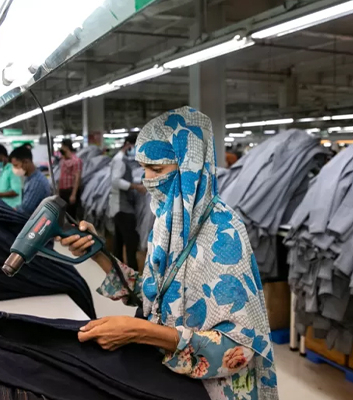
More than 60 million people, the majority of them women, are employed in textile and apparel manufacturing in emerging markets. The sector is facing increasing pressure to improve energy efficiency and reduce emissions. However, a significant proportion of the SMEs that make up these supply chains lack access to the financing needed to invest in new technologies that would help them reduce their environmental footprint.
Sarvesh Suri, IFC Regional Vice President for Asia and the Pacific, highlighted the structural challenge this fund is designed to address: “Small and medium-sized suppliers are the backbone of global brands’ supply chains and need access to affordable, appropriately structured financing to remain competitive.” He added that “this new fund brings together leading brands, investors and suppliers around a common solution: mobilising capital to improve productivity, energy efficiency and operational resilience, and contributing to the maintenance of quality jobs.”
Financing for Targeted Investments and Measurable Results
The fund will finance projects that contribute to reducing greenhouse gas emissions, improving energy and water efficiency, and lowering the environmental impact of the textile industry. Eligible projects will include the installation of renewable energy systems, replacement or upgrading of machinery, improvements to boilers and other equipment, optimisation of production processes, water reuse and wastewater treatment. The fund will also support initiatives aimed at improving chemical management in textile manufacturing.
Each company applying for financing will be required to submit a structured plan identifying its factory’s needs, planned investments and associated environmental targets. The feasibility of each project will be assessed, and indicators will be established to monitor investment progress and measure results.
Óscar García Maceiras, Chief Executive Officer of Inditex, underlined the collaborative intent behind the initiative: “Transforming the textile supply chain requires the industry to work together and for manufacturers to have access to both the technical knowledge and the necessary financing to make investments.” He noted that Inditex is already working with its suppliers to understand factory-level needs and develop specific transformation plans, and that D-TAFS “can help take the next step” — turning identified improvements into actual investments and measurable results.
To ensure the fund’s effectiveness, an accountability process will be conducted every four months. As part of this process, the environmental outcomes achieved through the financed measures will be reported and analysed, with a particular focus on measuring emissions reductions.
Asad Mahmood, CEO of SIMA Funds, commented: ” Factory owners may know they need to replace a boiler or invest in renewable energy, yet without a customised loan structure, appropriate terms and implementation support, those projects can be relegated to mere theoretical studies.” He described D-TAFS as “a financially attractive and scalable solution” built on SIMA’s experience supporting sustainable solutions in this value chain, and emphasized that the fund is “not just about financing — it is about demonstrating that it is possible to achieve climate impact, meet market demands and strengthen competitiveness and resilience at the same time.”