
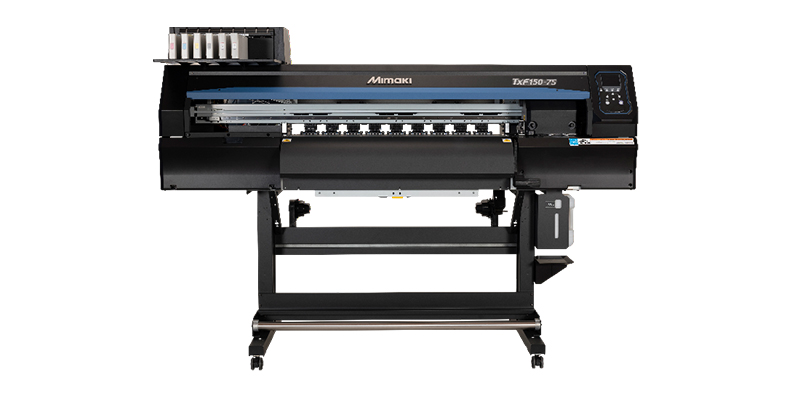
First Direct to Film Inkjet Printer for Textile Applications from Mimaki: TxF150-75
Mimaki, is one of the leading manufacturer of inkjet printers and cutting systems, announces its first ‘direct to film’ inkjet printer the TxF150-75, which designed for customizable textile applications at its Global Innovation Days event. The new machine will be sold by Mimaki Eurasia in Turkey as of April, along with the world.
Utilising a heat-based transfer method, the TxF150-75 is ideal for creating premium, customised merchandising, sportswear, and various other promotional textile applications. This is the latest entry from Mimaki for the decorated apparel segment made its EMEA at-show debut at Printwear & Promotion Live in the UK (26th-28th February 2023).
Based on Mimaki’s existing 150 Series, one of its best-selling models and equipped with Mimaki Core Technologies, the new TxF150-75 also puts an end to many problems in the DTF market.
Built-in ink circulation system and degassed ink pack design prevent common DTF issues, such as poor ink ejection and white ink clogging. These core technologies, which also include the nozzle check unit and nozzle recovery system, all ensure that processes are carried out efficiently with minimal intervention needed. The TxF150-75, which can be fed with rolls weighing up to 45 kg, comes with Rasterlink7 RIP Mimaki’s software as standard. In addition, the TxF150-75 DTF inkjet printing machine can produce 80 cm-wide printed DTF sheets with a print speed of up to 3.3 m2 per hour and a print resolution of up to 1440 dpi.

PHT50 transfer pigment ink, which is not harmful to health and the environment
Mimaki also developed the PHT50 transfer pigment ink for users as well as, the new TxF150-75 DTF inkjet printer. This dye, that consisting of five colors (CMYK and White), can be used safely in all textile products. Apart from the properties of the paints, Mimaki has also made changes to its packaging to meet the new requirements. Inks offered in deaerated aluminum packages do not cause paint spraying problems and provide users with a stable printing process.
Environmentally friendly PHT50 transfer pigment inks do not contain harmful ingredients. As of March 2023, these inks are OEKO-TEX® Eco Passport certified, guaranteeing safety and environmental standards are met in line with Mimaki’s sustainability pledges. With the certificate, it will be confirmed that the original Mimaki dyes are environmentally friendly, while at the same time it will be documented that the final textile product is not harmful to the health of the customers.
Mimaki Eurasia Regional Sales Manager Hüseyin Şarerler said that DTF printing is a method quickly adopted in the textile and decorated apparel industry. Şarerler stated that screen printing is still widely used in the clothing market, but this requires molds that are not suitable for low volumes and special productions. Şarerler continued his words as follows: “Besides the high production cost, preparing molds in this method requires a long time and effort. In heat transfer management, where rubber layers are used, the unnecessary parts of the transfer have to be removed manually while fixing the printed design to the fabric. In other words, this method is not as effective as desired. On the other hand, DTG (direct-to-garment) printing, which has been widely used in recent years, eliminates the need for molds, and the fabric needs to be pre-treated, and the operator must perform the process manually at every step.”
“We’re excited to introduce this product to the market, which excels in quality.”
Mark Sollman, Sr. Product Manager EMEA, Mimaki Europe comments, “We could see the impact DTF technology has had on the industry in recent years, with its significant advantages over existing technologies. Namely, DTF avoids the time intensive process of plate creation in screen printing and the required weeding in traditional vinyl heat transfer. The technology can also create vibrant designs with its full color printing capabilities. We’re excited to introduce this product to the market which excels in usability, reliability, and quality.”
DTF printing provides an easy and affordable process for most decorating apparel items. In DTF printing, which is a new production method for the textile and decorated apparel, the design is initially printed directly on a special transfer film. Next, this printed film is sprinkled with hot-melt powder (also called sugar or transfer printing powder in the industry). This powder is then heated and dried to form a transfer sheet. The resulting transfer sheet is heat pressed onto clothing products such as t-shirts, completing the process.


