Oerlikon and Haelixa Make Supply Chains Traceable
In cooperation with the Swiss company Haelixa, Oerlikon Manmade Fibers Solutions will, in future, be able to make the entire value chain of a textile end product transparent and hence sustainable. The two development partners are offering a solution for the comprehensive traceability of products, as required by the European Green Deal.
An essential part of the solution is the DNA marker technology developed by Haelixa that enables complete traceability of materials. These markers survive all production process steps, validating that the end product is identifiable. “This innovative technology employs distinct DNA tailored for each project, establishing a unique identity for the material,” explains Holly Berger, Marketing Director at Haelixa. “Once the DNA is integrated into the material, it becomes irremovable, impervious to falsification or alteration.”
Handling is straightforward: the DNA marker is fed into the spinning process with the preparation oil, for example. The preparation system is modified accordingly. Further feeding options are currently being developed.
Smart factory: total transparency with atmos.io
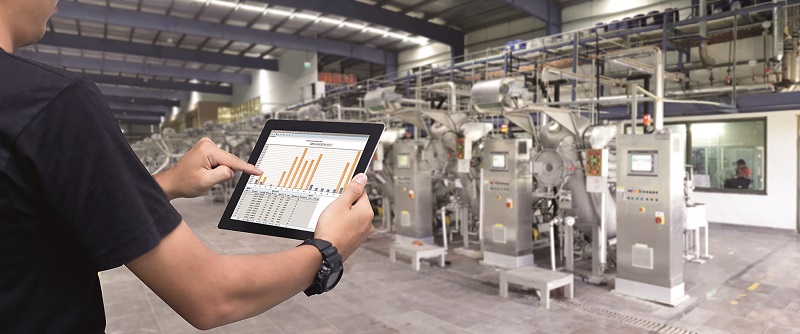
The concept is complemented by atmos.io, Oerlikon’s digital platform, which records and evaluates extensive production and process data during the yarn manufacturing process. Atmos.io gives the yarn its digital identity during its time on Oerlikon systems, from the melt to the packaged package. This technology has been used successfully for some time to monitor the production process. With atmos.io, deviations in process parameters and yarn data can be identified and rectified within a very short time, which in turn keeps the yarn quality stable and reduces waste rates.
Combining both technologies enables clear traceability of the yarn produced, even in the downstream process steps. Hence, the yarn’s components, qualities, manufacturing conditions, and origin are traced beyond doubt in the finished garment. “The unique DNA carries the ‘roots’ of the yarn digitally recorded in atmos.io into the everyday life of the end consumer,” says Jochen Adler, CTO at Oerlikon Manmade Fibers. The textile end products meet the requirements of the digital product passport required by the EU, which contains the information needed to assess their life cycle assessment and circularity. Initial long-term tests have shown 100% traceability of the yarns in the POY and FDY spinning process. If the yarn manufacturer relies on the atmos.io platform, production systems can be adapted relatively easily to use the DNA markers.

EvoSteam staple fiber process from Oerlikon Neumag bluesign® verified
In the meantime; the new polyester staple fiber process EvoSteam from Oerlikon Neumag receives the bluesign® test label “bluesign® Verified Data”.
For this, the innovative, energy and resource-saving EvoSteam process had to undergo strict data verification. It impressed with savings in energy, water and raw material consumption, as well as a reduction in operating costs (OPEX) and the CO2 footprint.
All relevant process data was compared with the conventional drawing process and analysed. The results are impressive: “I am delighted that, following intensive development work on the new EvoSteam process, we have been able to reduce the total energy consumption for steam and electricity by up to 8%. In addition to reducing production waste by up to 50%, we expect to save around 3.2 million litres of water per year. For the operators of our plants, these are considerable cost savings while at the same time reducing impact on the environment by reducing the CO2 footprint by around 6%,” says Dr Friedrich Lennemann, Head of Technology Development at Oerlikon Neumag, summarising the result. By receiving the bluesign® Verified Data label, Oerlikon Neumag is not only emphasising its commitment to sustainability. All polyester staple fibers produced with the EvoSteam process will actively contribute to the bluesign® System in the future.
For the EvoSteam process, Oerlikon Neumag received the bluesign® Verified Data label for the first time. The label includes the verification of impact data such as water, spinning preparations, thermal and electrical energy as well as the CO2 footprint by means of a plausibility check of the supporting records for the EvoSteam draw line, the central element in the EvoSteam process. The reported data was assessed as 2.1 – fair – in accordance with the defined methodology.
EvoSteam process for sustainable staple fiber production
The EvoSteam process was presented to the global public for the first time at ITMA 2023 in Milan. Visitors to the trade fair spoke of a major development step, as the EvoSteam process dispenses with liquid baths. The function of the immersion bath is assumed by a carefully-coordinated setup of godets and pulsed spray nozzles. With this, the moisture is metered precisely and added according to the needs of the process. This completely dispensing with liquid baths generates significant savings in terms of water, energy and finishes, while also increasing occupational safety and cleanliness at the production line.