“There is No Other Product on the Market That Comes Close to the Performance of Kıray’s Wet Cutting Machines”
Interview: Dilek HAYIRLI
Beybo Boya, which works for global brands Adidas and LC Waikiki and has a daily fabric production capacity of 25 tons, continues to invest despite challenging market conditions. By focusing on domestic production and technological transformation, the company has achieved significant gains in productivity.
 Beybo Boya San. ve Tic. A.Ş. was founded in 1983 in Merter as a small garment workshop by Ali Akkanat, the older brother of Kâmil Akkanat, who is currently the Chairman of the Board. In 1996, the company moved to its headquarters in Esenyurt, Istanbul, and later became part of Akkanat Holding, which brought together the group companies under one roof. Beybo’s dyehouse was established in 1987 in Çorlu. Today, Beybo Boya operates as an integrated facility across three different locations: Istanbul, Çorlu, and Seydişehir in Konya. The Istanbul headquarters houses the management, accounting, and design departments. The Çorlu facilities include yarn production, knitting, dyeing, yarn and fiber dyeing, and cutting departments. Garment manufacturing, piece printing, and embroidery processes are carried out at the facility in Konya. At its Çorlu facility, which is built on a total area of 70,000 square meters, Beybo Boya employs 250 people and dyes 25 tons of fabric per day. The company works exclusively with two clients: the global brand Adidas and Turkish retailer LC Waikiki.
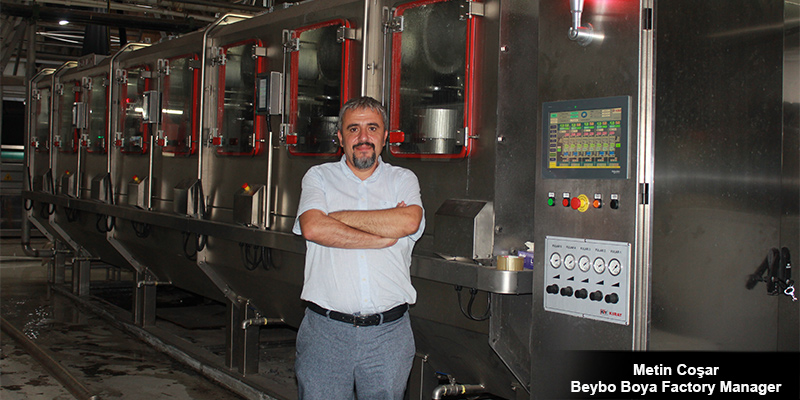
We interviewed Metin Coşar, Beybo Boya Factory Manager, for our Tekstil Teknoloji magazine, who primarily uses domestically produced machinery for all processes at his facility. Coşar explained that they use Kıray Makina’s wet cutting, scouring washing machine, and rope continuous washing machines for the finishing process, providing advantages in many aspects, including efficiency, energy and water savings, cost savings, and sustainability.
Which product groups do you mainly focus on in your production line?
At Beybo, we operate in the field of knitted fabric dyeing with a daily dyeing capacity of 25 tons. We primarily work with single jersey, double-knit fabric and three-thread fabrics, producing items such as T-shirts, sweatshirts, leggings, and sweatpants. Our production mainly focuses on women’s and children’s clothing. Additionally, our yarn dyeing department has a capacity of 5 tons per day; however, since we primarily produce for our own internal use, our average daily output is around 1 ton.
Could you please share the current machinery park of Beybo Boya with us?
When Beybo was first established, the majority of our machines used in processes such as dyeing, stenter, and sanforizing were imported. At that time, since there were not many local manufacturers, we had to prefer imported machinery. As local manufacturers began to improve themselves, under the vision of our Chairman of the Board Kâmil Akkanat and our Vice Chairman, Ömer Akkanat, we started to prefer domestically produced machines. Today, our facility includes: 3 automatic fabric opening machines with self-sewing, 19 dyeing machines, 6 yarn dyeing machines, 1 drying machine, 2 wet cutting machines, 1 rope continuous washing machine, 4 stenters, 3 sanforizing machines, 2 raising machines, 1 shearing machine, 1 brushing machine, 1 scouring washing machine.
“Customer Satisfaction and Quality are at the Center of Our Investments”
How do you think this machines contributes to your production capacity, product diversity and quality standards?
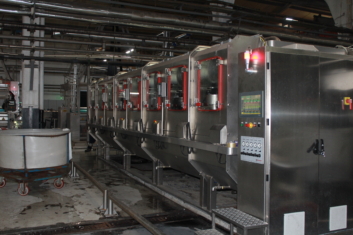 One of the biggest challenges in textile production, particularly in dyeing processes, is shade variation between dye lots. For example, if you dye a 5-ton order in 500 kg machines across 10 batches, it becomes difficult to achieve the same shade consistency in each batch, which negatively affects quality. Since the orders we receive are generally in large quantities, we restructured our production process accordingly and we expanded our machine park. We invested in two machines with a capacity of 1,750 kg, two with 1,000 kg, and one with 1,250 kg. This allows us to complete a 5-ton order in just two batches. As a result, shade variations are minimized, ensuring better color consistency and higher quality. We took a similar step in our sanforizing department and, for the first time in Turkiye, started using three-felt sanforizing machines. This innovation significantly improved the fabric’s handle. At the heart of all these investments lie customer satisfaction and quality.
As Beybo Boya, what are the criteria you attach particular importance to in your production?
At Beybo Boya, quality is always at the core of our production. We adopt an uncompromising and disciplined approach. Our quality control unit reports directly to the factory management, and no product is shipped without approval. If necessary, the product is reprocessed. We are also an accredited quality control laboratory for global brands like Adidas and LC Waikiki. Tests performed by us are not retested by these brands.
Could you give us information about the process of your collaboration with Kıray Makina?
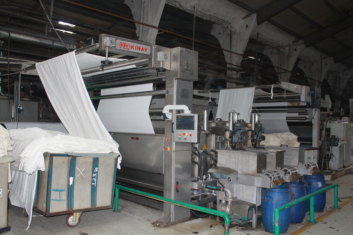
Our collaboration with Kıray Makina dates back approximately 15 years, to the time when Samet Kıray, Chairman of the Board, was involved in sensor and automation. Mr. Samet Kıray’s diligence, determination, and continuous self-improvement were instrumental in this collaboration. Initially, we replaced the cradle-type centering units at the RAM inputs with Kıray’s fabric centering units and were very pleased with the results. Over time, we upgraded all our fabric centering units to Kıray. Wet cutting machines were then introduced. Frankly, there’s no other machine on the market that even comes close to the performance of Kıray’s wet cutting machines. We don’t know of any other machine capable of cutting at 120 m/min with tension control. Processing the fabric without tension provided significant advantages in terms of shrinkage and grammage. Furthermore, operational simplicity: Thanks to the fully automated system, the operator simply feeds the fabric and finally unloads it—no further intervention is required.
“While 45–50 Liters of Water Were Used for 1 Kg of Fabric, We Reduced This Amount to 8 Liters”
To maintain your competitive edge and quality, what do you prioritize when investing in machinery and technology? How do criteria like sustainability, efficiency, energy savings, durability, and price play a role in your decision-making process?
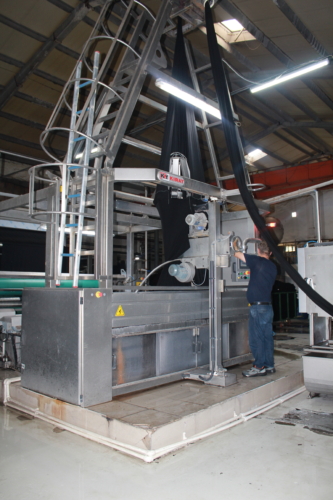 Due to high energy costs in Turkiye, efficiency, energy savings, and sustainability are among our top priorities in our machinery investments. For example, while traditional drum washing uses 45–50 liters of water per kilogram of fabric, we’ve reduced this amount to 8 liters thanks to the rope continuous washing system we developed with Kıray Makina. This has led to significant savings in water, energy, and chemical consumption. By pre-cleaning fabrics with scouring washing machines, we reduce emissions and extend machine cleaning times. This provides both environmental benefits and increases efficiency.
Over the years, we have also implemented energy-efficient systems such as LED lighting and inverter-driven motors. Of course, price is important, but it is not the only determining factor. What really matters here is the unit cost of the machine and the added value it provides. A faster and more efficient machine may have a higher initial investment cost, but in the long run it can prove to be much more economical. Kıray’s machines are also very successful in terms of price-performance ratio. For years, we suffered foreign currency losses by relying on imported machines, but today we can confidently say that with local machines we achieve the same, or even better, quality. Durability is another critical factor. Especially in machines used in wet processes, the quality of stainless steel is of great importance. The attention Kıray Makina pays to this — from sheet thicknesses to stainless steel quality, and even ensuring that the bearings themselves are stainless — guarantees that the machines are long-lasting and reliable.
What are the main challenges faced in finishing processes? Can you tell us about the advantages of Kıray Makina’s solutions in overcoming these challenges?
Before working with Kıray Makina, one of the most challenging aspects of the finishing process was length shrinkage during the wet cutting stage. This stretching effect was inevitable with existing machines, and we were constantly struggling with it without even realizing it. Kıray’s load cell systems make it possible to process the fabric without stretching it. This allows the fabric to enter the stenter line in a much more controlled and balanced manner. This has largely eliminated shrinkage problems and ensured a more stable operation in the stenter.
Another important issue was the fiber and dye residues that emerged in the enzyme baths of the wet cutting lines. In Kıray’s system, these residues can be filtered and collected directly in the enzyme tank. This prevents dead fibers and unfixed dyes from being carried over into subsequent processes, resulting in a much cleaner fabric at the finishing stage. At the same time, we observed that the cleaning intervals of our stenter machines have been extended, the filters are no longer clogged, and the overall need for maintenance has decreased. In textiles, an improvement made in one process often creates a chain reaction that positively affects the following stages. We can see these effects most clearly at the garment stage. For example, dust caused by uncleaned fabric can directly affect the operators working with sewing machines. In other words, a proper improvement made in the wet cutting line can have positive impacts all the way to the final stage — even on employee health. With Kıray Makina, we have clearly felt this difference.
Does Kıray make updates to meet your demands regarding the machines you purchase?
Yes, Kıray and we have now formed a true partnership. We clearly express our needs, and they truly listen and understand them. Sometimes we say, “It would be better if we changed this or that,” and sometimes they offer suggestions. For example, they suggested adding an extra cylinder to a machine, and we’ve seen real benefits. We’ve developed projects together. For example, the scouring washing machine is a product of this collaborative effort. When the Ministry of Environment and Urbanization mandated filters for stenter machines, we at Beybo adopted a different approach. In collaboration with Kıray Makina, we developed a “scouring washing machine” that captures contaminants before the stenter, rather than after. This system removes oil and fibers from the fabric before it enters the fixer, significantly reducing flue emissions and even eliminating smoke.
The project not only provided environmental benefits but also significant gains in production: reduced contamination in chimneys and sieves, extended cleaning intervals, and reduced chemical use. Because the fabric entered cleanly, stenter speed increased, final product quality improved, and we achieved 30% energy savings. Although the Provincial Directorate of Environment was initially cautious about this solution, they were convinced after receiving technical reports from Istanbul Technical University and on-site measurements. Consequently, the neighborhood environmental committee’s decision was changed, and the scouring washing system was officially accepted as a filter alternative.
Following the successful results we achieved with the scouring washing machine, we wanted to bring a similar approach to the dyehouse. Our goal was to make the boiler processes more efficient. To this end, we developed a “rope-type continuous washing” unit with Kıray Makina. Initially, we considered an open-end system, but with Samet Kıray’s guidance, we switched to a rope system. This way, the fabric leaving the dyehouse enters the rope washing line directly and then moves synchronously to the wet cutting line. The system is fully automated, requiring only a single operator. The results: time savings, shorter charging times, significant reductions in water, energy, and chemical consumption, and increased operational efficiency.
What documents and certificates do you have regarding sustainability, environmental awareness and quality management?
Quality, environment, and energy management are among our indispensable priorities. We support the goal of achieving zero carbon by 2050 and continue to take concrete steps in this direction. In addition to the ISO 9001 Quality Management System certificate we have held for many years, we also possess ISO 50001 Energy Management System and ISO 14001 Environmental Management System certificates. We constantly update ourselves and invest in technologies that will increase our efficiency. To reduce our carbon footprint, we carry out various initiatives and place great importance on using renewable energy sources. We are also transforming our vehicle fleet accordingly; we currently have 7 electric vehicles and plan to gradually transition our entire fleet to electric.
“We Gave Domestic Producers a Chance and We Received a Great Reward”
We’re going through a difficult time in the textile industry. However, you mentioned that you’re continuing to invest during this period. What’s the motivation behind this approach?
Yes, the sector is going through a challenging period, but we haven’t given up on investing during this period. Because we still believe in this sector. Believing that production and investments must continue, we commissioned Kıray’s rope washing machine in January 2025. Production was sustainable with our existing machinery, but we made this investment for efficiency, sustainability, and savings. Thanks to the new machine, we’ve achieved significant savings in water and energy consumption; we can now complete a three-shift job in two. Our investments will continue because companies, like living organisms, must evolve and transform. It’s impossible for companies that don’t keep up with technology to survive. We act with this awareness and prefer domestically produced machinery whenever possible. We’ve given domestic manufacturers a chance and have reaped the rewards. I hope all industrialists will follow this vision.