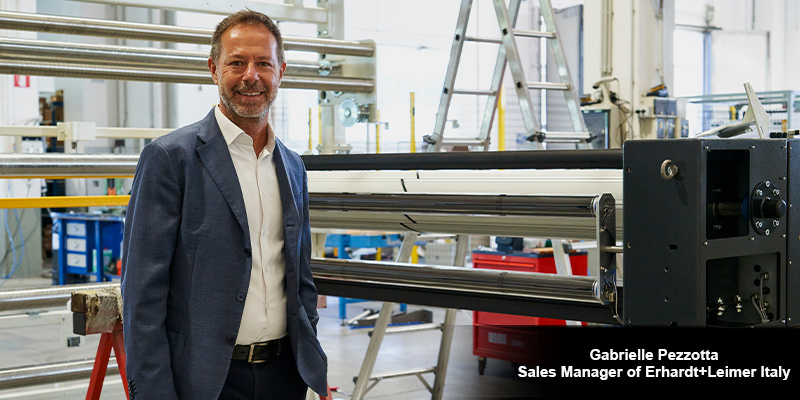
“Our Presence at ITM 2026 is a Clear Signal of Our Investment in This Region”
Interview: Dilek HAYIRLI
Gabriele Pezzotta, Sales Manager of Erhardt+Leimer Italy, states: “ITM 2026 represents more than just an exhibition; it is the strategic heartbeat of the textile industry for the entire Eurasian region, and not only. We believe that our presence at ITM 2026 is a clear signal of our investment in this region.”
As one of the most important gatherings of the textile machinery industry, ITM 2026 is preparing to bring together global players while also serving as a strategic showcase for technology providers. In our interview with Gabriele Pezzotta, Sales Manager of Erhardt+Leimer Italy, we discussed both the technologies shaping the future of the industry and the company’s objectives for ITM 2026.
“We Are Also Pivoting from Being A ‘Part Supplier’ to a ‘Solution Partner’”
In your opinion, what will be the key opportunities and major challenges shaping the textile industry in 2026? How does your company plan to capitalize on these opportunities?
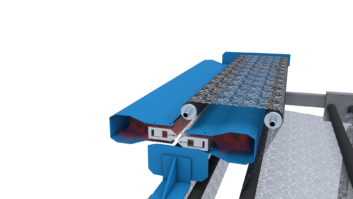
ELCLEAN
In 2026, textile manufacturers are under immense pressure to reduce energy consumption and waste. This creates a massive demand for high-precision, low-friction mechanical components that optimize machine performance. The shift toward “Smart Factories” allows us to integrate sensors into our mechanical parts. This transition from reactive to predictive maintenance is a significant growth area. We are also pivoting from being a ‘part supplier’ to a ‘solution partner’ by offering components pre-equipped with IoT-ready diagnostic sensors.
Erhardt+Leimer has long been a benchmark in web guiding and tension control systems. How are your latest solutions addressing micro-level deviations in high-speed textile processes?
rhardt+Leimer has evolved its systems to meet the demands of ultra-high-speed production where ‘micro-level’ is the only acceptable tolerance. Our latest solutions, particularly within the Elguider and Elsmart families, address these challenges through a three-pillar technical approach:
- Next-Gen Sensor Fusion (The “Smart Detection” Concept) To eliminate micro-deviations, we no longer rely on a single data point. We are implementing Multi-Sensor Fusion that combines high-resolution wide-band infrared sensors with the latest Elseamtex optical AI sensors. This allows the system to distinguish between a structural defect in the textile and a true lateral deviation, ensuring that the guiding system doesn’t ‘over-react’ to material irregularities, even at speeds exceeding 150 m/min.
- Adaptive Control Algorithms (Beyond PID) Standard PID control is no longer sufficient for the dynamics of modern textiles. Our current roadmap leverages Model Predictive Control (MPC) and Adaptive Gain Control. These algorithms ‘learn’ the elasticity and behavior of the specific web in real-time. If the material tension changes or the web speed ramps up, the system automatically recalibrates its damping and response factors to maintain sub-millimeter precision without human intervention.
- Mechanical Synergy: The Brushless Revolution Precision is only as good as the actuator. We have integrated EL.Motion brushless DC drives across our guiding frames. These drives provide the high-frequency response needed to execute the micro-corrections dictated by our AI sensors. By minimizing mechanical backlash and utilizing high-resolution encoders, we ensure that the digital command translates into instantaneous, smooth physical movement.
With increasing production speeds and more complex fabric structures, how do your systems maintain stability in dynamic conditions?
At Erhardt+Leimer, we view high-speed stability not as a single feature, but as a result of the perfect synchronization between our sensors, controllers, and actuators. By integrating our web guiding with Eltens load cells, we implement a Feed-Forward mechanism. If the system detects a sudden spike in tension (common in high-speed changes), it pre-emptively adjusts the guiding response. This synergy between tension control and position control ensures that the fabric remains stable and centered, even when subjected to extreme dynamic stresses during rapid ramp-ups.
“Our Technology Integrates with Stenter, Digital Printing, and Warp Knitting Machines with Equal Ease”
Integration has become a key challenge for manufacturers. How do your technologies ensure seamless compatibility with different machine brands, legacy systems, and digital factory infrastructures?
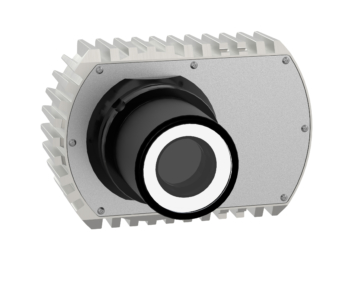
ELSEAMTEX
To ensure compatibility with all major machine brands, our controllers (such as the EL.NET framework) support a multi-protocol approach. Whether the primary PLC is based on Profinet, EtherCAT, Ethernet/IP, or CANopen, our systems communicate natively without the need for expensive third-party gateways. This ‘plug-and-play’ capability allows our technology to be integrated into a Brückner stenter, a Reggiani digital printer, or a Karl Mayer warp knitter with the same level of ease.
Sustainability is now a critical parameter in textile production. How do your solutions contribute to reducing waste, energy consumption, and carbon footprint, particularly through precise process control and automation?
At Erhardt+Leimer, we believe that sustainability is the natural byproduct of intelligent automation and high-precision process control. In the textile industry, where resources are finite and margins for error are slim, our solutions empower manufacturers to transform “efficiency” into “ecology”. For example, Elstraight eliminates waste by correcting weft distortions in real-time, while Elcount optimizes raw material and energy use through surgical thread density monitoring. The Elclean web cleaning system plays a vital role in reducing material waste; by removing dust and impurities before critical processes like digital printing, it prevents expensive printing errors and rejects. This ensures that raw materials are used to their full potential, significantly lowering the volume of scrap fabric.The Elmat system targets the most energy-intensive part of production: the drying process. By providing high-precision temperature and moisture measurement, Elmat allows for the exact control of stenter frames.This advanced automation ensures a consistent “First Quality” yield, drastically reducing the carbon footprint and energy consumption of the entire textile production chain.
What are the key technological trends you foresee shaping the future of web guiding and process control systems? How is Erhardt+Leimer positioning itself in response to these developments?
The industry is moving beyond simple automation toward self-optimizing systems. Future lines will not just follow a set point but will dynamically adjust to material variations without human intervention.
We are leading this through EL.NET, our digital control architecture. By using decentralized intelligence, our components “talk” to each other, allowing the machine to perform complex self-calibration and real-time corrections, reducing the need for highly skilled operators on the shop floor.
“Our Goal is to Reduce Lead Times and Logistics-Related Problems”
What are your strategic priorities and investment areas for 2026, particularly in terms of R&D, digitalization, and global market expansion?
Deep learning and AI (as seen in Elseamtex) are areas of investment for Erhardt+Leimer, in addition to the development of self-optimizing machines that can predict disturbances – such as tension spikes and weft distortions – before they impact quality, moving toward a “zero-defect” manufacturing reality.
Our strategic goal is to reduce lead times and logistics-related by producing closer to our customers in Germany, China, India, Italy and USA, we enhance our resilience against trade volatility and provide faster support, from sales to service.
ITM 2026 stands out as one of the most important textile machinery exhibition in the region. What are your thoughts on the contribution ITM 2026 will make to the industry? Which technologies does Erhardt+Leimer plan to highlight at ITM 2026?
ITM 2026 represents more than just an exhibition; it is the strategic heartbeat of the textile industry for the entire Eurasian region, and not only. We believe that our presence at ITM 2026 is a clear signal of our investment in this region. We aren’t just bringing systems and machines, but solutions for a resource-efficient future where automation handles the complexity so that manufacturers can focus on creativity and growth. At our booth, together with our agent Iteks, we will showcase the above-mentioned technologies and our latest solutions such as our Elclean, non-contact cleaning system.