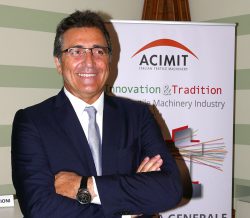

‘‘Those Who Do Not Invest in the Future Have No Chance of Succeeding’’
‘‘The textile knitting sector is at a distinguished point in Turkey and in the world. Because the knitting sector is constantly growing and developing technologically. Currently, knitted fabrics constitute a significant proportion of exports in Turkey and in the world.’’
Knitting Industrialists Association (ÖRSAD), which brings together the companies that manufacture and sell knitted fabrics, aims to produce solutions for all kinds of problems of the sector. Moreover, it operates in economic, economic, educational and social fields.
ÖRSAD, which focuses especially on the education and carries out studies in the textile sector, makes machinery donations to the schools that provide education in the field of the textile industry as well as its activities in cooperation with universities and industry.
For the Special Issue of Knitting Technologies exclusive file of our Textile Technology magazine, we conducted an interview with Fikri Kurt, ÖRSAD Chairman of the Board. Mr. Kurt touched mostly upon the education issue among the other textile sector problems and stated: ‘‘We will always cooperate with universities in order to educate young people in our country. Those who do not invest in the future have no chance of success.’’
Could you please give us brief information about Knitting Industrialists Association?
The Knitting Industrialists Association (ÖRSAD) was founded in 2002. I have been the president of the association since then. The member committee of our association consists of approximately 500 people. Our association was established in order to be able to solve the problems related to the expectations and solution proposals in the sector either in between ourselves or in the presence of the state institutions, be beneficial and provide a profitable business for the national economy.

How do you assess the knitting industry in Turkey?
The textile knitting sector is at a distinguished point in Turkey and in the world. Because the knitting sector is constantly growing and developing technologically. Today, in Turkey, the textile industry can be categorized into three main groups in terms of fabrics. These are namely; woven fabrics, knitted fabrics and raschel fabrics. Currently, knitted fabrics constitute a significant proportion of exports in Turkey and in the world. Our woven fabrics of indoor textiles rank first in the world and in Europe. Our quality and skill knowledge in textiles is increasing day by day and we are coming to a position to compete with and encounter world countries.
As ÖRSAD, what are your problems related to textile sector?
I think each region should have its own industry. For example, consider a metropolitan province like Istanbul. Each district should have an industrial zone for itself. Unfortunately, industrialization structure is not very efficient in Turkey. Some businesses produce in places we call under the counter. Due to the investments made here, the service concept regarding efficiency and quality in the sector is gradually decreasing. Thus, we become unable to do what we want in competing with other countries. In addition, our sector is experiencing difficulties since it doesn’t have educated personnel from within the companies. There needs to be an educational reform in Turkey as soon as possible. The abolition of Imam Hatip schools caused the abolition of vocational schools. Now we are paying the price of this incapability as a country with the difficulty of finding qualified personnel in all sectors. When we look at the population of the country, we see that there is 13.5 percent unemployment rate. Therefore, we need to give importance to vocational schools again. If we want the European Union criteria to sink into our country, we have to look at how useful the schools in the field of education reform in Europe are. I would like to emphasize that we should also embrace the students who choose the department of textile in universities.
What kind of activities does ÖRSAD do in the field of education?
Last year, 12 exporters union, especially the Istanbul Textile and Raw Materials Exporters Association (İTHİB), Istanbul Garment and Apparel Exporters Association (İHKİB) and Istanbul Leather and Leather Products Exporters Association (İDMİB), and Turkey Textile Industry Employers Association (TTSİS) with The Council of Higher Education (YÖK) conducted a study under the name of industry and university cooperation. We, as ÖRSAD, took part in this study. Students who entered the first 20 thousand in the university exam and who chose textile engineering major were awarded with a complimentary scholarship in the amount of the minimum wage. 70 percent of the net minimum wage was given to the students achieved between 20 and 50 thousand in the exam, and 50 percent of the net minimum wage was granted to the students achieved between 50 and 80 thousand as complimentary scholarships. In addition, a job guarantee will be given to the student who completes 4 years of schoolwork. These students will be able to see practical applications in industrial workplaces. Thanks to this cooperation and study, textile departments in universities reached a 95 percent occupancy rate in 2019.
I, as the Chairman of the Board of Knitting Industrialists Association, have been working for this sector for 14 years and I am making every effort for this sector. As a sector, in our efforts to serve better to the public, we donated machinery to Şehit Büyükelçi Galip Balkar Vocational and Technical Anatolian High School in Zeytinburnu. In addition to donating machines together with İTHİB, I personally donated machinery to that school. Factories producing machinery abroad donated machines to this school as well. The Department of Textile at Süleyman Demirel University had asked us for a machine. We donated a knitting machine through an organization by İTHİB and ÖRSAD. I also donated machinery to a school in Malatya. As Knitting Industrialists Association, we need to create the incentive in vocational schools ourselves.
What kind of incentive do you think should be?
If we create a pool as industrialists for the students who will study in vocational schools, and from this source in the pool; incentives in the amount of 25, 50, and 100 Liras may be granted during the education which will increase both the number and desire of students. The civil society understanding of Turkey is now in a stronger position. Our country has a structure that can make its voice heard and be a sanctioning power. We should raise our work in vocational schools and universities-industry cooperation, moreover, express our problems and develop solution-oriented formulas. If we do this, it means that we have designed our future right.
Do you have any educational projects in the future?
The building of Şehit Büyükelçi Galip Balkar Vocational and Technical Anatolian High School in Zeytinburnu was demolished and a new school building is being built in its place. After that school becomes operational, in order to better develop the vocational schools in Turkey generally, we will declare our views personally to the Ministry of Education and we will focus on these issues even more. In addition, I also think that these efforts should be developed under the responsibility and awareness of the Ministry of Education. We will always be in cooperation with universities for the upbringing of young people in our country. Those who do not invest in the future have no chance of succeeding. We are trying to provide added value and employment opportunities to our country with the abilities we have and to come to a position to compete with and encounter the world countries.
Interview: Kübra KARACA