Aydın Tekstil Invests $40 Million in Upholstery Fabric Production Facility
Ali Sami Aydın, Chairman of the Board of Aydın Tekstil, commenting on the new upholstery fabric production facility to be established in İkitelli with an investment of 30-40 million dollars, said: “If you enter into competition with China, you will be left behind from day one. If you follow trends, prioritize innovation, and create added value through R&D, you will make a difference and get ahead.”
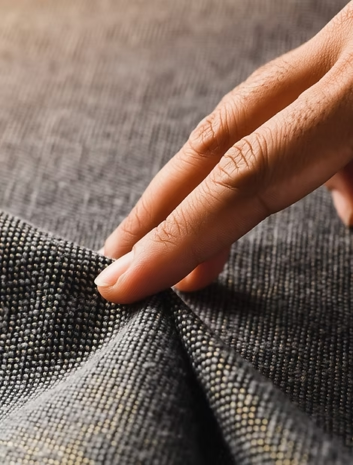 While many companies have shifted their investments abroad in recent years due to rising costs, firms that capture global trends and focus on value-added production continue to invest in Türkiye. Moreover, despite the price difference, these companies continue to receive high demand. One of these companies is Aydın Tekstil. The company plans to commission its new upholstery fabric production facility in Istanbul, İkitelli, next year with an investment of 30–40 million dollars.
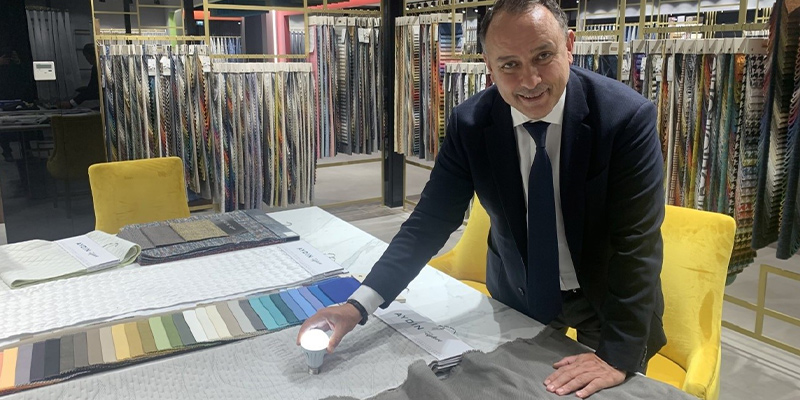
Ali Sami Aydın, Chairman of the Board of Directors of Aydın Tekstil, emphasized in his statements to Ekonomim Newspaper that Türkiye cannot progress in the textile industry with price-focused competition from China. Aydın stated that the way to increase Türkiye’s competitiveness is through value-added production; “If you compete with China, you’ll be left behind from day one. If you follow trends, prioritize innovation, and create added value through R&D, you make a difference and move ahead.” Also a Board Member of the Istanbul Textile and Raw Materials Exporters’ Association, Ali Sami Aydın said that the facility to be established in İkitelli will have a vertically integrated structure covering processes from yarn to weaving, dyeing, and design. Stating that the investment amount is planned in the range of 30–40 million dollars, Aydın said, “We decided as of the beginning of last year. The facility, with 20,000 square meters of indoor space, will be completed within one year. Approximately 300–400 people are targeted for employment.”
“Our Products Are Sold at 300 Euros Per Meter”
Ali Sami Aydın stated that a significant portion of the companies struggling in the market are stuck in competition because they cannot sufficiently follow design, color, pattern, and trends. Aydın said, “Here, we aim to serve editors in Europe directly with higher-trend goods. These editors are generally wholesalers who sell goods worldwide under their own names at 200–300 euros per meter. We are targeting them.” Emphasizing that one of the company’s strongest aspects emerges at this point, Aydın said, “Our distinctive feature is that we have the know-how to maintain the same color, the same pattern, or the same quality in production. We will be utilizing that here.”
A 65-Year-Old Company Exporting to 120 Countries
In addition to its new investment, Aydın Tekstil carries out upholstery fabric, mattress fabric, decorative carpet, and home textile production in a total area of 500,000 square meters in İkitelli, Sakarya, and Kayseri. With more than 65 years of experience, the company exports to 120 countries with 3,000 employees. Pointing out that Türkiye’s greatest advantage is vertical integration and accumulated know-how, Ali Sami Aydın stated that having all production processes and know-how in the country—from fiber to yarn, from fabric to dyeing—makes Türkiye one of the strongest production centers after China.
“You Have No Chance Against China with Basic Products”
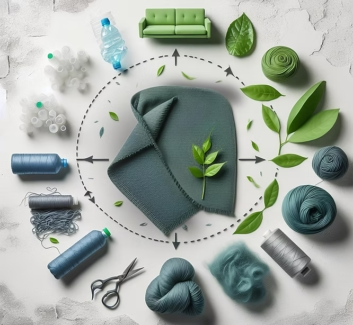 According to Aydın, the way for Türkiye to achieve a sustainable competitive advantage in textiles and apparel is not to enter price competition in basic products, but to increase product value through design, innovation, and technical features. Ali Sami Aydın said, “If you set out saying my competitor is China, you’ll be left behind from day one. Because you have no chance of competing with China. Therefore, by producing value-added products instead of basic goods, you can very comfortably cope with this business.” Aydın pointed out that Europe can still produce textiles and export them, emphasizing that Türkiye can also compete if it focuses on the right areas.
Another topic emphasized by Ali Sami Aydın was sustainability. Stating that competition is shaped not only by the added value of the product but also by carbon footprint, green energy, and environmental standards, Aydın said, “We currently meet all our energy needs in all our factories from solar energy. Even if our price is higher, brands prefer us.” Aydın Tekstil has a 40 MW solar power plant and meets its energy needs from this source.
“Following Trends Is One of the Most Difficult Things in the World”
According to Aydın, one of the most critical elements of survival in the sector is correctly interpreting trends and fashion. Stating that this field is not as easy as it seems, Ali Sami Aydın said, “It is truly very difficult to follow this. You have to be very patient with the customer.” Aydın explained that not only the pattern and color in fabric, but also touch (hand feel), technical performance, and innovative finishing processes are decisive. “When you add features such as flame retardancy, technical characteristics, resistance to fading in the sun, stain resistance, self-cleaning properties, dust repellence, and anti-allergenic qualities to the fabric, your market expands tremendously,” said Aydın, noting that the market reachable with a uniform product is limited.
“There Is a Great Opportunity in Home Textiles”
Aydın stated that R&D, design, and trend teams have a special place among the elements increasing the company’s competitiveness, and that they work closely with trend-setting individuals and designers abroad. In this way, they do not lag behind fashion movements in Europe and can develop products simultaneously. Aydın said, “Whatever is launched in season in the showroom of an Italian, German, or French company, the same product is also available with us. In other words, we do not hang on display one year later what they put in their showcases a year later.”
Ali Sami Aydın also exemplified the importance of value-added production with figures. Reminding that the export value per kilogram in automotive is around 8 dollars, Aydın said that this figure is approximately 12 dollars in home textiles. “This is a very important detail. It is a very niche market and if it is embraced, these figures have the chance to go much higher,” he said.
Stating that trends such as the increase in the number of houses worldwide, the shrinking of living spaces, and changes in furniture and interior design have turned home textiles into an even more strategic field, Aydın noted that if these trends are read correctly, Türkiye can achieve strong growth in this area. Making a clear call to other companies in the sector, Aydın said, “My advice is that they should take their heads out of the sand and follow global trends and literature very well. When they do so, they can capture those niche markets. Otherwise, they will enter into competition with Far Eastern countries, and we have no chance of emerging from there unharmed.”