
New Investment Base in Textile: Turkey
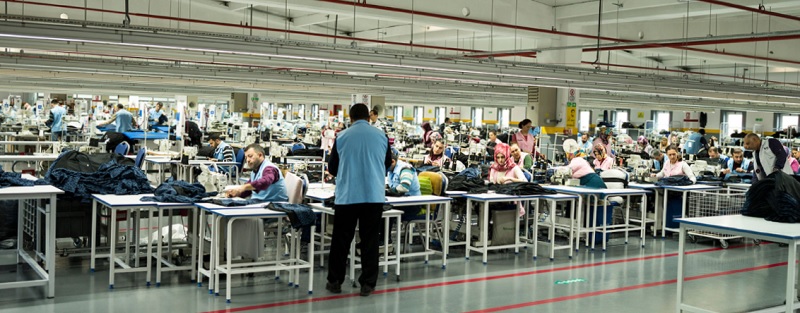
After the stopover in production due to the coronavirus epidemic, the Far East market, in particular, began to have difficulties in responding to the accelerating demand of European retailer brands. Long-distance transportation costs have increased exponentially. The transportation problem that emerged when the cargo ships were insufficient to meet the demand for shipment caused the freight prices to increase. When production delays add to these problems, European companies started to turn to closer centers like Turkey for supply. At this point, the Turkish textile industry, which stepped in with the advantage of geographical location, has become the production base of fashion giants by bringing together the trio of quality-reasonable cost-fast delivery. Turkish manufacturers started to increase their production capacity in order to keep up with the orders.
Migiboy Establishes Spandex Factory
Migiboy, one of the leading companies in the Turkish textile industry, announced that it will realize the spandex factory with an investment of 200 million dollars. With the factory to be established on an area of 400 thousand square meters in Niğde Organized Industrial Zone, it is aimed to prevent the annual import of 40 thousand tons of spandex. The factory, which is targeted to be completed in 14 months, will employ 500 people.

4 Million Euros Investment Plan from Yünsa
Yünsa, Europe’s largest integrated wool fabric manufacturer, completed successfully 2020 without any damage in terms of both production and investment. Yünsa, which modernized its production line with an investment of 2 million Euros last year, will make an investment of four million Euros this year.
Korteks to Produce Polyester Yarn from Pet Bottles
Korteks, one of the Zorlu Textile Group companies, will produce polyester yarn completely out of PET bottles, thus performing a first in Turkey and Europe, in its Polymer Recycling Facility, which was commissioned with a 10 million dollar investment, with a new generation of a textile approach based on a circular economy based on innovation.
55 Million TL Investment from Lila Group to Textile Industry
Lila Group, one of the leading cleaning paper producers in our country, decided to increase its capacity by investing in its dye house facility, which operates in the textile sector. The group will increase the production efficiency of the facility by 100 percent with 55 million TL investment and modernization works, in which the latest technologies in the textile world are going to be used.

330 Million Dollars New Investment from SASA Polyester
SASA Polyester started working on purified terephthalic acid (PTA) and fibre investments. SASA Polyester Board Member Mehmet Şeker announced that they started preparations to build a new fiber facility with an annual capacity of 367,500 tons.
Giant Textile Factory from İbişler Tekstil to Fatsa
İbişler Tekstil is establishing a textile factory of 10 thousand square meters in Fatsa Organized Industrial Zone (OSB). In the first stage, 1,200 people will be employed at the factory and will be export to 17 countries.
New Facility Investment in Ergene from Mersan Makine
Mersan Makine established a new factory in Çorlu/ Ergene due to the increase in machine demands, while continuing its production in its production facility in Istanbul Esenyurt. The company, which focused on R&D studies during the pandemic period, commissioned 3 felt sanforizing machines that they patented and started the production of new orders.
Benetton to Increase Its Investment in Turkey
Italy-based Benetton Group has announced that it will gradually leave its low-cost production centers in Asia and increase its production in Serbia, Croatia, Turkey, Tunisia and Egypt. Benetton Group Chief Executive Officer Massimo Renon, regarding the production increase said; “It’s a strategic decision to have more control over the manufacturing process as well as shipping costs.”

4 Million Euro Investment from Hugo Boss to Turkey
Operating in the Aegean Free Zone, the Hugo Boss Turkey factory will host new investments brought by the changing clothing trends with the pandemic. The company will increase its production capacity and employment in Turkey with new investments to be commissioned next year.
Arif Kaya, General Manager of Hugo Boss Tekstil Sanayi, said that orders shifted to Turkey due to the effects of Covid-19 cases on companies in Asia. Kaya, “Our company also gets its share from this order shift. Our company has a very serious growth expectation for the next year. We are growing in sports products. We will produce 500 thousand units this year, 2 million units next year, and 4-4.5 million units in the following years, in crew neck and polo-shirts. The number of our employees is around 3,300, and we will employ 1000 more by the end of next year.
Explaining that the company has investment plans of 4 million Euros for the next year, Kaya stated that a significant part of this resource will be allocated to the new t-shirt factory to be established on an area of 5 thousand square meters.
Ready-to-wear company LPP will shift its supply chain to Turkey
Poland-based apparel company LPP has announced that they will shift a part of their supply chain to Turkey. At the same time, Inditex, one of the world’s largest retail giants, is expected to increase its purchases in Turkey from 20% to 25%.
Huge Increase in Circular Knitting Machinery Imports
Almost all of the circular knitting machines used in the production of knitted fabrics are imported. Turkish knitted fabric industry, one of the world’s leading buyers, imported 2566 circular knitting machines with a total value of 117.8 million dollars in the January-August period of 2021. 1483 of these machines came from China. The amount paid for this import was approximately 44 million dollars.
The second largest import was from Germany. 371 machines were imported from this country in the first 8 months of the year. The foreign exchange paid was $28.7 million. 291 machines with a total value of 16 million dollars were imported from Italy, which is the third country from which the most imports are made.
In the first 8 months of 2020, 1303 circular knitting machines worth 60.1 million dollars were imported.