“No Government Can Afford to Overlook Such a Powerful Textile and Ready-to-Wear Industry”
Minister of Trade Ömer Bolat stated that the textile and ready-to-wear industry has reached a value of USD 75 billion, including the domestic market, and ranks first in terms of employment, saying, “What state or government would dare to abandon, or would even want to abandon, such a golden goose ? These rumors are simply not true.”
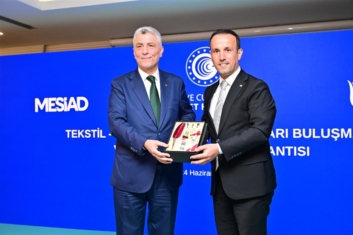
Speaking at the Textile and Apparel Industry Evaluation Meeting organized by the Merter Industrialists and Businesspeople Association (MESİAD) at a hotel in Güngören, Bolat spoke about Merter’s journey toward becoming the center of the textile and fashion industry.
 Referring to the global and regional challenges experienced in recent years, Bolat said that despite the COVID-19 pandemic, the Russia–Ukraine War, the earthquakes centered in Kahramanmaraş, and high inflation, Türkiye has continued to increase its economic growth, employment, and exports.
Recalling that the combined exports of the ready-to-wear, textile, and apparel industries amounted to USD 28.58 billion in 2019, before the COVID-19 pandemic, Bolat stated that this figure rose to USD 34.455 billion in 2021 following the pandemic. Noting that this represented an increase of approximately USD 6 billion in exports, he added that the industry’s exports reached USD 35.256 billion in 2022 before declining in the following years to USD 31.7 billion.
Minister Bolat said: “The extraordinary growth recorded in 2021 and 2022 resulted from Western buyers rushing to Türkiye instead of China and the Far East due to COVID-19, saying, ‘Here are two years’ worth of orders, with cash payment in advance.'”
Bolat also pointed out that overall exports experienced a surge during the same period due to booming demand, emphasizing that although external demand weakened afterward, Türkiye nevertheless continued to grow.
Orders Shifting to the Far East Are Returning to Türkiye
Minister Bolat stated that the pessimistic remarks made recently about the textile industry do not reflect reality, noting that orders have once again begun to move significantly in Türkiye’s favor over the past few months.
Recalling that when they took office there were unrealistic claims such as “customers are no longer coming,” “the industry is finished,” and “the government has abandoned the textile sector,” Bolat stressed that these statements do not correspond with the data collected from the field.
 Drawing attention to recent global developments that have once again reshaped supply chain dynamics, Bolat said that international order flows have begun shifting in Türkiye’s favor, particularly following the military operations carried out by the United States and Israel against Iran. Bolat stated that “A significant number of customers who had shifted their orders to Far Eastern countries are now returning to Türkiye. The data we have collected from across the country clearly confirms this,” adding that rising logistics costs in the Far East, along with growing concerns over supply chain security, have been key factors driving this shift back to Türkiye.
Emphasizing that Türkiye remains the region’s most reliable manufacturing, logistics and sourcing hub, Bolat stated that orders have shown a clear tendency to return to Türkiye over the past three to four months. He therefore urged the sector not to panic. “There was a time when everyone was saying that customers were moving to the Far East. Today, however, we are seeing those customers coming back. They have realized through experience that it is not easy to replace Türkiye’s strengths in quality, design, skilled workforce and manufacturing capability,” he said.
“We Have Started Seeing the Results of the Measures We Have Taken”
Minister Bolat stated that Turkish manufacturers and exporters have now reached every corner of the world, noting that Türkiye exports to 215 countries and customs territories, while 89,000 foreign-invested companies are currently operating in Türkiye.
Pointing out that the global economy is going through a difficult period, Bolat said that protectionist tendencies in international trade have intensified, disputes have increased within organizations such as the World Trade Organization and NATO, and some countries have begun implementing unilateral trade policies. He added that certain competitor countries are influencing global markets through substantial state subsidies, but emphasized that despite these developments, they do not wish to paint a pessimistic picture.
Bolat noted that Türkiye quickly regained its production strength following the COVID-19 pandemic, stating that industrial production growth has outperformed that of many European countries compared with 2019.
Referring to the support and protective measures introduced for the textile, ready-to-wear, and leather industries, Bolat said: “We are now seeing the impact of the measures we have taken in ready-to-wear, yarn, fabrics, leather, leather goods, and footwear. Imports in these sectors have declined compared to last year.”
Bolat emphasized that the support provided to the sector is not limited to trade policies alone. He stated that over the past three years they have attended six major trade fairs, where they met directly with industry representatives, listened to companies’ problems and demands on site, and introduced various support mechanisms aimed at increasing the number of international procurement delegations and foreign visitors attending trade fairs in Türkiye.
Commenting on high shipping costs and logistics-related problems in overseas deliveries, Bolat said that the necessary initiatives had been taken in line with the sector’s requests and that significant issues had been resolved through contacts with the relevant authorities, particularly in Azerbaijan, Kazakhstan, and Uzbekistan.
Bolat also stressed the importance of joint action within the sector in order to achieve a lasting reduction in shipping costs, stating that cooperation among manufacturers and exporters would contribute both to the development of alternative logistics solutions and to establishing a stronger negotiating position with logistics companies.
“We will Gain Nothing By Panicking and Dispersing”
Minister Bolat stated that Türkiye continues to rank among the world’s leading producers and exporters in the ready-to-wear and textile industries, delivering a message of confidence and unity to industry representatives instead of panic.
Emphasizing that the sector is built on solid foundations, Bolat said: “Just because others are investing in different countries does not mean we have to follow the same path. We can become stronger by acting together. We will gain nothing by panicking and dispersing.”
Recalling that Türkiye exports USD 31.7 billion worth of textiles and ready-to-wear products annually, including carpets and home textiles, Bolat stated that Türkiye ranks seventh in the world, third among European Union countries, and remains the leading manufacturing country in Europe in this field.
Bolat stated that the sector should not be evaluated solely on the basis of export figures, adding that in addition to Türkiye’s domestic market of 86 million people, approximately 65 million tourists visiting the country also make a significant contribution to the sector through purchases of textiles, ready-to-wear clothing, footwear and accessories.
Pointing out that the domestic market has a larger volume than exports, Bolat emphasized that the textile and ready-to-wear sector, whose total size has reached approximately 75 billion dollars, is also one of Türkiye’s largest sectors in terms of employment.
“No state would ever give up on such a strong sector that creates added value for the economy and generates employment.” Bolat said, adding that negative remarks about the future of the sector do not reflect the truth.
Noting that some companies which had recently shifted production abroad are now beginning to return to Türkiye, Bolat emphasized that a strong domestic market is also a decisive factor in international competitiveness. He stated: “A company or an industry that is not strong in its own country cannot achieve lasting success in foreign markets. You must first be strong at home, and then maintain your competitiveness in global markets.”
“Let Us Work to Ensure Access to Quality Products at Reasonable Prices”
Trade Minister Bolat stated that the state and the government would continue to stand by producers and exporters, emphasizing that the domestic market should not be neglected while focusing on global markets.
“The world is our market. However, let us not overlook our domestic market,” Bolat said, calling on sector representatives to help create a competitive market in which citizens can access quality products. “We must work together and increase our competitiveness so that our citizens can buy quality products at reasonable prices,” he added.
Bolat also referred to the regulation that entered into force at the beginning of the year, ending the import of products worth up to 30 euros from foreign e-commerce platforms on behalf of real persons under the simplified customs declaration system. He said Türkiye was acting in line with international practices in this regard.
Noting that the European Union would introduce a similar practice as of July 1, Bolat said the EU would apply a 3-euro tax and a transaction fee per package for low-value shipments, while similar standard import procedures are also in place in the United States.
Emphasizing that the scope of support mechanisms offered to producers and exporters is expanding day by day, Bolat said the sector should make effective use of fair participation incentives, trade and procurement delegations, support for opening stores and warehouses abroad, and logistics incentives.
Bolat stated that Türkiye has now become a production and trade model followed by many countries, underlining the need to take stronger steps particularly in digital trade. Calling on the sector “not to neglect e-export,” Bolat said negotiations with the European Union in this field were ongoing, while the Gulf countries, the Caucasus, the Middle East and the Turkic Republics would be among the most important growth markets for Turkish exporters in the coming period.