TGSD Calls for a New and Integrated Industrial Policy Against the Risk of Deindustrialisation
Stating that the contraction experienced in the ready-to-wear and textile sectors, where 364,000 jobs and 10,497 businesses were lost between 2022 and June 2026, should be regarded as a warning for Turkish industry, Turkish Clothing Manufacturers Association (TGSD) Co-Chair Toygar Narbay pointed out that Turkish exporters start the global competition race 10 points behind every morning. Stating that the current model is leading to deindustrialisation, Narbay said that there is a need for a new and integrated industrial policy that brings together production, employment, technology, financing and branding policies under a single roof. Narbay also shared his proposals for a three-stage roadmap for this policy.
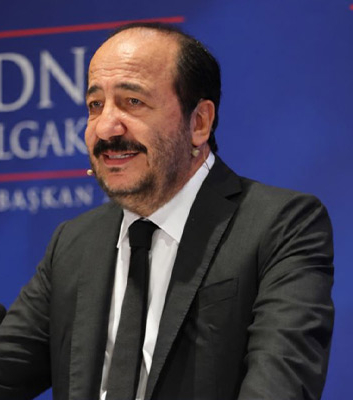
With its half-century of experience, the Turkish Clothing Manufacturers Association (TGSD), which has contributed to the development of the ready-to-wear sector, shared developments in the sector and its policy recommendations for the future of Turkish industry at a press conference it organised. At the meeting, attended by TGSD Co-Chairs Toygar Narbay and Dr Ümit Özüren, the findings presented in the Vision 2050 and Strategic Roadmap, which were also submitted to the Presidency, relevant ministries, members of parliament and representatives of political parties, as well as sectoral analyses, were discussed.
“We Need to Generate 13.6% EBITDA, While Our Competitors Need to Generate 3.6%”
Stating that geopolitical and economic developments have put Turkish industrialists at a disadvantage in global competition, Narbay said: “Today, an industrialist in Türkiye needs to generate 13.6% EBITDA simply to preserve their capital. For our global competitors operating in a low-inflation and low-interest-rate environment, this threshold is 3.6%. Due to this 10-point gap, Turkish exporters start the race behind every morning. This situation does not only concern the ready-to-wear and textile sectors; it applies to all our exporters.”
“The Break in Ready-to-Wear and Textiles Signals Risks for the Future of Industry”
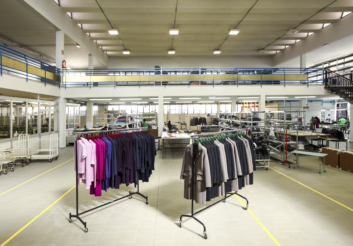
indoor clothing factory, clothes hanging
Stating that ready-to-wear and textiles are among the sectors that reflect the structural problems in industry early and strongly, Narbay said: “Following the peak we reached in exports in 2022, we lost 364,000 jobs and 10,497 businesses in ready-to-wear and textiles in the period up to June 2026. While large businesses have downsized, our production scale, skilled human resources and supply chain have also weakened. The break experienced in ready-to-wear and textiles points to risks related to scale, productivity and human resources that other branches of industry may also face in the coming period. Therefore, this picture should be regarded as a serious warning against the risk of deindustrialisation. We need a new and integrated industrial policy that brings production, exports, employment, financing, technology and branding policies together around the same objective.”
“We Presented a 138-Item Framework; Now We Need a ‘Whistling Arrow’”
Emphasising that the new industrial policy should focus not so much on the amount of support but on the results generated by resources, Narbay said: “Today, each of the supports provided for textiles and ready-to-wear corresponds to a specific need, but resources are used by different institutions and according to different priorities. As TGSD, we examined all of these existing state aid measures one by one. We eliminated 2 items from 86 incentive items, redesigned the remaining 84 items according to the needs of the sector, and added 54 new policy instruments that have no equivalent in the existing structure. Thus, we prepared a single sectoral framework consisting of a total of 138 items and submitted it to the General Directorate of State Aid at the Presidency of Strategy and Budget. Our demand is to establish a structure in which this framework is managed from a single centre and implemented as a whole. Because with a measurable, monitorable and performance-based structure, we can increase the impact of public resources on production. In fact, we have arrows; now we need a ‘whistling arrow’ that will direct all of them towards the same target.”
“The Figures in the New MTP Confirm Deindustrialisation”
Stating that the warning about deindustrialisation is not merely an assessment by the sector and can also be seen in the figures in the Medium-Term Programme (2027–2029), published on 6 September, Narbay said: “According to the table included in the new MTP, the ratio of our goods exports to national income falls from 17.1% in 2025 to 14.2% in 2029. In other words, while the economy is growing, the share of goods exports is shrinking. Moreover, the previous programme had projected a ratio of 16.4% for 2028; in the new programme, the projection for the same year has fallen to 14.5%. The fact that the expectation has been revised downward by 1.9 points within one year shows that the trend we have pointed to is also reflected in official projections.”
“Ready-to-Wear and Textiles Should Be Included Among the ‘Strategic Sectors’”
Emphasising that they consider it valuable that ready-to-wear and textiles are mentioned by name in the programme and included among the areas covered by SME support and instruments aimed at protecting employment, Narbay said: “On the other hand, while our sector is included under the heading of ‘labour-intensive sectors’ in the programme, strategic sectors are defined as areas such as defence, healthcare, semiconductors and artificial intelligence. Yet ready-to-wear is Türkiye’s third-highest unit-value export category, with a unit value of $16.2 per kilogram; together with textiles, it is the manufacturing sector making the largest contribution to closing the current account deficit, with a foreign trade surplus of $14 billion. In addition, technical textiles, smart textiles and composite materials are direct inputs for the defence and advanced materials fields that the programme considers strategic. For these reasons, we demand that ready-to-wear and textiles be included among the ‘strategic sectors’ in the MTP, in addition to the definition of ‘labour-intensive sectors’.”
“We Can Expand Trade by Establishing Production Hubs in Neighbouring Countries”
Stating that production hubs should be established under Turkish capital and management along the Syria, Northern Iraq and Azerbaijan corridor, Narbay said: “In this way, by taking on cost-sensitive orders, we can both make use of idle machinery capacity again and fill the textile and auxiliary industry capacity within the country while reducing costs. In Syria alone, we foresee 250,000 jobs and an annual export capacity of $5 billion in the medium term. While strengthening design, R&D, technical production and brand management in Türkiye, we can expand trade with neighbouring countries through a Special Industrial and Commercial Free Zone to be established in the East. In addition, under the Government Procurement Agreement (GPA), we can bring our capacity in technical textiles, protective clothing and corporate apparel to the international arena. Thus, we can gain access to the public procurement market in ready-to-wear and textiles, which accounts for $50–100 billion of this market, with a total value of approximately $1.7 trillion.”
“Made in Türkiye” Emphasis at the 19th Istanbul Apparel Conference
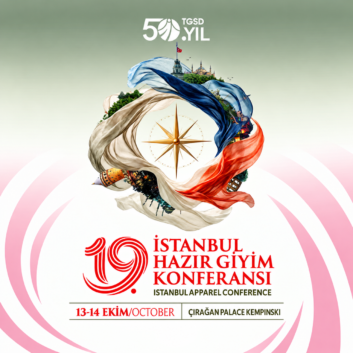 TGSD Co-Chair Dr Ümit Özüren also provided information about the 19th Istanbul Apparel Conference, which will be held on 13–14 October under the theme “Redefined Value: Made in Türkiye.” Explaining that the conference will examine the competitiveness of the Turkish ready-to-wear sector, the changing global trade landscape, new markets, sustainability and the Green Deal, artificial intelligence and digitalisation, next-generation materials and production technologies, as well as logistical advantages in the global supply chain, Özüren said: “Alongside leading figures from the sector and business world, such as Gemma D’Aura from McKinsey, Copenhagen Fashion Week Founder and CEO Eva Kruse, former Member and Vice-President of the European Parliament Heidi Hautala, McKinsey Creative and Marketing Director Paul Bennett, who will discuss Türkiye’s Position, Opportunities and Realities in the US Market, Concept Costume Illustrator and Designer Meleesa Lorrett, and TÜSİAD Chief Economist Gizem Öztok Altınsaç, figures representing Türkiye’s brand and cultural strength across different sectors will come together at the conference.”
Özüren continued: “The main message of the conference, where TGSD’s 50 years of production and export experience will meet the conditions of the new era, will be to redefine the meaning of ‘Made in Türkiye’ by taking it beyond production and together with Türkiye’s cultural and creative values, alongside its strength in innovation, sustainability, technology, design, logistics and branding. In this part of the conference, a special gathering will be held to examine Türkiye’s redefined brand value from the perspective of different disciplines. Moderated by Levent Erden, one of Türkiye’s leading marketing, communications and digital transformation experts, representatives from different sectors ranging from tourism to gastronomy and from cinema to fashion will come together to discuss how the new meaning of ‘Made in Türkiye’ can be built together. With the participation of leading figures from different fields such as Oya Narin, President of the Türkiye Tourism Investors Association, actor, producer and brand ambassador Kerem Bürsin, and Gökmen Sözen, CEO of Gault&Millau Türkiye, this session will explore how production, creativity, culture and lifestyle originating from Türkiye can be transformed into a shared value narrative, how different sectors can reinforce one another, and how the concept of Made in Türkiye can be transformed into a stronger, more distinctive and holistic brand value on a global scale. With their long-standing experience in the national and international fashion world, Ece Sükan and fashion designer Arzu Kaprol will demonstrate how design, innovation and creative vision can be brought together with Türkiye’s strong production infrastructure.”