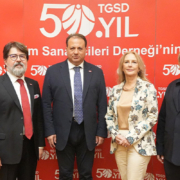
19th İstanbul Apparel Conference Focuses On Türkiye Brand and Global Partnerships
Organised by the Turkish Clothing Manufacturers’ Association (TGSD) under the theme “Redefining Value: Made in Türkiye,” the 19th Istanbul Apparel Conference addressed strategies to strengthen the sector’s global competitiveness and create new business opportunities. Approximately 2,000 bilateral business meetings were held between Turkish manufacturers and 64 global buying groups as part of the conference.
Organised by the Turkish Clothing Manufacturers’ Association (TGSD) in the year it celebrates its 50th anniversary, the 19th Istanbul Apparel Conference brought together public representatives, domestic and international manufacturers, buying groups representing global brands, academics and non-governmental organisations. Held under the theme “Redefining Value: Made in Türkiye,” the conference addressed the sector’s current position, global competitive conditions, transformation needs and strategies to strengthen the Türkiye Brand on its first day. Bilateral B2B meetings held on the second and final day brought Turkish manufacturers and international buying groups together for direct business discussions.
CALL FOR A MULTI-SECTORAL STRATEGY TO STRENGTHEN THE TÜRKİYE BRAND

Ümit Özüren, Co-Chairman of TGSD
The conference was opened by Dr Mehmet Ali Kılıçkaya, Director General of Exports at the Republic of Türkiye Ministry of Trade, and Dr Ümit Özüren, Co-Chairman of TGSD. Özüren emphasised that a common strategy to strengthen the Türkiye Brand should be developed with the participation of stakeholders from different fields, including business, academia, the public sector and civil society, to ensure that the value produced in Türkiye receives greater recognition in global markets.
Highlighting Türkiye’s manufacturing capabilities, proximity to Europe, logistics connections and flexible production capacity, Özüren stressed the importance of bringing the research capabilities of universities into closer contact with the experience of businesses. Stating that “the speed at which we transfer knowledge into production will determine our competitiveness,” Özüren underlined the need to increase the number of designs, technologies and brands developed in Türkiye. He also emphasised the importance of enabling young people to play a greater role in the sector’s future, strengthening women’s participation in the workforce and management, and placing equal opportunities and safe working conditions at the heart of the production culture.
Addressing international brands and buyers, Özüren stated that long-term relationships, predictable orders and cooperation in transformation investments would strengthen the entire value chain.
TOYGAR NARBAY: “WITHOUT A COUNTRY BRAND, THERE CAN BE NO BRANDS FROM THAT COUNTRY”
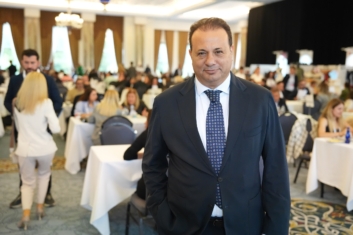
TGSD Co-Chairman Toygar Narbay
During the session entitled “We Are at a Critical Juncture: Where Is the Way Out? What Did the Reports Say, and Where Are We Today?”, TGSD Co-Chairman Toygar Narbay and TÜSİAD Chief Economist Gizem Öztok Altınsaç assessed the economic outlook for the apparel sector and its competitive conditions.
Stating that the sector was going through a challenging period while maintaining its manufacturing strength, Narbay reported that between January and July, the European Union’s apparel imports declined by 4.9%, while those of the United States fell by 8.2%. Türkiye’s decline remained limited to 1.5%. During the same period, Türkiye’s exports to North America increased by 4.6%. Narbay also noted that employment had started to rise again since the beginning of the year and that concordat applications had decreased by 28%. However, he emphasised that the current situation did not yet indicate a recovery.
Underlining that competitiveness cannot be measured solely by labour costs, Narbay stated that speed, vertical integration, market access and business standards were also decisive factors. Although the sector had increased its unit prices by 13% since 2022 and improved productivity, he explained that the 21% decline in production and rising costs had adversely affected companies’ profitability. Drawing attention to the likelihood that uncertainty would persist in the coming years, Narbay emphasised Türkiye’s potential as a strong sourcing partner for Europe, stating: “Nearshoring is not a preference; it is insurance.”
Narbay also discussed the 138-point framework submitted to the Presidency’s Directorate of Strategy and Budget as part of TGSD’s Strategy Map and Vision 2050 study. He stated that 83 of the existing 86 support measures had been revised and 55 new proposals added. Outlining recommendations such as a 10% exchange-rate adjustment support for net exports, increased employment support based on regional development levels, and the establishment of a comprehensive three-year financing bridge, Narbay highlighted the importance of qualified manufacturing, digitalisation, artificial intelligence investments and investment in the Türkiye Brand. He stated that the sector could reach a size of USD 39 billion by 2050 if strategic measures were implemented.
APPROXIMATELY 2,000 BILATERAL BUSINESS MEETINGS WITH 64 GLOBAL BUYING GROUPS
 The bilateral B2B meetings held on the second and final day of the conference provided an opportunity for domestic manufacturers and buying groups representing international brands to establish new business connections. A total of 64 buying groups, predominantly from Europe and the United States, participated in the meetings, with 25 of these groups attending with the support of the Republic of Türkiye Ministry of Trade. Approximately 2,000 bilateral business meetings took place between Turkish manufacturers and buying groups.
Highlighting the importance of B2B meetings in reaching new customers and developing existing commercial relationships, Toygar Narbay stated that global brands consider delivery speed, quality, flexible manufacturing and inventory management, alongside product price, when making sourcing decisions. He noted that Türkiye’s capabilities spanning design through to production, combined with its proximity to key markets, enabled the country to meet these expectations.
Narbay stated that the priority was to convert these advantages into long-term orders. Emphasising the importance of relationships between brands and manufacturers based on mutual trust and predictability, he noted that a regular flow of orders would strengthen manufacturers’ capacity and investment planning while enabling brands to respond more quickly to changing demand. He added that the aim was to turn the direct contacts established during the conference into new orders, greater market diversification and lasting business partnerships.
The following companies participated in the B2B event with stands: Adenza, AHKİB, Bolero, Burteks, Deniz Tekstil, Erateks, Gelişim Tekstil, Kyass, Kumaş Tekstil, Lefaxx Jeans, Marka Tela, Murat Çorap, Palmiye Tekstil, Penti, Simteks, Teda Tela and ZH Dış Ticaret.
Gemma D’Aura, Global Leader of McKinsey’s Apparel and Luxury Fashion sector, was the conference’s international opening speaker. She delivered a presentation entitled “The New Value Equation: Where Does ‘Made in Türkiye’ Win?”
Founded in 1976, TGSD continues its work to support the development of Türkiye’s apparel industry, promote the sector internationally and strengthen industry cooperation. Through the Istanbul Apparel Conference, the association aims to enhance the sector’s global competitiveness and support the development of international business relationships.