“We Must Offer Customers Innovative Software And Excellent Service To Stay Competitive”
Interview: Dilek Hayırlı
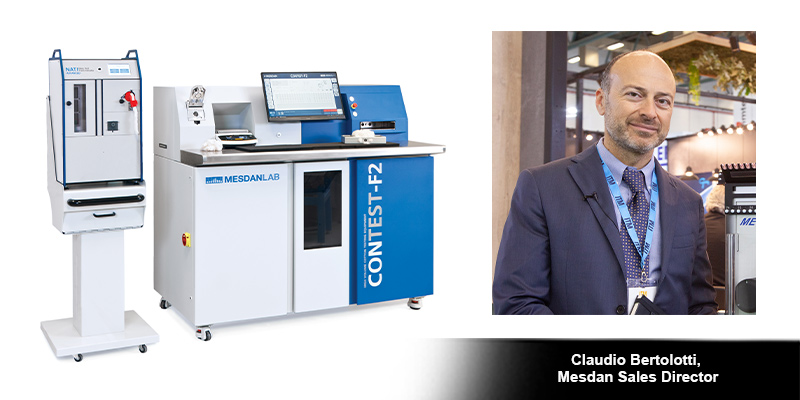
Although the outlook for the textile industry in 2025 is challenging, Mesdan® has demonstrated stable performance by maintaining its sales. Claudio Bertolotti, Sales Director at Mesdan, emphasizes that in an increasingly competitive environment, the key to making a difference lies in innovative software, excellent service, and technical expertise.
When it comes to textile machinery and laboratory technologies, Italy has long been regarded as a global benchmark thanks to its engineering quality, design-driven approach, and technical know-how. Today, Mesdan® is one of the brands that continues this tradition by positioning quality control not merely as a testing process, but as a specialized field that requires knowledge, experience, and consultancy. In our interview with Mesdan Sales Director Claudio Bertolotti, we discuss how Italian engineering is reflected in quality control technologies, the impact of changing yarn structures on testing processes, and Mesdan®’s global growth strategy beyond 2026.
“OUR SALES WERE AT THE SAME EXTENT AS IN THE PRECEDENT YEARS”
In a period marked by global uncertainties, how would you describe 2025 for the textile laboratories and quality control equipment sector?
 Market situation in 2025 was not good for the textile industry generally. For the business of quality control instruments, instead, it was not that bad for Mesdan, thanks to the educational and R&D customers, who luckily do not strictly follow the trend of the industry and are less sensitive to the geopolitical tensions and uncertainity of the period. In fact, our sales were at the same extent as in the precedent years.
Quality, traceability, and compliance with standards are becoming increasingly critical in textile production. How is the role of textile laboratories evolving today? In your view, how are expectations regarding accuracy, repeatability, and speed in testing processes changing?
Role of quality control became important already years ago, with the moving of the production sites to cheaper production locations and the needs of quality assurance under standard and consistent conditions. Today, QC is also important in the prospectives and with the purpose of sustainability and recycling of the texile materials. At the same, in some high-end manufacturing mills and testing houses, the automation and the digitalization of the lab equipment is also playing an important role in the purchasing decisions.
Mesdan-Lab holds a strong global position in quality control equipment for textile laboratories. What are the core engineering and design approaches that make this competitiveness sustainable? Which technical criteria are prioritized during the product development process?
Competitors from Asiatic countries like China and India are adopting higher manufacturing quality standards and everyday get more and more aggressive on the global market, promoting their instruments also in our own country. Mesdan Lab equipment are all still 100% manufactured in Italy, hence we can’t make them cheaper. Today is not anymore enough for us to manufacture a good instrument, but it is essential to be able to provide customers with an innovative software, and an excellent service, not only in terms of after sales, but also by guaranteeing to customers all our deep and long-terms expertise and technical knowledge.
“NEW YARNS PUSHED MESDAN FOR A HARD WORK”
The growing diversity of yarns—such as recycled yarns, technical yarns, and high-tenacity or elastic fibers—creates new requirements for laboratory testing processes. How has Mesdan® adapted its testing methodologies and equipment designs to meet the needs of these new yarn types?
 This issue for Mesdan has been more critical for the Yarn Joining division; new yarns pushed Mesdan for a hard work of testing and designing of new splicers and mingling chambers, to be able to process them all.
Knotting machines continue to play a critical role in yarn preparation and testing processes. What technical advantages do Mesdan® knotting machines offer in terms of mechanical performance, knot strength, and process reliability?
Our Yarn Joining R&D is not focussed on mechanical knotters anymore; but the creation of those new yarns required the continuous development of new configurations and components for our pneumatic splicers, both for the automatic winding machines and all the hand-operated applications (twisting, weaving preparation, yarn dyeing, technical yarns processing, etc).
Sustainability has become an important focus even in laboratory testing processes. How do Mesdan® solutions contribute in areas such as energy efficiency, reduced testing time, and minimizing sample and consumable usage?
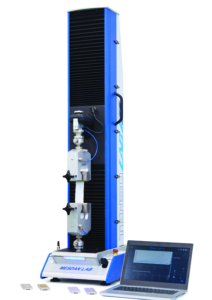
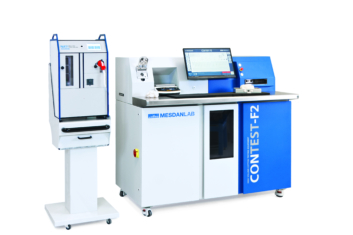
Our lab range is always under upgrading and renovation, and the number of fully automatic instruments is being increased. Contest-F2 and Contest-S are automatic equipment for the fibre testing recently developed; Autofil and Autodyn 3 are automatic tensile yarn strength tester; all the other yarn testing instruments (for the twist, the friction, the evenness, the knitting, etc) are also available in the fully automatic version.
“WE HAVE AN IMPORTANT MARKET SHARE IN THE EU COUNTRIES AND NORTH AMERICA”
Competition in the global textile machinery and laboratory equipment market is intensifying. In which key export markets does Mesdan® currently hold a strong position? What kind of demand do you observe for laboratory investments in emerging markets?
Mesdan holds a significat market share in many markets. New investments in emerging markets are not always ready to pay more for a top-quality laboratory but luckily Mesdan has an important market share also in the EU and North America, where QC requirements are higher and Mesdan is recognized as a manufacturer of innovative and high-tech instruments.
Türkiye is one of the strategic markets in terms of textile production and laboratory infrastructure. How do you evaluate the Turkish market from Mesdan®’s perspective today? Which segments do you see as offering new opportunities in the coming period?
Türkiye hase been for long one of the most important countries in the textile industry; unfortunately the economic difficulties that the country is facing today do not help to have very positive prospectives for the future; we have seen already investments in the sector moving to Egypt or elsewhere. More or less as we experienced in Italy and in the EU 20 years ago.
Looking at the next five years of the textile laboratory sector, which technological and structural transformations do you believe will be most decisive? What role will standards, digitalization, and automation play in this transformation?
As I said, besides the equipment itself, we must give customers innovative software and excellent service; we must become a technical consultant for them, a specialist, supporting them with our long-terms expertise and technical knowledge in quality control and also yarn joining.
What are Mesdan®’s key strategic priorities for 2026 and beyond? Which areas stand out in terms of new product development, R&D investments, digital solutions, and global growth plans?
Between 2026 and 2027 (when ITMA will be held), many of our R&D projects will see the light and important lab equipment will be launched on the market; both completely new instruments and restyling/renovation of already existing instruments