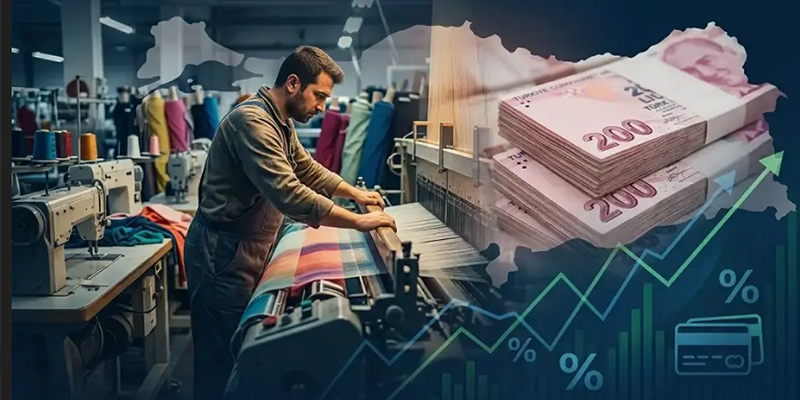
Dual Support for the Textile and Manufacturing Sector
With statements made by Minister of Labor and Social Security Vedat Işıkhan and Minister of Industry and Technology Mehmet Fatih Kacır, a comprehensive support package targeting the textile, apparel, and manufacturing sectors has been put into effect. The announced programs aim both to preserve employment and to strengthen businesses’ access to financing.
Minister of Labor and Social Security Vedat Işıkhan emphasized that strong support will be provided to the manufacturing sector through IŞKUR, announcing that a total budget of 50 billion TL has been allocated for 2026. Within this scope, businesses operating in textile and furniture production that maintain their number of insured employees will receive support of 3,500 TL per employee. Additionally, other SMEs in the manufacturing sector will be provided with financing support of up to 50 million TL, on the condition that they preserve employment.
“Performance Support” started on March 2nd
Minister of Industry and Technology Mehmet Fatih Kacır announced that a “performance support” scheme has been launched for the textile and apparel sectors under the “Credit Financing and Employment Protection Program for the Manufacturing Industry.” As of March 2, within the scope of the program, sectors with high labor intensity such as textiles, apparel, leather, and furniture will receive 3,500 TL support for each job retained, corresponding to 30 premium days. The main objective of the program is to protect approximately 1.1 million jobs.
On the financing side of the program, manufacturing companies will be provided with access to 100 billion TL in favorable loan opportunities. The aim is to increase the resilience of the manufacturing sector by providing access to financing. The loan amount cannot exceed the monthly average of the company’s total earnings subject to premiums for November and December 2025. The maximum loan limit per company will be 50 million TL. The loan will be disbursed in a single transaction by the end of June 2026.
In addition, investment incentives, R&D, and design supports continue in order to support long-term transformation in the sector. Since 2012, thousands of investment incentive certificates have been issued in textile manufacturing, targeting billions of lira in investments and the creation of hundreds of thousands of jobs. Projects carried out with co-financing between Türkiye and the European Union also aim to increase efficiency and added value in the sector.
Investment Incentives and EU Co-Financed Projects
Kacır stated that 6,699 investment incentive certificates have been issued in textile product manufacturing since 2012, and these certificates foresee investments of 957 billion TL. For clothing manufacturing, 5,000 incentive certificates have been issued, targeting investments of 110 billion TL and the creation of 628,000 jobs. He also reminded that a 34 million euro project, co-financed by Türkiye and the EU, is underway, aiming to increase productivity and added value in textiles, ready-made clothing, and furniture.
Meanwhile, data from the United Brands Association (BMD) presents a striking picture of the sector’s current situation. BMD President Sinan Öncel stated that in January, four out of every five brands experienced declines in both sales volumes and revenues. The percentage of brands reporting a decrease in unit sales was given as 90% in footwear and 77% in ready-to-wear. Öncel stated that in the annual comparison, 58% of brands increased their unit sales and 92% increased their turnover, but approximately half of the brands’ turnover growth lagged behind the CPI.
While the announced support packages are considered an important step against the demand contraction and cost pressures faced by the sector, they are expected to play a critical role in preserving employment, ensuring production continuity, and enhancing the financial resilience of companies.