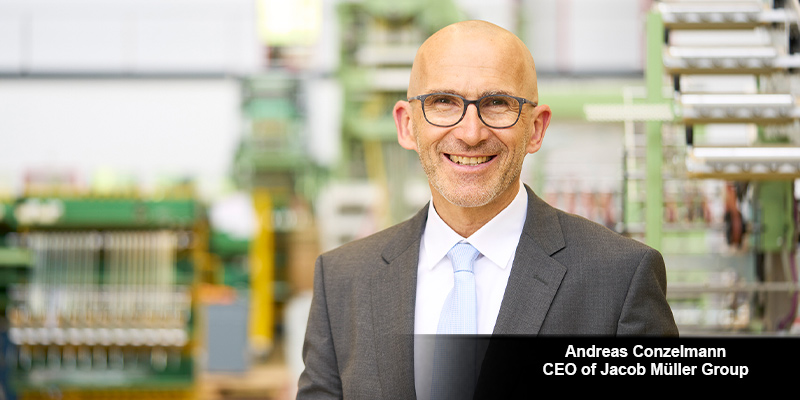
“We Accept Digitalization As The Backbone of Modern Manufacturing”
Interview: Tuğba Karademir
The Jakob Müller Group is making a difference in the industry with its innovation- and sustainable production-oriented solutions in the field of narrow fabrics and label machines. Despite the uncertainties experienced in 2025, the company’s flexible and advanced technology-based approach continues to provide customers with comprehensive solutions.
One of the leading names in the textile machinery sector, the Jakob Müller Group left 2025 behind in a challenging market environment. Andreas Conzelmann, CEO of the Jakob Müller Group, shared in an interview with Tekstil Teknoloji Magazine the developments in the field of narrow fabric machines, the value that the integration of MEI International has added to the company’s portfolio, and innovations focused on digitalization and sustainability. Conzelmann also evaluated the opportunities in Türkiye’s dynamic textile market and the collaborations planned with local manufacturers in the coming period.
How was the year 2025 for Jakob Müller Group? What were the main challenges and opportunities for the narrow fabric machinery sector?
Like many of our customers, the Jakob Müller Group navigated a challenging environment in 2025 within the narrow fabric machinery sector. Order intake fell somewhat below expectations, primarily influenced by the current global geopolitical landscape. While we did observe pockets of growth in specific regions, market activity in many areas remained stalled due to the high degree of global uncertainty.
The integration of MEI International into the Jakob Müller Group has attracted considerable attention in the industry. How has this integration progressed, and what strategic advantages does it bring to your product portfolio in the narrow weaving and label sectors?
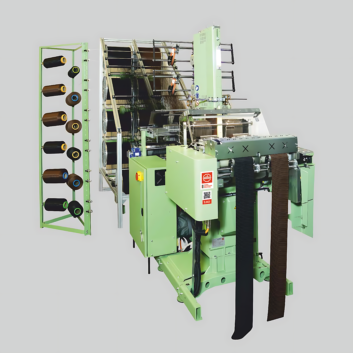 The integration of MEI is progressing according to plan, and we expect to finalize the consolidation of our sales channels by the third quarter of 2026. Strategically, this union provides our customers access to the most comprehensive range of label production solutions on the market. It enables us to offer a full spectrum of choices – ranging from ultra-flexible rapier looms to high-productivity air-jet label weaving machines. Ultimately, this consolidation ensures that customers have a single, reliable partner for all their weaving and labelling needs, supported by a unified global service network.
Narrow fabrics are used in many industries, from apparel and labels to automotive and technical textiles. What are the most important technological trends shaping this segment, and how is Jakob Müller responding to these developments?
We are witnessing a significant trend toward versatility. Manufacturers today require machinery capable of rapidly switching between the production of simple tapes and complex technical solutions. Jakob Müller has responded to this demand with modular machine architectures designed for quick style changes and high adaptability. Furthermore, we are addressing the massive industry push toward sustainability by engineering our systems to efficiently process recycled yarns and natural fibres.
How do you see the role of air-jet weaving evolving in the narrow fabrics sector, and what innovations is Jakob Müller developing in this field?
Jakob Müller has been an established player in this domain for many years, and with the acquisition of MEI, we have significantly reinforced our offering. These advanced machines allow our customers to maximize productivity on scales that were previously unattainable, particularly for large batch sizes. In collaboration with MEI, our aim is to render high-speed production more economically and environmentally viable.
Digitalization and smart production systems are becoming increasingly important for textile manufacturers. What kinds of automation, monitoring or digital solutions does Jakob Müller offer to help manufacturers improve efficiency and quality in narrow fabric production?
We view digitalization not merely as an add-on, but as the backbone of modern manufacturing. Through our new Müller Connect 2.0 Interface, we enable direct machine networking. This facilitates remote diagnostics and predictive maintenance, seamlessly integrating with third-party services to enhance efficiency and quality.
Türkiye has a strong and dynamic textile industry. How do you evaluate the Turkish market for Jakob Müller Group, and what cooperation opportunities do you see with Turkish manufacturers in the coming years?
Türkiye remains one of our most vital and dynamic markets. The Turkish textile industry is known for its resilience and ability to adapt quickly to both fashion and technical trends – attributes that align perfectly with our flexible machinery solutions. We see immense cooperation opportunities specifically within the technical textile sector. As Turkish manufacturers move up the value chain into automotive, medical, and other technical applications, they require the precision and reliability that Jakob Müller provides. We are committed to strengthening our local presence, offering not only machinery but also the technical consultancy required to help Turkish partners transition into these high-value niches.
While the final machine line-up for ITM 2026 is currently being finalized, we are excited to announce that we will be introducing LAB1887; our new collaborative innovation hub dedicated to narrow textiles.