“Türkiye is One Of The World’s Most Important Yarn Production Hubs”
Interview: Tuğba Karademir
By accelerating its strategic transformation through the acquisition of Barmag, Rieter is expanding its global strength in both natural and synthetic fibers. With innovations focused on automation and digitalization, the company is redefining the balance between efficiency and sustainability in yarn production.
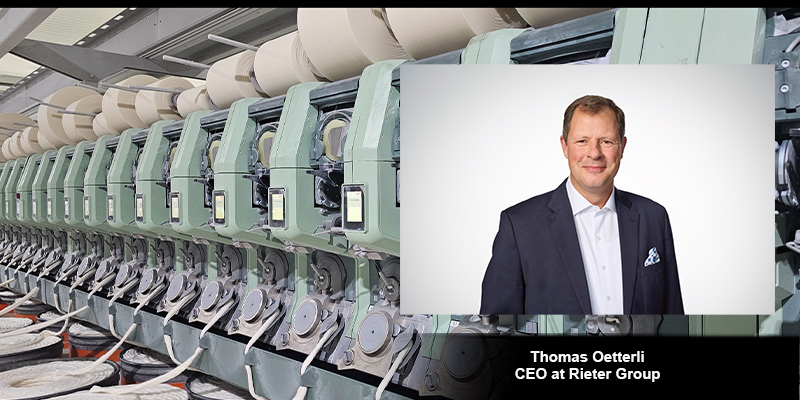
Amid the ongoing transformation of the global textile industry, Rieter is further solidifying its position through strategic investments and advanced technology solutions. The Barmag acquisition, completed in 2026, marked a strong entry into the synthetic fiber sector, positioning the company to shape the future of yarn production with its focus on automation, digitalization, and sustainability. In this exclusive interview with Rieter Group CEO Thomas Oetterli, we discussed the company’s global strategies, its perspective on the Turkish market, and the innovations it will showcase at ITM 2026.
How was the year 2025 for Rieter?
 Rieter successfully completed the acquisition of Barmag on February 2, 2026, and reached an important milestone in the company’s repositioning. Barmag has been integrated into the Rieter Group as the “Man-Made Fiber” Division. With this strategically transformative acquisition, we are expanding our core business beyond the short-staple fiber business in a targeted way. This positions Rieter as the global market leader along the entire value chain for natural and man-made fibers. In addition, as a complete systems supplier, Rieter is further strengthening its technological leadership in the areas of automation and digitization.
“There is No Automation Without Digitization”
Rieter is known for offering integrated solutions across the entire spinning process. What have been the most significant technological developments or product improvements in your spinning systems over the past year?
One of the most pressing challenges for the spinning industry is the shortage of skilled labor. This is why Rieter’s Vision 2027 is mission-critical for spinners: a fully automated spinning mill designed around technologies that address this need head-on and help to boost mill efficiency. Our customers can already today improve productivity with automation modules such as driverless transport systems and automated packaging solutions, which significantly reduce manual workload. By 2027, Rieter aims to enable mills to produce 1.9 tons of yarn per shift with just three qualified operators per 10 000 spindles.
 There is no automation without digitization. We therefore also strengthened our leadership in digitization through further advancing Essential, our digital mill management system. Essential gives customers transparency in real-time across production, quality and energy data. This allows our customers to make faster, fact‑based decisions and optimize processes within and across spinning mills.
Another key area of innovation is recycling, which addresses the growing demand for circular solutions amid tightening regulations such as the EU laws for sustainable textile consumption. Rieter developed advanced technologies in fiber preparation, carding and combing that enable mills to run stable processes with shorter, more variable recycled fibers while achieving high recycled content without compromising yarn quality. This supports spinners as EU laws for sustainable textile consumption must be observed and consumers increasingly demand sustainable products.
Air-jet spinning technology continues to attract strong interest from manufacturers. How has the market responded to the air-jet spinning machine J 70, and what advantages does this technology offer in terms of productivity, yarn quality and energy efficiency?
The market’s response to the air-jet spinning machine J 70 has been positive. Our customers value its spinning speeds of up to 600 m/min, which deliver unmatched productivity combined with consistent yarn quality and low energy consumption. These enviable attributes help our spinners address two key challenges at once: cost pressures and sustainability goals.
The J 70 also opens up new possibilities. Its excellent raw‑material utilization enables the economical spinning of carded yarn. A newly developed twist element makes this possible by taking production speeds to a new level and ensuring peak raw-material utilization. Spinning mills also benefit from this innovation when processing other raw material applications. In addition, downstream processors report excellent running characteristics in subsequent processing stages.
“Türkiye is A Highly Strategic Market For Us At Rieter”
Türkiye is one of the world’s most important yarn production hubs. How do you evaluate the Turkish market for Rieter, and what opportunities do you see for further cooperation with Turkish spinning mills?
 As one of the world’s most important yarn production hubs, Türkiye is a highly strategic market for us at Rieter and a priority in our long-term commitment. The country combines a long textile tradition with a modern, export-driven industry. Well-known international fashion brands rely on the quality of the high-end products produced there. Rieter’s technology portfolio is ideally suited to support the country’s focus on quality, flexibility, automation, digitization and sustainability. For more than 50 years, we have been playing our part in shaping this fascinating and dynamic market.
Turkish spinning mills are early adopters of advanced automation and digitization, and we see significant potential to deepen our cooperation, particularly in the areas of energy-efficient spinning systems, recycled-fiber processing, and end-to-end automation. With our comprehensive systems portfolio and strong local presence, we are well positioned to support Türkiye’s continued leadership in global yarn production.
The upcoming ITM 2026 International Textile Machinery Exhibition will be a key meeting point for the global textile machinery industry. What technologies, systems or innovations will Rieter highlight at ITM 2026, and what solutions will be particularly relevant for spinning mills?
ITM 2026 is a major milestone for Rieter, where we will present a focused portfolio designed to help the region’s customers enhance cost efficiency, strengthen responsiveness and boost competitiveness. The event will also mark our first-ever joint appearance with Barmag.
Rieter will showcase its latest automation solutions that enable the step-by-step implementation of the fully automated spinning mill for ring and compact-spinning mills, further advancing on our path toward Vision 2027 with the fully automated spinning mill. A key highlight is our new universal compacting solution COMPACT4, which sets new benchmarks in flexibility, reliability and spinning efficiency. With optimized spinning geometry, low maintenance requirements and low energy consumption, it delivers excellent yarn quality and outstanding cost effectiveness.
We will also highlight the combing preparation machine OMEGAlap E 40, which has achieved up to 33% higher productivity than its predecessor and delivered energy savings of up to 30% at customer sites. Our rotor spinning machine R 70, which reduces energy consumption per kilogram of yarn by up to 10% compared to the segment benchmark also convinces customers with 7 to 15% higher productivity while reliably delivering superior yarn quality. Additional ITM 2026 highlights include AI-enhanced raw material yield and yarn quality for the card C 81 and latest innovations for spinning recycled fibers.