“After Devoting 45 Years To The Industry, I Will Not Move To Another Country”
Interview: Dilek Hayırlı
Founded in 1985 with weaving and finishing operations, Felin Tekstil continues today to serve global industry leaders in the field of contract finishing with its advanced finishing technologies, strong machinery park, sustainable production approach, and distinctive fabric hand-feel expertise.
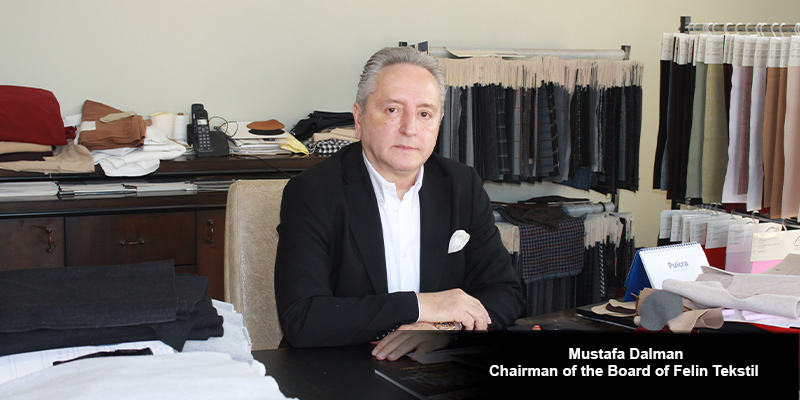
Mustafa Dalman, Chairman of the Board of Felin Tekstil, shared the company’s production journey from past to present and offered his insights into the current state of the industry with Tekstil Teknoloji magazine.
WHAT STARTED WITH 2 STENTER MACHINES HAS EVOLVED INTO A VAST FLEET OF MACHINES
 Having received a formal education in textiles, industrialist Mustafa Dalman describes his early years in the sector as “come up through the ranks.” Starting to work in textile dyeing and finishing plants at a young age, Dalman decided to put the experience he gained—after learning every detail of the trade—into his own venture. Laying the foundations of Felin Tekstil in the early 1980s, Dalman initially outsourced all production and offered fantasy fabrics for the domestic market. Over time, as the need to take greater control of production emerged, investments in weaving looms as well as dyeing and finishing facilities become a current issue.
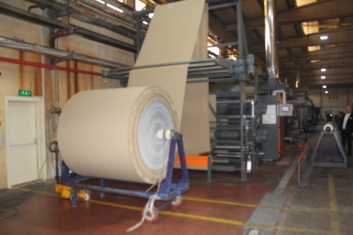
The major fire that struck the Istanbul-based facility in 2003 opened the door to a new beginning for Felin Tekstil. Following the fire, Dalman made a crucial decision and laid the foundations for the modern facility located in the Ergene Organized Industrial Zone. The new facility, which became operational in 2004, quickly grew, particularly through investments in dyeing and finishing. Starting with two stenter machines, the journey evolved into a large machinery park with nine stenter machines, washing machines, eight raising machines, scouring machines and various finishing systems, in response to increasing demand. The facility, covering a total of 22 acres of land with 14,000 square meters of enclosed space, currently employs 230 people and operates with a daily production capacity of 40 tons of fabric.
PRODUCES FABRICS FOR MILITARY AND POLICE UNIFORMS
The company’s production range includes polyester–viscose, elastane polyester–viscose, wool, wool–polyester, linen, and linen-blend fabrics for coats, skirts, jackets, trousers, suits, blouses, and shirts, as well as 100% cotton plain, striped, and checked fabrics. Stating that they have produced women’s and men’s outerwear fabrics for many years, Dalman emphasizes that Felin Tekstil has never been a company that “does what everyone else does,” highlighting their focus on creating special collections. The product range, extending from suiting fabrics to trouser and coating fabrics, stands out with its patterns, touching, and finishing details. Still preferred for projects with high quality expectations, Felin Tekstil continues to produce fabrics for the uniforms of the land forces, gendarmerie, and police today.
A TURNING POINT: CAPTURING THE WOOL TOUCHING IN POLYESTER-VISCOSE FABRIC
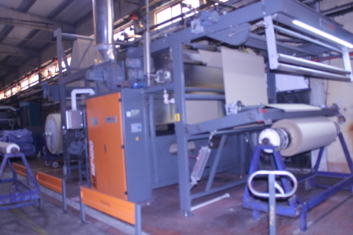 Stating that the key factor differentiating Felin Tekstil in the industry is the quality of fabric touching, Dalman explains that the goal of achieving a wool-like touching—especially in polyester–viscose fabrics—has guided all of their investments. He describes a strategic investment made in 2004 as a turning point for the company and the sector: “At that time, wool was very expensive and the market had shifted toward polyester–viscose fabrics, yet these fabrics were far from the noble texture of wool. I began to research how a wool touching could be imparted to polyester–viscose fabrics. As a result of my research, I discovered that the ‘Decatizing’ machine could successfully achieve this process. I purchased a decatizing machine from a local manufacturer. Thanks to this machine, we were able to give polyester–viscose fabrics a wool-touching. This move created a major differentiation and growth momentum for us in the market. At the time, our colleagues and friends in the industry would visit our facility, trying to uncover the secret behind this texture. Of course, later on, everyone started to imitate us.”
“I CHOOSE THE MACHINE ACCORDING TO THE FABRIC”
Explaining that the main criterion in machinery investments is the ability to achieve the fabric he envisions, Dalman says, “I never invest in a machine before the fabric is fully formed in my mind.” Trial processes carried out together with the R&D team ensure that customer demands are introduced to the market with the correct finishing applications.
“UNTIL THE LAST FIVE YEARS, I WAS EXPORTING TO MANY COUNTRIES INCLUDING EUROPE AND THE UNITED STATES”
Stating that for many years he carried out intensive exports to various regions—primarily numerous European countries, as well as Eastern Bloc countries such as Russia and Ukraine, and the United States—Mustafa Dalman notes that he has consciously stepped away from fabric production over the past five years. Dalman explains: “For many years, I was actively involved in both domestic and international markets. However, by the time I reached the last five years, I clearly realized that fabric production is an extremely demanding and stressful field, both physically and mentally. For this reason, I decided to stop fabric production. Today, I focus solely on contract finishing services; by providing washing, dyeing, finishing and raising services, we prepare the fabrics of various manufacturers for the market.”
“THANKS TO THE RECYCLING SYSTEM, WE HAVE REDUCED WATER CONSUMPTION BY HALF”
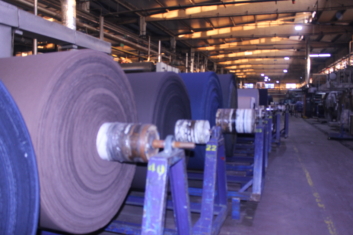 Felin Tekstil is part of the supply chain of global brands such as Inditex Group (Zara), Marks & Spencer, and Primark, as well as leading domestic brands including Koton, LC Waikiki, and DeFacto. Within the scope of these collaborations, regular audits, environmental reporting, and waste management practices are carried out with great diligence. Emphasizing that compliance with the production standards of global industry leaders has become a necessity, Mustafa Dalman also draws attention to the company’s environmentally friendly investments. He states that thanks to water recycling systems, they have reduced water consumption by half, thereby achieving significant savings in natural gas, steam, and electricity usage as well. Waste management, stack filtration systems, and environmental reporting processes are monitored on a regular basis.
“OUR AIM IS TO PRODUCE FABRICS THAT ENABLE THE MID-MARKET SEGMENT TO DRESS WELL”
According to Mustafa Dalman, current economic conditions have reshaped consumer behavior and the fundamental dynamics of today’s textile market. The focus has shifted away from high-priced fashion toward producing stylish, high-quality–looking fabrics at accessible costs. Dalman states that they have built their strategy around “dressing the mid-market segment well.” Working together with the design and R&D teams, Dalman explains that despite cost pressures, they develop fabrics that look high-end yet remain economical. He adds: “The share of the luxury segment is limited; our goal is to enable the middle segment to dress more elegantly and with better quality. We offer products that convey a premium fabric feel through their design, touching, and finishing, while still being affordable.”
“WE ARE TRYING TO OVERCOME THE CHALLENGING ECONOMIC PERIOD BY PRESERVING OUR WORKFORCE AND MACHINERY PARK”
Emphasizing that Türkiye’s textile industry has been under significant cost pressure in recent years, Mustafa Dalman points out that the widening gap between exchange rates and production costs has made exports increasingly difficult. Felin Tekstil’s strategy in this period is clear: to remain in Türkiye and to protect its existing infrastructure and skilled workforce. Saying, “After dedicating 45 years to this business, I will not move to another country,” Dalman continues: “I have devoted 45 years of my life to this industry, and I am determined to stay in Türkiye and resist until the end. Our production quality is at a level that is recognized worldwide. However, the imbalance between labor and energy costs and the exchange rate has pushed us toward contract manufacturing. We have defined our strategy to preserve what we have, to keep our experienced workforce and strong machinery park alive.”
“WE PRODUCE FABRICS BETTER THAN ITALY”
Reinforcing his belief in Türkiye’s strength in textiles with a personal anecdote, Mustafa Dalman shares the following: “At one point, a customer did not like the fabric we produced. We then invited one of Italy’s most renowned fabric experts to our facility. After working for many hours, the Italian master produced a fabric, yet the customer did not like his fabric and returned to the one we had made. We do the finest work both in fabric production and in sewing.”
“TEXTILES WILL NEVER DISAPPEAR IN THIS COUNTRY”
With 45 years of experience, Mustafa Dalman delivers a clear message to the industry, stating that textiles will continue to be an indispensable production field in Türkiye. Referring again to the example of Italy, Dalman says: “Textiles will never disappear in this country; they may become more boutique-oriented, they may transform, but just as in Italy, they will always continue to exist. Türkiye’s production know-how, technical capacity, and human resources are the greatest assurances of this.”