Metod Makina’s Global Roadmap: Efficiency, Safety, and Sustainability
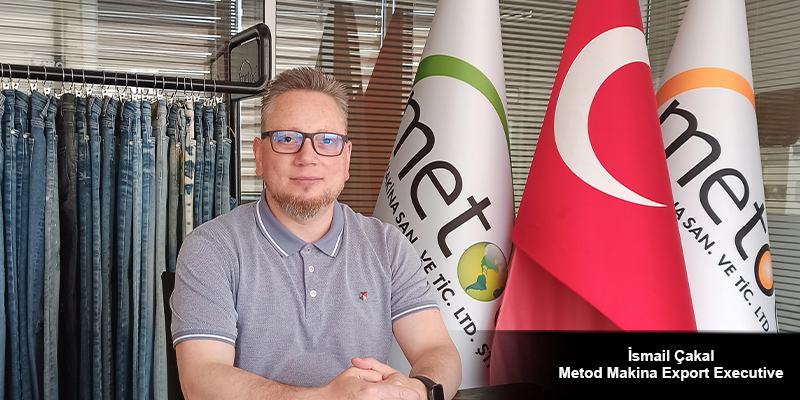
Metod Makina Export Executive İsmail Çakal assessed the transformation in the sector under the deepening global economic challenges, changing denim production trends, and increasing cost pressures following the pandemic; he explained the roadmaps ranging from ozone technologies to robotic systems, from export strategies to R&D investments.
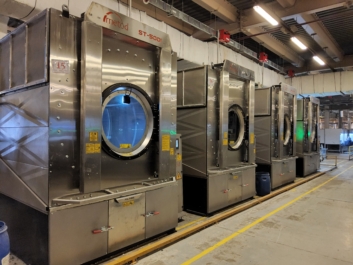 Metod Makina, a leader in denim dry and wet process technologies since 2002, faced a challenging test in 2025, both in Turkiye and globally. Rising production costs, low exchange rates, and a slowdown in global investments drove companies towards more efficient, sustainable, and automation-based solutions. In this interview with İsmail Çakal, Export Executive of Metod Makina, we discussed changing production trends, the advantages that innovative systems like MetoZone and Hawk-Eye bring to the sector, the new balances in export markets, and the company’s future vision.
How was 2025 for Metod Makina? What changes in demand or trends did you observe in denim dry processing equipment, both in Turkiye and in international markets?
I can say that 2025 was the most challenging year for our company since its establishment in 2002, a year in which we have achieved many firsts in the sector, including the pandemic period. Although our total sales figures were at the average level of the last three years, the significant increases in general production costs and fixed expenses due to current market conditions, and the exchange rates remaining below the desired levels, caused us to take on projects under more difficult conditions and complete many projects with very low profitability, despite the increase in our sales.
Although we primarily serve the denim industry, we also operate in different areas. Demand for dry processing equipment, particularly certain machine groups, began to decline approximately 6-7 years ago due to changing production trends in the sector. In response to both this decrease in demand and requests from our customers, we added wet processing machine groups to our product range. Indeed, in recent years, a large portion of our orders have been for wet processing machines rather than dry processing machines.
Recent increases in overall production costs, particularly labor costs, have forced domestic manufacturers to seek new locations with lower production costs, such as Egypt. The relocation of production abroad by the sector’s main players has led to a near standstill in domestic investments. In fact, the year 2025 saw a significant slowdown in the sector due to economic difficulties experienced not only in Turkiye but globally; this was reflected in a noticeable decrease in investments abroad.
You mention that each machine undergoes pre-production and post-production testing processes. How have the technical improvements you made to your products in 2025 concretely contributed to your customers’ production efficiency and reduced errors?
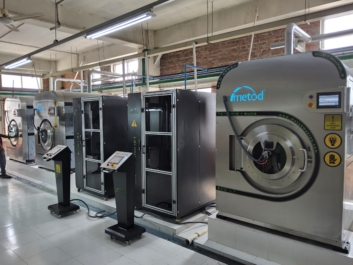 The testing process is a critical stage in identifying and resolving potential problems and manufacturing defects before shipment, ensuring complete product delivery, and allowing our customers to quickly integrate them into production after delivery. While our machines have standard features, we make flexible adaptations in terms of software and design according to customer demands. We meticulously evaluate feedback from end users and place this feedback at the center of our product development processes. Every improvement supports the performance, efficiency, and long-lasting, trouble-free operation of our products. For example, as a result of recent tests on one of our products, we achieved approximately a 15% improvement in total energy consumption without any loss in performance. Thanks to this improvement, our customers can reduce their cost per product by producing with lower energy consumption.
“Thanks to Our MetoZone and Ozone Plus Systems, the Use of Pumice Stone Has Decreased by 90%”
How does the MetoZone Ozone Application System offer performance advantages to businesses in terms of environmental impact, chemical reduction, and effect quality in denim washing processes?
Unfortunately, the textile industry is one of the sectors that causes the most environmental damage. In recent years, ozone application systems, developed with the goal of sustainable production and increasingly used, provide businesses with savings in time, energy, water, and chemicals. Thanks to our MetoZone Ozone Application System and its integrated Ozone Plus auxiliary system, our customers achieve significant gains in many areas. The Ozone Plus System, with its special injector developed entirely in-house, offers the possibility of achieving the desired effect with minimal environmental impact using only a very small amount of water or special chemicals (10-50 ml) per product.
Today, our MetoZone and Ozone Plus systems are actively used in countries such as Bangladesh, Pakistan, Egypt, Mexico, Colombia, and Vietnam due to their compact structures. Thanks to these systems, many of our customers have reduced the amount of pumice stone used in traditional methods by up to 90%, while some have switched to completely stone-free production. Considering the product, storage, and cleaning costs of pumice stone, as well as capacity loss and environmental impact, the contribution this reduction provides to businesses is quite significant.
What technical advantages do the control systems and mechanical designs used in your denim drying process machines offer in terms of effect repeatability and reduced operator dependency?
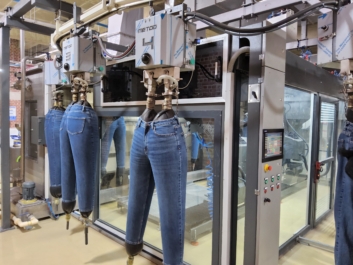 First, I would like to point out that one of the biggest problems faced by our clients, especially those in the growth phase, is space constraints. If our clients have specific requirements regarding machine layout dimensions, our project team prepares custom designs for them, and after final approval, we proceed with the production process.
When developing products, our priorities include ease of shipping and in-house deployment, and simplicity, clarity, and speed of use, maintenance, and cleaning for the end user. Accordingly, we conduct R&D, product development, and production-focused designs for each product. We place great importance on feedback from the field to ensure operators can use the machines in the simplest, most error-free, and shortest possible time.
All these elements aim to increase efficiency and ensure continuity in production by strengthening operator-machine harmony. For example, thanks to our patented Robotic Spraying System (Hawk-Eye), operators can use the recipes recorded in the system repeatedly with the same standard. This system, based on the principle of unmanned production, prevents the operator from being exposed to chemicals while enabling production to be carried out seamlessly, quickly, and in exactly the same way from the first product to the last.
What innovations do the technologies used in your machines incorporate in terms of effect repeatability, operator safety, and production speed?
Our product range includes many technologies for different production needs. Some machines in the dry processing group are used to achieve natural and random effects, while others focus on replicating the same effect precisely. Our fundamental approach here is to offer the solution best suited to the customer’s intended use. We design all our machines to operate more precisely, quickly, and with greater control, prioritizing employee safety. In this regard, our patented Hawk-Eye Robotic Spray Application System stands out. The system makes it possible to achieve the same effect with zero errors from the first product to the last, while preventing chemical leaks inside and outside the facility thanks to its special filtering and automatic filter cleaning system. High levels of occupational safety are also ensured by keeping operators outside the chemical application area. Similarly, all safety measures are integrated into our MetoZone Ozone Application System. Thanks to the special auxiliary equipment within the system, a stable and high-concentration ozone flow is ensured, resulting in consistent and repeatable results in every batch.
“We Deliver Our Products to Approximately 45 Countries”
In line with your mission to expand your technological network, what are your export strategies for 2026 and beyond? In which regions do you particularly target growth?
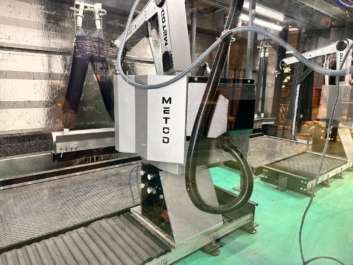 As an export-oriented company, we have delivered our products to approximately 45 countries to date, primarily including Bangladesh, Pakistan, Vietnam, Egypt, India, Colombia, and Mexico. While the main production centers of the sector are mainly Bangladesh, Pakistan, and India, global economic conditions can cause investments to shift to different countries periodically. In the last 1-2 years, we have seen Egypt stand out due to relatively low labor and energy costs, investment incentives offered by local governments, and easy access to skilled labor. In line with this, we are actively present in the field to be closer to both our existing and potential customers; and we aim to increase our market share in regions where the sector is concentrated, especially in Egypt.
With its commitment to flawless workmanship, what kinds of rapid response, remote connection, or maintenance models does your after-sales technical service team offer to ensure customer production continuity?
As a machine manufacturer, accessibility and fast after-sales service are indispensable for us. No matter how high-quality the product, malfunctions due to user error or natural conditions are inevitable. What truly makes the difference is how quickly and accurately these situations are addressed. With this understanding, we have an experienced and dedicated technical service team. Thanks to expert teams at our main headquarters and within our dealerships, we resolve problems in the shortest possible time. Our intervention process is shaped according to criteria such as the cause of the problem, its urgency, its impact on production, the possibility of remote access, and the availability of parts. Since our priority is always the fastest solution, we guide our customers with remote support in the first instance whenever possible. In necessary cases, we activate our local service teams, and in more critical situations, we directly activate our central technical service team. Our fundamental approach is clear: “A working machine is the best reference.”
What are Metod Makina’s planned investments, R&D efforts, and new product projects for the upcoming period?
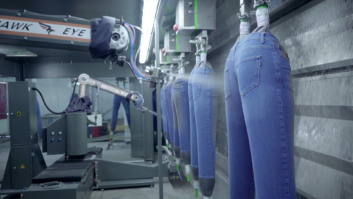 At Metod Makina, we have a wide range of products encompassing both dry and wet processing machines. Therefore, we meticulously evaluate all positive and negative feedback from end users regarding our products and reflect this in our continuous improvement approach. Although we conduct pre-shipment testing, feedback obtained under real-world production conditions is of great importance, especially for the development of new products. In this context, we completed improvements to the robot in our patented Hawk-Eye Robotic Spraying System by mid-year. We commissioned our system, which automatically loads products into drying machines and which we added to our product range approximately two years ago, in Bangladesh and Pakistan; further developments on this system are also on our agenda. For our most popular product, the MetoZone Ozone Application System, R&D processes focused on efficiency and uninterrupted operation have been completed, and it has been implemented in facilities in Egypt and Colombia in line with customer demands.
In addition, we have started receiving customer requests in areas not currently in our product portfolio, such as painting machines, and we plan to begin working in this direction in the coming period. Furthermore, we are continuing our collaborative work with one of Turkey’s leading companies on a special process for the upper group. As Metod Makina, with our young and dynamic team that is not content with the status quo and closely follows technology and industry needs, we will continue to produce innovative solutions.