UCMTF: We Are Quite Optimistic About The Turkish Textile Market
Christian Guinet, UCMTF Secretary General
The pandemic process has led to the development of new business models in the textile industry, as in many other industries. Digitalization and telecommuting models are among the priorities of companies. Textile machinery manufacturers associations, like companies, are developing new concepts to facilitate their members’ work and to support product promotions. The French Textile Equipment Manufacturers’ Association (UCMTF) has taken two important steps to adapt to this new era. UCMTF, which prepares a new website to reach the desired information faster, is designing a virtual fair for its members to promote their products. UCMTF Secretary General Christian Guinet shared the information about this virtual event with Tekstil Teknoloji magazine for the first time.Guinet said; “May I give you a breaking news: this virtual show will include 3D demonstrations of equipments.”
We interviewed with UCMTF Secretary General Christian Guinet for the “France Special Issue” of our Tekstil Teknoloji Magazine. Guinet shared the actions taken by French companies during the pandemic, the changes in the sector and their predictions about 2021.
UCMTF Prepares Virtual Fair for Machine Promotions
How was your member’s reaction to Pandemic? How did French companies create a roadmap to get through the process with less damage?
2020 was unlike any other year. Our companies started 2020 with very good order backlogs and many new projects were being studied with our customers. Then came the Corona virus. In many countries, our customers’ factories have been closed or partially closed for around two months. Ours too were partially closed. During this global turmoil, demand for services and sales of spare parts came nearly to a halt and many projects were postponed. Our priorities were, of course, to protect our own employees and to give our customers the few but often urgent services they needed. We executed quite well these priorities. Now, thanks to the dedication of our teams, our worldwide organizations, our equipment lines and more than anything else, thanks to our partnerships with our customers, we look to the future very positively.
As the association our main goal is to promote our members worldwide. We are introducing a new website which will be a very easy portal to visit them: www.ucmtf.com
We are also designing a virtual show which will be a very useful complement to the major equipment shows. May I give you a breaking news: this virtual show will include 3D demonstrations of equipments.
“The Textile Sector Needs to Adapt Quickly to Change”
What do you think about the textile machinery industry situation globally in this hard time and what is your prediction for post Corona Period? What steps should be taken for the textile industry to return to its old days?
An industry never returns to its old days. Markets are changing, some markets go up, some down. Look at ties manufacturers, they would have done better to enter new markets than trying to do their best on their historical market. Today, it is probably the same with the high end apparel for menswear but sales of sport apparel are skyrocketing, technical textiles are growing fast.
The textile equipment manufacturers have to adapt their own strategies to these changes. Even within one market, like the carpet industry, the fashion is changing and the industry has to adapt quickly.
Medical products and especially the production of surgical masks played an important role in the pandemic period. What action did French machine manufacturers take to keep up with this new situation?
Let me give you the example of Spoolex group: during the critical period of the pandemic, Roll Concept continued to manufacture and to deliver its technical rollers to major face mask machine manufacturers. With production capacities up to 600 masks/min, machines need high technical rollers with very low inertia in rotation. Roll Concept was able to react quickly to provide tailored made and easy to install low inertia rolls. Decoup+ successfully adapted a manual sealing machine to produce face masks and Calemard has provided the needed resources to support specific requests either for spooling machine or for wide slitter and was even able to deliver machines to cover urgent need for wide slitting textiles, non-woven and of course the very much needed meltblown products to produce surgical masks.
“Turkish Textile Industrialist Invests in the State -of -the- Art Technological Equipment”
Turkey, especially in pandemic process has become an important supply point for Europe again. What do you think about the Turkey textile market and its potentials?
Turkey has ben a major textile producing country for many years. There are many reasons. The first one is the entreprenorial spirit of the textile industrialists. The companies are often family owned and run by family members. They have long term objectives and invest for the future, particularly in equipments to be at the state-of-the art in terms of productivity and quality of the production. They do not give the priority to short term profits. That is why we have so many long term partners in your country. Our companies are also SME’s, often family owned and run. We can understand each other very well. We can go together much further than a commmercial relationship and become long time partners for a better future for both.
Then we are very optimistic for your country textile market, both for your domestic market and for your international markets.
“Europe is Trying to Revitalize its Industry, We Look to the Future Positively “
Please update our readers with the latest statistics of French textile machinery export. How is the French textile and textile machinery market currently performing? Which markets were developing and declining for the French textile machinery industry?
Turkey is of course both a present and future promising market. It has been our first or second market for quite a while., China has been investing heavily and their exports have shown it was the right way to sell worldwide. Other Asian markets are active and the investment mood is positive in many markets like Indonesia, Thailand, Vietnam or South Korea. In India, investments decisions have been slower that we had imagined despite the need to modernize their textile industry. Then, investments remain to be made. We believe India is a very promising market. In Iran, the textile industry is in the starting blocks as the machinery is outdated. The US economy is clearly growing and Europe is trying to revitalize its industry.
That’s why we look to the future positively.
Which kind of innovations and progress is expected in upcoming years in the French textile machinery sector?
Innovation is multi-face. Innovations can materialize in equipment, service, communication channels with our partners. Right now, there are major themes for innovations which go beyond the usual ones:
- Eco-responsibility and recycling
- Industry 4.0
All our companies are promoting textile intelligence and sustainability. May I give you one example of industry 4.0 integration which is really a disruptive innovation.
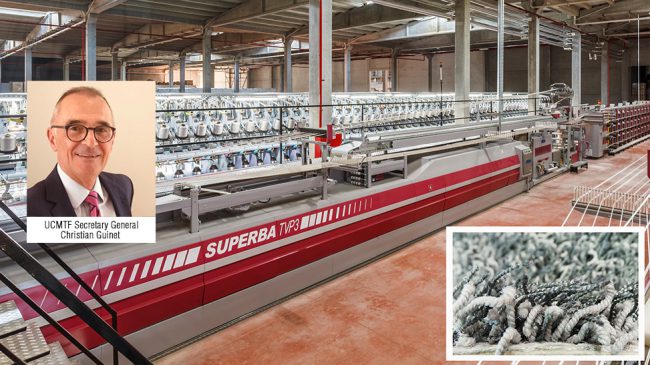
Superba is expanding its area of applications. The new Superba B403 automatic winder marks a real technological breakthrough. With its individual spindle motorization drive, combined with a single tension sensor per position, it enables a constant tension winding process, a very accurate bobbin length measuring as well as a unique quality control for each yarn position. It opens up new opportunities in terms of winding quality. Connected through cloud computing to the new Vandewiele Texconnect supervision system, the B403 is part of the Factory 4.0 concept. It provides readily-available data on yarn tension to supply the predictive maintenance and reduce yarn waste, allowing manufacturers to make the highest quality carpets at the most economic prices.
The textile producers who will integrate this concept starting from one or a few equipments and, in a second phase, to their all-production process and even to the flow of information between themselves and their suppliers and customers, will gain a real competitive advantage.
Concerning sustainability, the answer is quite similar. To save energy, water and raw materials, you have to start from each equipment and in a second phase to the whole production process. The ideas are quite simple but the execution requires the full involvement of the management.
The effects of the pandemic seem to continue in the first months of 2021. As UCMTF, what are your expectations from 2021?
You know that the French textile equipment manufacturers are particularly strong in long fibre spinning (wool, acrylic …), yarn twisting and control (including technical yarns), space-dyeing, heat setting for carpet yarns, carpet systems, dyeing and finishing, felts and belts for finishing processes, nonwovens, air conditioning of textile plants, and recycling processes of textile materials. In so many different sectors, some of our companies have been doing well in 2020. Their order backlogs are still extremely good and their main problem is to increase their production capacity. Some have had a very bad year in 2020; They will do much better in 2021 but probably will not recover their levels of 2019.
Interview: Dilek Hayırlı