
“We See ITM 2026 as an Important Showcase for Armas Makina”
Interview: Tuğba KARADEMİR
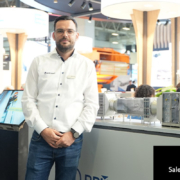
Armas Makina is taking its expertise in batch dyeing technologies one step further with the new-generation KnitMaster HT Jigger family. Deputy General Manager Emre Abdullahoğlu shared the company’s product strategies, which are shaped around efficiency, sustainability, and institutionalization, as well as its expectations for ITM 2026, with Tekstil Teknoloji Magazine.
In textile finishing processes, quality, efficiency, and sustainability can no longer be considered separately. Especially in batch dyeing technologies, process stability and resource management are at the center of investment decisions. Specialized in this field, Armas Makina is reinforcing its experience in HT Jigger technologies with the new-generation KnitMaster series while simultaneously continuing its institutional transformation. We conducted a comprehensive interview with Emre Abdullahoğlu, Deputy General Manager of Armas Makina, covering a range of topics, from product development visions to evaluations of 2025, from the approach to digitalization to ITM 2026 targets.
How would you define Armas Makina’s main product groups and service range within the textile machinery sector? In which machine types are you particularly specialized, and which production needs do these machines address?
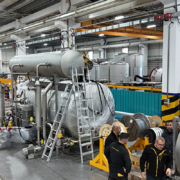
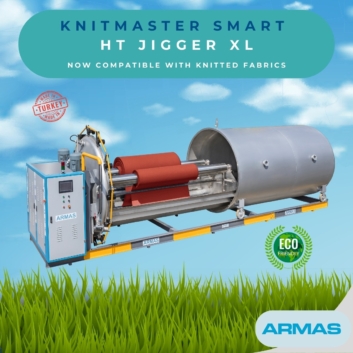 As Armas Makina, we are a machine manufacturer positioned in textile finishing processes, particularly on the batch dyeing side, with a clearly defined focus. Our main product group consists of HT Jigger machines. Jigger technology is a critical field in terms of quality and repeatability, requiring the correct management of parameters such as controlled winding/unwinding of the fabric, bath management, and process stability. We respond to these needs with solutions that reduce water and energy consumption while increasing efficiency without compromising stable quality.
On the service side, we do not limit the job to “machine delivery.” Commissioning, operator training, maintenance planning, spare parts, and technical service processes are an integral part of the product for us. Today, one of the issues Armas Makina particularly emphasizes is making all these processes manageable, measurable, and sustainable with corporate standards. Our goal is to offer the same speed, the same quality, and the same communication standard in every situation the customer may encounter in the field.
“KnitMaster HT Jigger Is a Platform Representing Armas Makina’s New-Era Product Approach”
Your company has recently developed new products, such as the KnitMaster HT Jigger XL. Could you talk about these and similar innovative machines and the innovations they bring to the sector?
Our new product, Armas KnitMaster HT Jigger (XL), is not merely a new model for us; it is a platform representing Armas Makina’s new-era product approach. With this machine, we responded to an important need in the sector: enabling knitted fabrics to be dyed efficiently and safely with the jigger process. Since knitted fabrics have a more delicate structure, process stability and the protection of the fabric throughout the process become much more critical. While developing KnitMaster, we placed this sensitivity at the center of the design.
One of the prominent aspects of the KnitMaster series is its focus on water and energy savings. Today, one of the most fundamental factors determining the competitiveness of enterprises is “consumption per unit of production.” While designing KnitMaster, our goal was to offer customers not only a good dyeing result but also higher process efficiency with lower consumption. On the XL side, we aim to scale efficiency with a structure that can be adapted according to the needs of enterprises.
“2025 Was a Year in Which We Developed Products and Organization Simultaneously for Armas Makina”
How did 2025 go for you? How do you evaluate the year in terms of production, sales, R&D, and exports? What is the level of satisfaction, especially regarding the launch of new machines, changes in customer demands, or market reactions?
The year 2025 was one in which we progressed simultaneously on the “product and organization” side for Armas Makina. In production, we established a serious internal structure to strengthen more predictable planning, a more standardized quality approach, and delivery discipline. On the R&D side, our focus was clear: to produce solutions that have real value in the field, directly affecting customers’ production metrics, and to make this tangible, especially in sensitive process areas such as knitted fabrics.
On the customer side, we observe that demands have matured. Today, not only “whether the machine works,” but also ease of use, process repeatability, water/energy consumption, service speed, and support quality are decisive in purchasing decisions. The interest in the KnitMaster series is a clear indicator of this transformation. Quickly feeding back field feedback into the product and process is a fundamental part of our corporate working approach. Overall, we evaluate 2025 as a year in which we positioned the right product with the right benefit language and strengthened our corporate infrastructure.
“Water and Energy Savings Are No Longer an Advantage, but a Prerequisite for Investment Decisions”
What were the prominent trends you observed in the textile machinery sector in 2025? How did Armas Makina respond to these trends? What were the main challenges you faced during this period?
 The trends that stood out in 2025 were very clear: sustainability, consumption management, and process standardization. Water and energy consumption are no longer an “advantage” but a prerequisite for investment decisions for most enterprises. In addition, solutions that make quality less dependent on the operator and increase repeatability are highly valued.
Armas Makina responded to these trends in two ways: On the product side, with KnitMaster, we focused especially on knitted fabric processes and placed efficiency and stability targets at the center of the design. On the organizational side, we accelerated our institutionalization steps, moving documentation, service standards, feedback management, and customer communication to a more systematic structure.
On the challenge side, cost pressure, more cautious investment decisions, and increased planning sensitivity came to the forefront. Under these conditions, what made the difference was clearly presenting values that provide benefits to the customer “today” and supporting them with a sustainable service structure.
“Efficiency Is Not a Feature Added Later in KnitMaster; It Is a Design Starting Criterion”
How have digitalization, automation, and Industry 4.0 approaches affected Armas Makina’s production process and machine/service design? What kinds of improvements have you made in the machines you developed (such as automatic control, energy/water efficiency, ease of use, etc.)?
Our approach to digitalization is practical: anything that does not produce measurable benefits in the field is not “real innovation” for us. Therefore, we address developments in automation and control with three objectives: process stability, consumption efficiency, and ease of use.
In our new-generation machines, managing the process more repeatably reduces the operator’s burden while making quality more stable. A stable process reduces waste, which directly affects the total cost of the enterprise. In terms of water and energy efficiency, especially in products such as KnitMaster, we positioned efficiency not as a feature added later, but as a design starting criterion.
On the service side, we are also strengthening our corporate standards: training, documentation, maintenance plans, and rapid evaluation of feedback from the field. Our goal is to establish a manageable and sustainable working order that preserves the machine’s first-day performance over the years.
“We Build Competition in the International Market Not on Price, but on Process Performance and Service Strength”
Which markets do your export activities mainly focus on? How do you evaluate the demand for Armas Makina and its competitive strength in the international market? How has the global response to your new products been?
Our approach to exports is clear: long-term business partnerships and a sustainable service model rather than short-term sales. In textile machinery, trust is built while the product is operating in the field; therefore, in international markets, we prioritize competing not only on price but also on process performance, consumption advantages, and after-sales support.
We observe interest in Armas Makina in markets where textile production is strong. In this sense, KnitMaster has a very clear advantage: being able to operate the jigger process in a more sensitive field such as knitted fabrics and combining this with a water–energy saving focus offers a strong value proposition on an international scale.
Competition is indeed intense; therefore, corporate infrastructure becomes decisive in exports. Standard processes, fast response, consistent documentation, and service organization… We want to base our growth on this foundation.
“We Plan to Highlight the Armas KnitMaster HT Jigger Family, Especially at the Exhibition”
The ITM 2026 Exhibition is of great importance for the sector. At what stage are your preparations for the exhibition? Could you share information about new products, prototypes, or technologies you plan to exhibit?
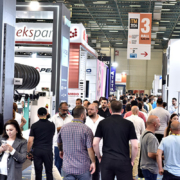
We see ITM 2026 as an important showcase for Armas Makina; however, for us, the real value lies in it being a contact point where we can initiate the right projects with the right customers. Therefore, our preparations are not limited to exhibition participation alone; they proceed as a holistic effort including product presentation, demo approach, and corporate presentation language.
At the exhibition, we plan to particularly highlight the Armas KnitMaster HT Jigger family. This product both responds to an important need with its knitted fabric dyeing capability and directly addresses enterprises’ agendas on the efficiency side. We aim to convey to visitors not only the “machine” but also the process logic and efficiency approach behind that machine clearly and understandably.
What are Armas Makina’s product development, R&D, market expansion, and investment plans for the coming period—especially for 2026 and beyond? Are there strategic steps, such as new machines you plan to develop, technologies you aim to improve, or expansion in target markets?
We manage our strategy for 2026 and beyond under four main headings: product development, R&D depth, market expansion, and corporate investment. On the product side, we want to expand the line opened by KnitMaster: solutions that increase stability in knitted fabric processes, reduce consumption metrics, and strengthen ease of use.
Our approach in R&D is not merely “launching new models,” but continuously refining products by listening to data from the field. Real differentiation often emerges through small but high-impact improvements in process stability, user experience, and service speed.
In market expansion, we aim for selective and sustainable growth. The right business partnerships/representations, a strong service infrastructure, and standardized after-sales processes are critical for us. Armas Makina’s institutionalization process forms the backbone that will carry this growth.