
Lenzing Ensures Physical Traceability of 100% of Its Fibers with Blockchain Technology
Interview: Özge Çağıl Sütcü
Lenzing, one of the world’s leading cellulosic fiber producers, has implemented an innovative solution with blockchain technology in collaboration with TextileGenesis™ to increase transparency in the industry regarding technological innovations. İlkşen Dedeoğlu Demiray: “Thanks to blockchain technology, we have achieved physical traceability in nearly 100% of our fibers by providing digital fiber traceability with our value chain partners.”
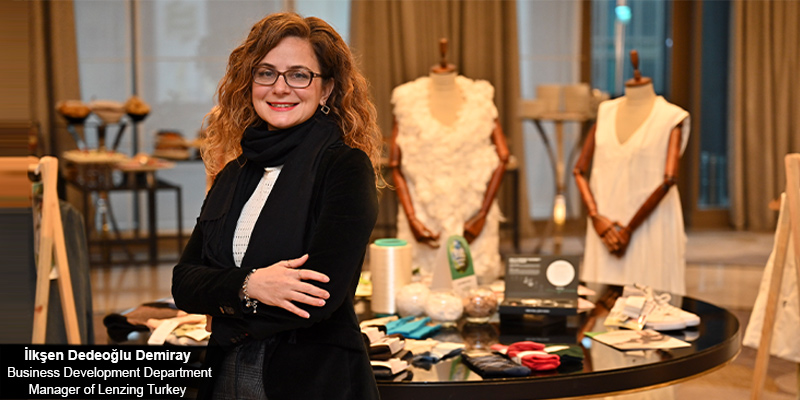
As Tekstil Teknoloji magazine, we interviewed with İlkşen Dedeoğlu Demiray, Business Development Department Manager of Lenzing Turkey. Dedeoğlu talked about their new projects, collaborations and the activities they carry out in Turkey.
The highlights of the interview are as follows:

Transparency
“We Developed a Real-Time Ocean Shipment Monitoring Device to Increase Supply Chain Transparency”
As one of the leading cellulosic fiber producers, sustainability is in our DNA. In all our processes throughout the value chain, we act upon the United Nations Development Goals at our center within the framework of criteria such as responsible use of water, sustainable innovations, and decarbonization.
In order to increase transparency in the textile industry about technological innovations, we implemented an innovative solution with blockchain technology in collaboration with TextileGenesis™. By providing digital fiber traceability with our value chain partners through blockchain technology, we have achieved physical traceability for nearly 100% of our fibers. In collaboration with project44, which is a digital supply chain solution company, we introduced a real-time ocean shipment monitoring device to the industry with the aim of increasing supply chain transparency in the textile industry and focused on increasing the visibility of carbon emissions. With this application, we are able to support our business partners to monitor the many processes of their fiber order (such as shipment status, container location, ship route monitoring and estimated arrival times at ports around the world…) with accurate real-time information. We have recently developed an innovative processing technique for wood-based TENCEL™ LYOCELL fibers specifically for stretch fabrics. The new processing technique involves redesigning the woven fabric containing TENCEL™ LYOCELL fibers combined with fabric pre-treatment. The new technique creates a fabric property that stretches with better recovery, does not shrink and wrinkle easily, and maintains a smooth appearance even after repeated washings.
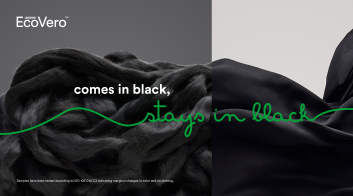
LENZING™ ECOVERO™ Black
LENZING™ ECOVERO™ Black Preserves Color in Fabric Despite Multiple Washings
In 2023, LENZING™ ECOVERO™ Black, which we produced by taking the benefits of ECOVERO™ one step further, consumes 50% less energy and water and releases 60% less carbon emissions compared to other fabrics by adding color pigments into the fiber solution during production. In addition, thanks to the innovation we have developed, the fabrics preserve their color quality despite countless washes and contribute to breathability.
Another innovation in this area was the integration of REFIBRA™ technology into ECOVERO™. With this new application, we have achieved a product consisting of 20% post-consumer textile waste while maintaining the environmentally friendly benefits of LENZING™ ECOVERO™ produced with REFIBRA ™ technology.

Lenzing, REFIBRA
The Higg Index Provides a Deep Source of Data for Brands
In addition, we are collaborating with the Sustainable Apparel Coalition (SAC), which brings together many clothing, footwear and textile brands, retailers, non-governmental organizations and academic institutions from around the world to work towards a shared industry vision. We develop new innovations with the Higg Index developed by SAC, which measures and evaluates the social and environmental performance of the value chain and the environmental impact of products according to five criteria. The Higg Index, the textile industry’s most widely used standard measurement tool, provides a deep source of data that brands can use by measuring criteria such as water use, carbon emissions and working conditions.
We are also pioneering the digitalization of value chain management with the Lenzing E-Branding service we launched in 2018.Those who use this platform, with new features such as design approval, fiber blend control tool, orientation tool, master class e-marking training and e-marking help desk, they can manage their processes faster, easier and more effectively. Users can also learn about certification and licensing of Lenzing brands through live webinars and self-learning modules offered on the platform. In addition, we support users in differentiating their products, aligning with customer values and building brand trust. Thanks to Lenzing’s trusted content story, we enable users with licensed products to create a sustainable brand story with fine details such as labels and shake cards.
“We Opened a Sales and Marketing Office in İstanbul to Expand Our Operations in Turkey”
Since 2017, we have taken our activities in Turkey one step further and opened our sales and marketing office in Istanbul. In terms of textile exports, we are able to serve both foreign and local brands due to the fact that many brands in Europe choose Turkey and our ‘proximity to the customer’ strategy we follow. In addition, since the beginning of 2023, we have been organizing “Lenzing Meetings”, which we have implemented to raise environmental awareness in the textile industry and to come together with our value chain partners. Last year, we came together with our value chain partners at 4 meetings in Bursa, Denizli and İstanbul and exchanged views on environmental awareness and sustainability. In addition, we talked about the solutions offered by Lenzing in this regard and offered the participants the opportunity to experience some of our products. We will continue to come together with sector representatives with the meetings we will organize this year.

LENZING™-ECOVERO™-X-REFIBRA™
“World Brands Such as H&M, Bestseller, Levis Use Our Fibers”
As for the market and business development; recently, in parallel with the increasing interest in sustainability, the interest of both global and boutique brands in environmentally friendly fibers is increasing. With the contribution of our business development department, we are developing important collaborations by creating awareness in brands about Lenzing’s cellulosic fibers in our country and other neighboring countries. Among the global brands that use our fibers are H&M, Bestseller, Levis, Calzedonia, Allsaints. In Turkey, there are brands such as Mavi, Penti, Oxxo, Madame Coco, Jimmy Key as well as boutique brands such as Muun and Lando Studio.
Lenzing and Södra Partnership to Enable Production of 60 Thousand Tons of Pulp
In 2021, we took an important step towards achieving a circular future with Swedish pulp producer Södra. Lenzing and Södra are jointly developing methods to enable the wider use of cellulose-based used textiles on an industrial scale. OnceMore® pulp developed by both companies is used for various purposes, including as a raw material in the production of Lenzing’s TENCEL™ brand specialty fibers using REFIBRA ™ technology. With this project, we aim to develop industrial scale recycling of textile waste. The second stage of the long-term project involves the construction and management of a facility for joint process development. The facility will allow Södra’s mill in Mörrum, Sweden, to produce 60,000 tons of pulp, consisting of 50% recycled material and 50% renewable pulp from sustainable forestry. The project will also make a significant contribution to the EU’s circularity action plan, supported by the European Executive Agency for Climate, Infrastructure and Environment (CINEA). Lenzing and Södra were awarded the International Textile Manufacturers’ Federation (ITMF) 2023 Award in the category “International Cooperation” for their joint achievements in the field of textile recycling and circular economy.


